




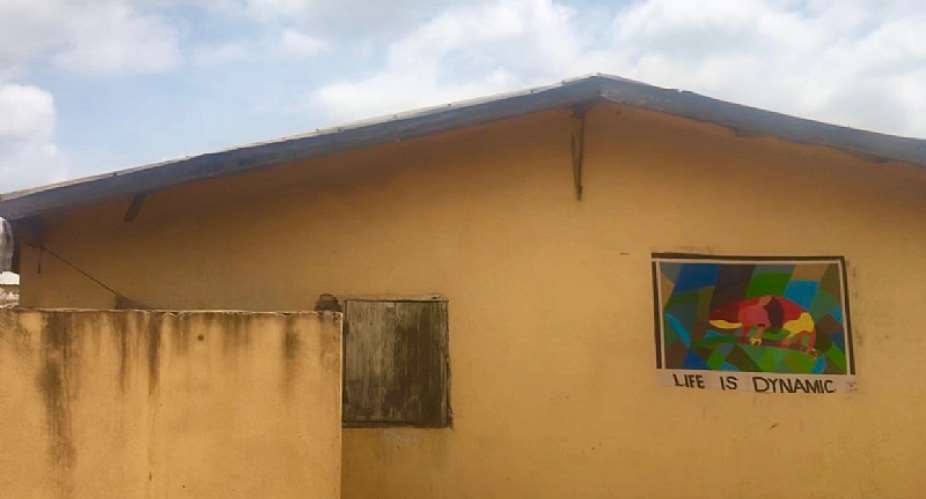
A few weeks back, when our nation undertook what was then the most logical step—quarantine, and the running hashtag was “stay home”, there was, within this necessity, a lingering absurdity—because for many in the country, the concept of ‘home’ can be a very tricky one. Homelessness, slums, squatting, ‘kiosk-homes’, apartment rentals for which one has not the money to honour the demanded one, two, or three-year advance-payments, etc.—these arguably, epidemics on their own, are all too familiar that they have become normal. These are the attributes of our nation’s cities—most tellingly, this is our nation’s capital.
However, this ineptness of our cities does not discourage rural-urban migration; this ineptness of our nation’s capital does not discourage urban-urban migration either. Each second, there is a person somewhere in the country strategising for a better life, and their to-do list has atop it:
- Move to Accra.
If all this talk of congested cities—specifically Accra—has got you humming “obi nka s3 24th k) wo kurom” as solution, you may want to hold off for just a minute.
Agriculture is to villages…
Urbanisation is a fact of development. The movement of people from the nation’s rural centers to its cities is not a bane, it is an imperative for development, one that can transform into immense blessings should a nation play its cards right. Our world now is a global community, it has been for some time now—and trade has been the main tool driving this oneness and closeness. Centuries ago, the prominent economic activity worldwide had been agriculture, and the nature of this activity was such that it flourished best in rural centers. For one: agrarian activities require a certain level of conservation of nature, something which cities with its industries cannot assure. Agriculture would thrive on the preservation of forests; cities may require the destruction of forests for the construction of say, roads.
So the demographic of nations during this agrarian economy was this: more rural population than urban. People yearned to be in rural areas instead because those were the El Dorado—where real economic action was.
Industry is to cities
Then the Industrial Revolution spread from Europe, to America, and the rest of the world. Industry naturally flourished best in cities—for ease of transportation, for instance, cities were carved out around major water bodies. So gradually, the world noticed a shift from heavy rural settlements to urban. All of a sudden, education was not just for engaging in abstract philosophic debates, education had a real economic value. All of a sudden, quick and effective transport systems were imperative, so the industrial age spawned in cities, railroad networks, better roads, inventions of cars, ships, and all other such modern amenities we have now. These amenities were birthed out of industrial necessities; these amenities then became the features of cities, and still remain so to this day.
Hence, the gap between rural areas and urban areas with respect to new age amenities will always remain—no matter how hard we try to conceive an egalitarian utopia. Because the fact is: one needs them more than the other. This however is not to advocate for the abandonment of villages, because doing so would spur a vicious cycle, one which would adversely affect cities too.
The cycle
Our nation’s over-dependency on the export of raw materials says a lot about our checkered growth. The fact of the matter is that on the international plane, the developed world has been through their respective industrialised eras, perfected it, and moved on to this new era of the Information Age. So it is particularly heartbreaking that we in the developing world—Africa, especially is still struggling to find its feet in manufacturing and industry. Globalisation is a race of nations—Ghana/Africa (through no fault of ours, in part) is a whole lot of steps behind in this race. This is because the main commodities we present in this global race—the international market are raw materials. And if it be the case, that raw materials are to rural areas, then the scenario we have in the country is that our villages are our best candidates—they are the runners we have placed in this global race. In this highly industrialised age, in this information age, this is very absurd.
One cannot work without the other: raw materials needs industry, and conversely, industry need raw materials—to convert them into highly competitive manufactured goods. The underpinning to this then is that villages need cities, and cities need villages to help the entire nation compete effectively on the international market.
Urbanisation is a barometer.
Worldwide, when this shift from agrarian to industrial economy happened, it was witnessed in nations a shift from rural populations to urban populations. With the explanation given, this should come as no shock—it should be expected. Europe recorded this rural-urban shift during the 18th – 19th century at the dawn of its Industrial Revolution. In England, for instance, urban population rose from 17% in 1801, to 54% in 1891. USA was to, in the 19th century, experience its own Industrial Revolution, thus this rural-urban shift too—from 5% in 1800 during its agrarian era, to 50% in 1920.
Asia came in strong in the 20th century, witnessing too this shift. Africa, yanking independence for itself, also sought to join the global economic race by carving out a share of industry for itself; the shift happened for us too—albeit slowly, our industrial journey.
By 2007, according to the UN, more than 50% of the world was urbanised. This was to rise to 54% in 2014; and projected to go as far as 68% by 2050.
It is an economic necessity—a nation in this highly globalised and information age ought to have more people living in its cities than its villages. In this modern era, there exists a real and direct correlation between urbanisation and economic growth.
So then why ever discourage urbanisation? This is because this blessing—rural-urban migration, can very easily spawn negative effects if not meticulously coached. Problems such as: congestion of cities, increase in inequalities, high cost of living, low standards of living, endemic slums, increase in crime, etc. may easily run rampant. And this cross, Ghana, like most developing countries, bears.
I started out intending to focus on the housing plights this ill-managed—pathological urbanisation has caused our country, but I have a 1,000 word limit, I could not even get there…


 GTEC freezes new PhD admissions nationwide pending audit of doctoral programmes
 NATO faces sovereignty dilemma as militaries rely on private tech, AI
 Afenyo-Markin demands answers over poor water quality in Central Region
 Mahama says Mayweather’s Ghana visit will boost tourism, boxing
 Police to develop human rights manual to strengthen professionalism and public t...
 How Korle Bu surgeons fixed back man's penis cut off whiles attempting to sit on...
 German President to visit Ghana for talks on trade and skills development
 Madina Court remands man over alleged GH¢18,500 theft from girlfriend
 Akufo-Addo left Mahama govt GH¢680bn debt bill for 2027-2030 — Isaac Adongo
 Bahrain accuses Iran of striking industrial site as tankers hit in Hormuz


