




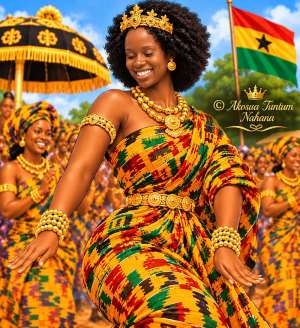
There is a distinct kind of power that comes from knowing who you are and where you come from. Growing up, many of us heard whispers of our ancestry, with family trees rooted deep in the rich soil of tradition. But recently, something shifted. I began to truly embrace my title, Nana Akosua, and step fully into a reality I have always known: I am a real-life Ghanaian princess.
My bloodline is not tied to just one lineage; it is a tapestry woven from four distinct royal connections across Ghana. On my paternal side, my grandfather's lineage traces back to Adukrom royalty in the Eastern Region. My maternal side carries the proud heritage of Akyem Asunafo royalty. In addition, my ancestry includes an Ewe royal connection. For personal and family privacy reasons, I have chosen not to disclose the specific royal stools or houses associated with these lineages at this time. Nevertheless, these connections form an important part of my identity and link me to several significant traditions within Ghana's rich history, culture and heritage.
When you carry such a rich history, you begin to see the world differently. It also makes you wonder: why don't we celebrate our royal traditions on a global scale in the same way other countries do?
The Global Double Standard on Royalty
Consider how the world comes to a standstill for European monarchies. Every royal wedding, coronation or family controversy becomes a global media event. People travel thousands of miles to catch a glimpse of castles and crowns, romanticising an institution that, in many places, has become largely symbolic.
Meanwhile, in countries such as Ghana, royalty is not locked away behind glass museum cases or reduced to a tourist photo opportunity. It is living, breathing and actively shaping society.
Yet, all too often, we keep our own brilliance quiet. The Ashanti Region, for example, does an incredible job of showcasing the grandeur of Asanteman, with its breathtaking durbars, vibrant displays of kente cloth, magnificent gold regalia and powerful drumming. My mother's paternal grandmother's side is from the Oyoko clan, the clan from which the Asante royals emerged, although her father's mother's side is not royal. However, more regions across Ghana and West Africa should be stepping into that same spotlight. We need to proudly showcase the depth, beauty and continuing relevance of our traditional systems of governance.
More Than a Title: The Living Duty of African Royalty
In Western contexts, the word 'royal' often conjures up images of privilege and ceremony. In traditional Ghanaian society, however, royalty is deeply intertwined with responsibility, service and leadership.
Kings, Queen Mothers and chiefs play important roles as custodians of tradition, customary authorities and leaders in community development. Their responsibilities extend beyond ceremonial appearances. They help preserve ancestral knowledge, maintain customary practices, resolve disputes and contribute to the welfare and development of their communities.
The Powerful and Often Overlooked Role of Queen Mothers
One aspect of Ghanaian royalty that deserves far greater international recognition is the influence and authority of Queen Mothers.
Queen Mothers are not simply the women who stand beside kings and chiefs during public ceremonies. In many Ghanaian traditional systems, particularly within Akan society, they occupy important positions in their own right and form an integral part of traditional governance.
Historically, Queen Mothers have played influential roles in the nomination and selection of chiefs, the preservation of royal genealogies and the protection of customary traditions. They serve as important advisers to chiefs, participate in traditional decision-making and exercise authority in matters affecting their communities.
Their influence also extends into the social fabric of society. Queen Mothers have long been advocates for women and children, supporting their welfare, addressing family and community disputes, promoting education and championing initiatives that empower women and girls.
They are also custodians of ancestral knowledge, cultural identity and the histories of their respective communities. Their understanding of royal genealogies and customary succession makes them important figures in maintaining continuity between generations.
What is particularly significant is that Queen Mothers have continued to exercise leadership despite centuries of colonial disruption and the historical marginalisation of women in formal political structures.
Their contributions deserve to be recognised not as secondary to those of kings and chiefs, but as an essential part of Ghana's traditional leadership systems.
When we celebrate African royalty, we must celebrate our Queen Mothers just as enthusiastically as we celebrate our kings. Their leadership, wisdom and contributions deserve international recognition.
When we celebrate our royal heritage, we are not simply celebrating status; we are honouring the resilience of our ancestors, who protected our languages, spiritual systems and communal structures through centuries of colonial disruption.
Time to Showcase Our Culture to the World
It is time to change the narrative. We should not have to wait for Hollywood or international media to validate the richness of our heritage. We already have everything we need right here at home.
Amplifying Our Cultural Events
From grand enstoolment ceremonies and royal court sessions to traditional council gatherings, libation rites and ancestral remembrance ceremonies, our cultural practices are living masterclasses in art, history, choreography and diplomacy. They deserve to be showcased on global platforms through high-definition documentaries, international media coverage and greater cultural recognition.
Owning Our Narratives
When young people, particularly young girls, hear titles such as Nana or Oheneba, they should recognise the significance, dignity and responsibility associated with Ghanaian royal heritage. We need to tell our own stories and bring our history into spaces that have long overlooked African systems of governance.
Spreading the Pride
Just as the Ashanti Region commands international respect for its cultural preservation, every royal house and traditional community across Ghana, from the Ewe states to Adukrom and Akyem, has a story that deserves to be told with confidence, dignity and pride.
We must recognise that Ghana's traditional institutions are diverse, each with its own customs, histories, leadership structures and cultural significance. That diversity is part of what makes our heritage so extraordinary.
Stepping Into the Crown
Embracing the title of Nana Akosua is deeply personal, but it is also about something much bigger than me. It is about looking back at the Ewe royals, the Adukrom elders, the Akyem Asunafo leaders and the ancestral connections that form part of my heritage, and saying: I see you. I remember you. And I will carry your legacy forward.
It is about recognising that our identities are shaped by generations who came before us, and that we have a responsibility to preserve and celebrate the traditions they left behind.
As a Ghanaian princess, I want to see a world in which our traditional institutions receive the same curiosity, admiration and international attention afforded to monarchies elsewhere. I want future generations, especially young African girls, to grow up understanding that their history is extraordinary and that their cultural heritage is something to embrace with pride.
It is time for all of us to turn up the volume on our culture. Ghana's royal traditions are not relics of the past; they are living expressions of identity, heritage, leadership and cultural preservation.
Our traditions deserve to be seen. Our stories deserve to be heard. Our Queen Mothers, Kings and Royals deserve to be celebrated. And our royalty deserves its place on the global stage.
The world is ready to witness the beauty of Ghanaian royalty. It is time we gave it the spotlight it deserves.


 Mahama proposes phased roll out of ECO to accelerate West African monetary integ...
 Mahama highlights cedi's recovery, urges investors to tap into Ghana's productiv...
 Cashew processors welcome Mahama’s policies to protect local industry
 China offers support for Ghana’s New Economy Programme through technology and in...
 Italy approves anti-semitism law despite concerns over freedom of expression
 Xi, Putin meet ahead of Trump's arrival in China for historic trilateral summit
 Haitians rally behind Bukele as Salvadoran troops battle gangs
 'NPP rented jets for $18,000 to $22,000 per hour' – Kwakye Ofosu defends new pre...
 'We need Dangote, but what about Ghanaian businesses you are destroying with par...
 Two vehicles catch fire at Ecobank-Papaye compound in Lapaz


