




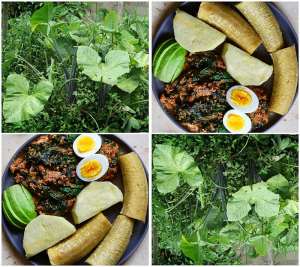
For many Ghanaians, kontomire is a familiar answer when the conversation turns to nutritious local foods.
The leafy vegetable appears in stews, soups, and other traditional meals. It is also commonly associated with iron and healthy blood.
But there is a side of kontomire that deserves more attention.
The iron in the leaf is not necessarily the iron your body absorbs.
This is because kontomire provides non‑haem iron, the form of iron found in plant foods.
The body can absorb this type of iron. However, its absorption is influenced by other components of the meal.
A Ghana‑specific study examined cocoyam leaves alongside other commonly consumed leafy vegetables. The researchers found that the amount of iron in a vegetable could not, by itself, predict how much iron would become available for absorption.
That finding changes how we should think about “iron‑rich” foods.
A food can contain iron without all of that iron becoming available to the body.
In other words, what is on the plate is only part of the story.
What accompanies the kontomire can make a difference.
Vitamin C can increase the absorption of non‑haem iron. This makes foods containing vitamin C useful partners for plant‑based sources of iron.
For a Ghanaian meal, this could include ingredients such as tomatoes and peppers, depending on the meal.
But the relationship is not always straightforward.
Some compounds found in plant foods can reduce the availability of non‑haem iron. Phytates and certain polyphenols are among the dietary factors known to interfere with absorption.
The Ghanaian research also showed why simply comparing the iron content of leafy vegetables can be misleading.
Cocoyam leaves contained measurable iron, but iron bioaccessibility depended on a combination of factors rather than iron concentration alone. The study used an in‑vitro digestion and Caco‑2 cell model to estimate iron bioaccessibility.
This does not mean kontomire should be removed from the Ghanaian plate.
It means we need to be more precise about what we say about it.
Kontomire can contribute to dietary iron intake. But saying that eating it automatically prevents or treats anaemia goes beyond what the evidence supports.
Anaemia itself is also more complicated than iron deficiency.
The World Health Organization says iron deficiency is the most common nutritional cause of anaemia. But infections, inflammation, blood loss, and deficiencies of other nutrients can also cause or contribute to the condition.
This is especially important for people who experience persistent tiredness, weakness, dizziness, or shortness of breath.
Simply eating more kontomire may not address the underlying cause.
A proper medical assessment is needed when anaemia is suspected.
For everyone else, the lesson is less complicated.
Keep eating the kontomire. Just understand what happens after you eat it.
Its iron still contributes to the diet. But the body has to release, absorb, and use that iron before it can contribute to iron status.
So, the next time kontomire is served, the question should not only be:
How much iron is in it?
It should also be:
How much of that iron can my body actually absorb?
Reference
Amagloh, F. K., Atuna, R. A., McBride, R., Carey, E. E., & Christides, T. (2017). Nutrient and total polyphenol contents of dark green leafy vegetables, and estimation of their iron bioaccessibility using the in vitro digestion/Caco‑2 cell model. Foods, 6(7), 54. https://doi.org/10.3390/foods6070054
National Institutes of Health, Office of Dietary Supplements. (n.d.). Iron: Fact sheet for health professionals.

 US fears wider Middle East escalation after Houthi attack Riyadh
 Pop star Ed Sheeran calls Gaza situation “unjustifiable” amid controversy
 'We have spent 60years arguing about Nkrumah and rather less time doing what he ...
 Judge recounts attempted MoMo scam on him moments after jailing scammer
 'Systemic failure due to NACOC removal from port inspections' – Inusah Fuseini o...
 Police uncover alleged network behind Ghana Jollof videos
 NACOC says cocaine suspects were under surveillance for up to two years
 Suhuyini assures Accra-Kumasi Expressway won’t miss December 2028 deadline
 Foreign Affairs Ministry releases 200-page RTI response on GH¢49.7m South Africa...
 Chartered flights account for GH¢27.18m of South Africa evacuation cost


