




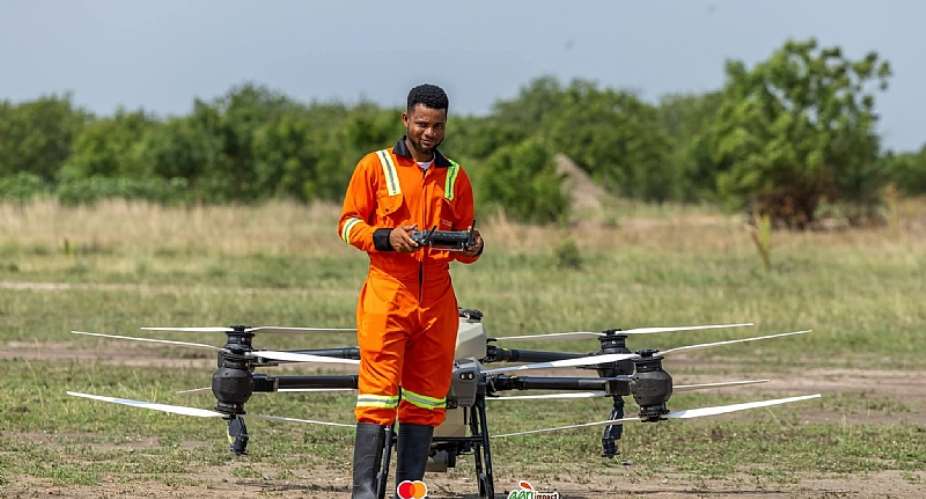
Looking back on this amazing journey, I am overwhelmed with thankfulness to God for His grace, guidance, and many blessings during the training period at KNUST and the internship period with Agro Kings Limited.
I wish to extend my deepest gratitude to the Mastercard Foundation, Kwame Nkrumah University of Science and Technology (KNUST), Agri-Impact Limited, and Agro Kings Limited for creating and conducting such an amazing program. At the start, I thought the program would be all about flying drones, but I came to realize that it was much more than I had anticipated. The program was highly structured and professionally conducted at a level comparable to a university diploma program.
All the knowledge and skills acquired during the training process are priceless. We went through the basic and advanced stages of learning drone technology, including aviation laws and regulations, flight basics, safety measures, mission planning, and calculations needed for water and chemical application in spraying.
One of the most exciting parts of the course was successfully passing two exams—one related to the course and the second administered by the Ghana Civil Aviation Authority (GCAA). By God's grace, I obtained the Remotely Piloted Aircraft Systems (RPAS) Certificate, marking the beginning of an exciting career in the field of drones.
Prior to entering the training course, I had no idea about drones. Now, after the training, I can say that drones are flying machines that operate according to the same laws and principles as ordinary aircraft and therefore should be treated with a high level of professionalism, responsibility, and technical competence.
Moreover, the course revealed the full potential of drones in the modern agriculture industry. With their help, farmers can easily monitor crops, apply chemicals and fertilizers, manage pests and diseases, create maps, collect information, and more.
Perhaps one of the most interesting parts of the course was the opportunity to practice flying using some of the best technologies in the drone industry. Even though I had no previous experience flying a drone, I had the chance to use advanced technologies including the DJI Mavic 4 Pro, TTA, DJI Agras T40, DJI Agras T50, and DJI Agras T100. Practicing with these advanced devices helped me improve my practical skills.
Now, I can say that I am a professional drone pilot, as I not only gained experience using drones but also acquired the theoretical knowledge necessary for this field.
Lastly, I want to thank our instructor for his patience and willingness to help us prepare for this task. His efforts contributed greatly to our learning process. May God bless him with wisdom and good health.
As this reflection comes to an end, I would like to encourage young people and professionals to develop practical skills alongside educational qualifications. Education is essential, but practical skills provide opportunities and confidence.
Again, I want to express my deepest appreciation to the Mastercard Foundation, KNUST, Agri-Impact Limited, and Agro Kings Limited for this wonderful opportunity. The insights, skills, and experiences gained during this program will be beneficial in my career and in advancing modern sustainable agriculture.
May God bless you all.
Felix Nibe-yang (Felisco)
Agriculturist, Blogger & drone pilot
 Mahama Commissions GH¢148.4m Cashew Factory, Creating 1,500 Jobs in Techiman
 21-year-old Ghanaian man stabbed to death in north London
 Another phone snatcher jailed 11 years in Ashaiman, marking second conviction in...
 Defeated NDC Central Regional Chairman blames former secretary, threatens legal ...
 Haruna Iddrisu urges AG, CID for prosecution of culpable persons in Obuasi SHTS ...
 24-hour economy is private sector-led, New Economy is US$10 billion government-l...
 Nana Kwasi breaks down in tears after reclaiming NDC Ashanti Regional chairmansh...
 Benjamin Danso unseats Ashie-Moore as NDC Greater Accra Regional Chairman
 Ghana to ratify three key AU financial institutions by 2027
 Catholic Bishops want full implementation of Kalba-Gbinyiri conflict report


