




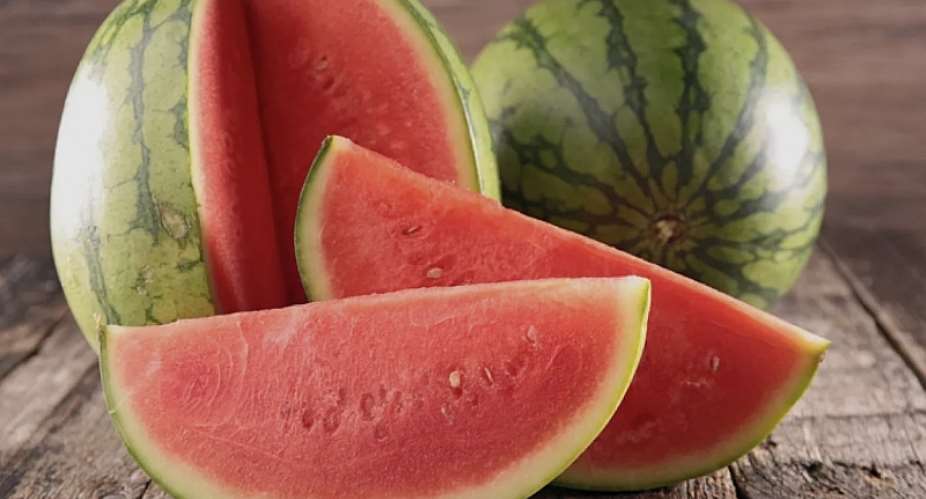
Every day, Ghanaian families slice open watermelons, enjoy the sweet flesh, and toss the rest — peel, rind, and seeds — into the bin. But a new study from the University of Health and Allied Sciences (UHAS), Ho, suggests those “waste” parts may hold real promise in the fight against one of the biggest health threats facing Ghanaian men: prostate cancer.
Prostate cancer is one of the most prevalent cancers among men in Ghana. Families know the fear and financial strain that come with such a diagnosis. Treatment can be costly and is readily available in only a limited number of places, particularly outside the country’s main cities.
Against this backdrop, final‑year Biochemistry and Molecular Biology student Nanor Bruce Rudolf, under the supervision of Prof. Clement O. Tettey, embarked on an investigation to answer a simple but important question: Could the parts of the watermelon we throw away help fight this disease?
To find out, the seed, pulp, rind, and peel of the watermelon were tested separately in the laboratory to check their effectiveness against prostate cancer cells and against healthy cells.
The results showed that the rind and peel — which are discarded by almost everyone — were the most effective at targeting the cancer cells, with very little damage to healthy, normal cells.
This indicates that the compounds in the extract of the watermelon rind and peel could selectively destroy cancer cells without affecting healthy cells, unlike many conventional cancer treatments.
The watermelon flesh (the pulp) also possessed effective anti‑cancer abilities, though not quite as strongly as the peel and rind.
The excitement surrounding this discovery is not only about the science; it also lies in the implications for everyday Ghanaians. Watermelon is inexpensive, readily available, and a familiar part of many households. If these preliminary results are validated by further study, they may open the door to developing an entirely new generation of anti‑prostate cancer agents — including very affordable, plant‑based support made from fruits already grown and consumed in Ghana.
This study is preliminary laboratory work. The researchers intend to further investigate the application of these extracts in animal models.
Notwithstanding, the results emphasize the need to increase investment in research on stable fruits, plants, and food waste as potential sources of affordable medicine.
Ghanaians are encouraged to consider the benefits of watermelon before throwing any part of it away. No part of the watermelon is a waste; it might be one of the solutions to one of the nation’s greatest health challenges.
Also, men are encouraged to undergo regular screening for prostate cancer, as early detection remains the most reliable way to conquer the illness, regardless of what future treatments may emerge from research like this.

 Ms. Emelia Affi Agbenyo must honourably resign as new EC Deputy Chairperson to p...
 Why have US-Ukraine relations soured ahead of the midterms?
 Govt to meet Free Zones Authority, Trade Ministry over Customs Act concerns
 Kojo Bamba was never my driver or bodyguard — Nana B
 Ekow Assafuah petitions OSP to probe alleged World Cup visa facilitation irregul...
 Africa attracting wrong waste management solutions – GAIA report
 Summon Kofi Adams, GTA boss over 2026 World Cup visa scandal — NPP tells Parliam...
 Obuasi SHS headmaster accused of sexual abuse is NDC constituency secretary – Ma...
 Family demands answers over death of 14-year-old student at Abomosu STEM SHS
 Osahen Afenyo-Markin reflects on loneliness of public service, says survival is ...



Comments
Wow very much educative, l've learnt much from here and l think l will apply and shear to people across