




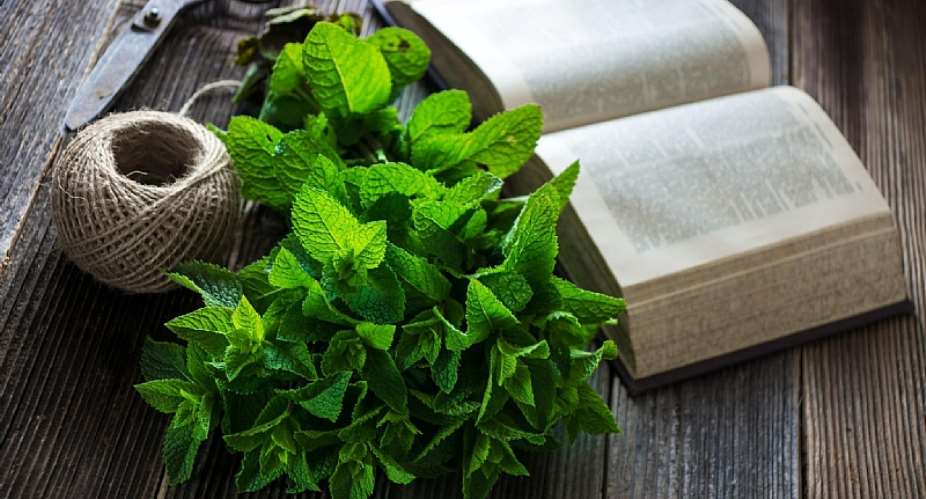
I. The Mint Leaf and the Promise
There is a particular cruelty in beautiful things that wound.The plant does not announce its paradox. It offers itself to the senses with quiet generosity, cool against the tongue, clean in the nostrils, green and unassuming to the eye. It has been pressed into medicines, stirred into teas, rolled into sweets given to children as rewards for endurance. Cultures across centuries have reached for it in moments of discomfort, trusting its reputation: this will soothe you. This will make the ache go away.
And yet, in sufficient concentration, mint burns. Not with the loud violence of pepper or flame, but with a slow, insidious chill that becomes, without warning, indistinguishable from heat. The very compound that cools, menthol, is the same compound that, in excess, triggers the body's pain receptors. The comfort and the wound share the same source. You cannot separate the sweetness from the sting. They were born together.
This is the oldest trick of institutional power.
Education arrives in the world wearing the same face. Fresh. Promising. Necessary. A civilization reaches for it the way the sick reach for medicine: this will help. This will heal. This will make the future bearable. We build temples to it and call them schools. We dress its priests in gowns and call them lecturers. We send our children to it with their eyes still bright and their questions still alive, trusting its ancient reputation: in here, you will become.
But somewhere between the promise and the practice, something curdles. Something in the mint turns.
II. The Grammar of Silence
Toni Morrison once observed that the function of racism was distraction; that it kept you from doing your work, from living fully. She might have said the same of fear. Fear is the oldest curriculum.
Walk through the corridors of any institution of learning at the hour between lectures. Listen not to what is said but to the architecture of what is not said, the particular silence that falls when a student lowers her hand mid-question, the way a young man's voice loses its register when certain names are mentioned. There is a grammar to this silence. It has conjugations: I will not ask. You should not ask. We have learned not to ask.
This is not the silence of Keats standing before the Grecian urn, struck dumb by beauty. This is not the productive silence of Wordsworth in the presence of nature, the mind made still so that something greater can enter. This is the silence described by Ngũgĩ wa Thiong'o when he wrote of the colonized mind, the silence that comes not from fullness but from the precise measurement of what one is permitted to say. It is a silence that has been taught, carefully and consistently, by the repeated punishment of speech.
The student who questions unfair treatment and is marked disrespectful is not merely being silenced. She is being enrolled in a secondary curriculum, one that runs parallel to the official syllabus and is, in many ways, more thoroughly examined. Its lessons are ancient:
Power is not questioned. Compliance is survival. Intelligence is not enough. Know your place.
These lessons are never printed in any prospectus. They live, as secrets always live, in the in-between spaces, in the whispered warnings passed between classmates after lectures, in the late-night conversations in hostel rooms where the real education happens, where students teach each other not chemistry or history or literary theory, but the far more urgent subject of how to survive this place without being broken by it.
III. The Marketplace in the Temple
There is a scene in the Gospel of Mark, violent, uncharacteristic, startling, in which Jesus enters the Temple in Jerusalem and finds it occupied by money changers and merchants. And he overturns their tables. The text records his words:
"Is it not written, My house shall be called a house of prayer for all nations? But you have made it a den of thieves."
I invoke this not for its theology but for its central image: the sacred space colonized by commerce. The place built for transformation, for encounter with something larger than the self, infiltrated by transaction. The house of learning becomes a marketplace. The altar becomes a counter.
When a student is compelled to purchase a lecturer's handout not because it will illuminate their understanding but because the alternative is to be made to feel unwanted, unwelcome, endangered, something biblical has occurred in the worst sense. The temple has been defiled. Not by vandals or enemies, but by those appointed to tend it.
What is an education system in which integrity is the first casualty?
What is a university in which the student who refuses to compromise is punished for her refusal?
What, precisely, are we manufacturing in these institutions, if not the precise opposite of what we claim?
IV. The Pedagogy of Fear
Paulo Freire, in Pedagogy of the Oppressed, gave us the language for this. He called it the banking model of education, the student as an empty vessel into which the teacher deposits knowledge and from which the teacher may later make withdrawals in the form of examinations and obedience. The student is not a subject but an object. Not a thinker but a receptacle. The ideal student, in this model, is the one who receives without questioning, who deposits what she is given and retrieves it on demand, who does not trouble the system with the inconvenience of her own mind.
But Freire's critique was not merely pedagogical. It was political. The banking model does not simply produce ignorance. It produces a particular kind of person, one trained in powerlessness, habituated to compliance, fluent in the grammar of silence. And this, he argued, is not an accident. The system that cannot afford to produce thinkers will manufacture followers instead. The institution that fears the questioning student will build classrooms designed to extinguish the question.
This is the hidden curriculum. And its most devastating effect is not on the grade transcript. It is on the interior life.
The student who once leaned forward in her seat, alive with the electric certainty that ideas mattered, that her mind was a gift, that the universe was full of questions worth asking, that student begins to lean back. Not in one catastrophic moment but in the slow, incremental retreat of a person learning to make herself smaller. Learning that visibility is dangerous. That the safest position is the one that draws the least attention.
Creativity requires courage. It requires the willingness to be wrong in public, to offer an unfinished thought, to stand in the vulnerability of not-yet-knowing. Fear makes cowards of the most gifted minds. And when fear becomes the dominant climate of a learning institution, what dies is not merely academic performance. What dies is the capacity for original thought. What dies, slowly and without ceremony, is the future.
V. The Lecturers
Let it be said, because fairness demands it and because literature has always been the art of the full picture:
There are other lecturers.
There are those who stay long after the official hour has ended, not because they are paid to but because a student's confusion troubles them the way unresolved music troubles a composer. There are those who write comments in the margins of papers not to wound but to say, "I see what you were trying to reach, and you were almost there." There are those whose classrooms are, genuinely, the spaces the brochures promised, alive with argument and laughter and the productive discomfort of minds in honest encounter with difficult ideas.
These lecturers know something the others have forgotten. They know that the moment a student's face changes, the moment a question lands and something shifts behind the eyes, and the student sees something she has never seen before, that moment is not a small thing. That moment is the whole point.
That moment is why Socrates stood in the marketplace and refused to stop asking questions even when they threatened to kill him for it. That moment is why Frederick Douglass, forbidden by law from learning to read, found ways to learn anyway, because he understood that literacy was not merely practical; it was ontological. It was the recovery of the self.
The good lecturer knows she is not the hero of this story. The student is the hero. Her role is the role that good literature always assigns to its wisest figures: not to provide answers but to make the questions unavoidable.
VI. What the Students Are Asking
Listen carefully, because they are not asking for very much.
They are not asking for their lecturers to be saints. They are not asking for education to be painless; the best education never is. They are not asking to be protected from difficulty, from failure, from the honest assessment that their work is not yet what it could be.
They are asking for the grade to mean something. They are asking for the mark on the page to be a measure of what their mind has done, not a measure of their compliance, their expenditure, or their willingness to be managed. They are asking for the examination hall to be a meritocracy, that ancient, imperfect, essential promise that in this space, what matters is what you know, what you can do, what you have become.
They are asking, in the language of Langston Hughes, for their dream to be deferred no longer:
What happens to a dream deferred?
Does it dry up like a raisin in the sun?
Or fester like a sore,
And then run?
What happens to a mind that enters university luminous with possibility and exits, if it exits, having learned primarily that power is arbitrary and compliance is wisdom? What happens to a generation schooled in fear? What kind of nation do we build with the graduates of that curriculum?
VII. Peppermint, Reconsidered
The plant did not choose its paradox. It is what it is, capable of healing and capable of harm, depending entirely on how it is used, how much is given, into whose hands it falls. The menthol that burns in concentration is the same menthol that soothes in measure. The difference is not in the plant. The difference is in the one who administers it.
And so with education.
The institution itself, the idea of the school, the university, the space set apart from ordinary life where the mind can encounter itself and the world in new ways, is not the wound. The idea is still the idea it always was: radical, beautiful, redemptive.
The classroom, emptied of its abuses and restored to its purpose, is still the most revolutionary space a society can build. More revolutionary than any parliament. More dangerous to oppression than any army. Because what it produces, when it works, is the one thing that power in all its forms has always feared most:
A person who can think.
The question is not whether education can be what it promises. The question is whether those entrusted with its practice will choose to honor the promise.
Whether they will remember that the student who sits before them, anxious, hopeful, carrying the accumulated weight of her family's expectations and her own unvoiced dreams, is not a problem to be managed. She is not a consumer to be exploited. She is not a subordinate to be kept in her place.
She is the whole point.
She is the mint leaf, still green, still fresh, still capable of becoming medicine, if only the right hands will hold her without crushing.
VIII. A Letter to the Classrooms
To the rooms where the questions have gone quiet:
The silence you have achieved is not peace. It is the silence of held breath, of swallowed words, of the question that died between the thinking and the asking. You have mistaken the absence of challenge for the presence of learning. You have confused compliance with comprehension. You have taught a generation to perform understanding rather than pursue it.
But the mind, like the plant, is a persistent thing. It will find the light through whatever crack is available. The student you silenced in your classroom is finding her questions elsewhere, in borrowed books, in late-night conversations, in the stubborn interior life that no grade can fully reach.
She is still learning. She is learning in spite of you.
And when she is done, when she stands at last in her full authority, in possession of her mind and her voice and her irreducible dignity, she will not remember your name for what you taught her.
She will remember it for what she taught herself, in the dark, when you were not looking.
"Until the lions have their own historians, the history of the hunt will always glorify the hunter."— Chinua Achebe
"The most common way people give up their power is by thinking they don't have any."
— Anonymous

 ECOWAS donates Gambia $480,000 to support December 5 presidential election
 NPP demands withdrawal of two-year ban on early BECE candidates
 Gov't to build $300 million AI Compute Centre to strengthen technology capacity ...
 Ghanaian domestic workers hospitalised abroad to receive medical, evacuation sup...
 Institutions investigating South Africa evacuation allegations will vindicate me...
 NPP demands evidence over viral video of alleged cash stash in former appointee’...
 Mahama announces acquisition of two more Airbus H175 helicopters for Ghana Air F...
 Asantehene mourns Agogomanhene
 Queen’s University Belfast Clears Jason Arday Research Paper Following Review
 Mahama hands over three new aircrafts to Ghana Air Force


