




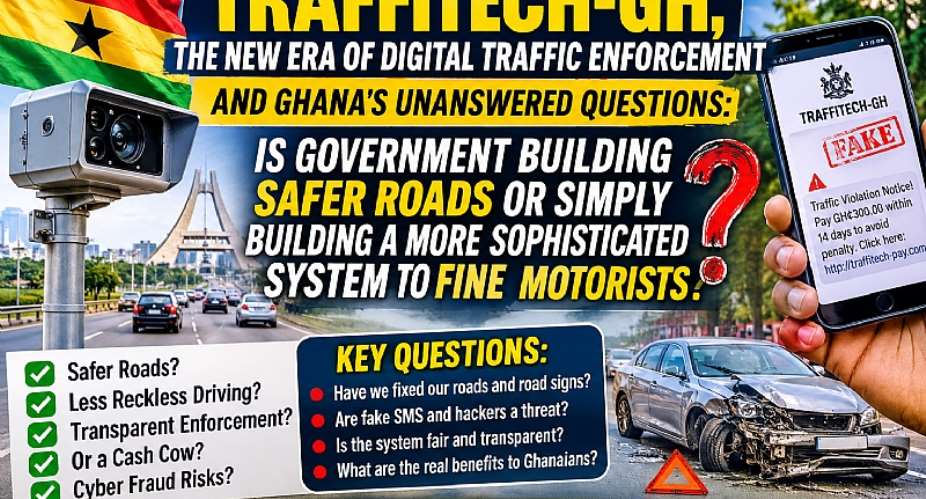
Ghana is entering a new chapter in road traffic enforcement. With the introduction of TRAFFITECH-GH, the Ghana Police Service is moving towards a system in which cameras, sensors, radar technology, and digital devices can detect traffic offences and trigger electronic notices to vehicle owners.
On paper, this is a welcome development. Ghana has struggled for years with reckless driving, speeding, disregard for traffic lights, wrongful overtaking, unlicensed driving, and other forms of indiscipline on its roads. The human and economic consequences of road accidents have made the search for effective solutions increasingly urgent.
But there is a fundamental question that deserves far more attention than the excitement surrounding technological innovation:
Can Ghana successfully enforce road traffic laws through sophisticated technology when the roads, road signs, markings, pedestrian facilities, and other essential safety infrastructure are still inadequate in many places?
And another question is becoming increasingly important: can motorists trust an electronic enforcement system when criminals are already exploiting the public's fear of traffic fines to circulate fraudulent messages and steal people's money?
These are not arguments against technology. They are questions about accountability, preparedness, cybersecurity, fairness, and the responsibility of government.
Because technology should make citizens safer, not make them more vulnerable.
1. Why TRAFFITECH-GH, and Why Now?
The Ghana Police Service officially commenced the full implementation of TRAFFITECH-GH on November 1, 2026, following an earlier announcement that the programme would begin on October 1.
The September postponement was intended to provide additional time for public education and sensitisation.
The programme is designed to automate the enforcement of road traffic laws and regulations. Rather than depending exclusively on police officers stationed at intersections or roadside checkpoints, the system uses technology to identify violations, including:
- Speeding
- Running red traffic lights
- Wrongful overtaking
- Failure to wear seatbelts
- Driving with expired licences
- Operating vehicles without valid insurance
- Expired roadworthiness certificates
- Misuse of sirens
The system deploys fixed cameras, mobile or in-vehicle devices, laser speed-measurement equipment, and Personal Digital Assistant (PDA) devices used by officers. When an offence is detected, the photographic or video evidence is transmitted for review. Following validation, an Electronic Notice of Violation (ENV) can be sent to the registered vehicle owner.
This is an important distinction: the system is not supposed to issue penalties merely because a machine captures an image. Human review is part of the process.
Why automated enforcement?
Manual traffic enforcement has limitations. Police officers cannot be everywhere simultaneously. Some motorists disregard officers, while others exploit gaps in enforcement. Corruption, selective enforcement, and human error can also undermine public confidence. Automated enforcement promises consistency, evidence-based prosecution, and a reduced dependence on roadside encounters.
However, the real test is not whether Ghana can install cameras. It is whether the country can build an enforcement system that is accurate, transparent, secure, and fair.
2. The Benefits: What Could Ghana Gain?
There are genuine opportunities in TRAFFITECH-GH:
- Discouraging Reckless Driving: A motorist who knows that speeding or running a red light may be captured even when no police officer is physically present could become more cautious.
- Reducing Corruption: The system could cut down opportunities for bribery and unofficial negotiations between some motorists and enforcement officers. Digital evidence and centralised processing make manipulation more difficult.
- Data-Driven Insights: It could improve the collection and analysis of road safety data, helping authorities identify dangerous hotspots.
- Enhanced Accountability: Photographs, videos, timestamps, and vehicle registration details provide concrete evidence when an offence is disputed.
- Saving Lives: If properly implemented, it could help reduce road crashes, injuries, deaths, and the financial burden associated with road accidents.
Where is the evidence?There is a critical distinction between what technology is designed to achieve and what it has actually achieved. Where is the independently verified evidence showing that TRAFFITECH-GH has reduced accidents, injuries, and fatalities since its commencement? Ghanaians deserve measurable results, not just technological promises.
3. The Question of Preparedness: Have We Fixed the Roads Before We Start Punishing Drivers?
This is arguably the most uncomfortable question confronting the authorities. Ghana's road safety problems cannot be reduced to driver indiscipline alone.
While some motorists drive recklessly, the government must also accept responsibility for the road environment. Consider the conditions on some Ghanaian roads:
- Faded or completely missing road markings
- Missing, damaged, or poorly positioned speed-limit signs
- Faulty traffic lights
- Roads with potholes and dangerous surface conditions
- Poorly designed intersections
- Inadequate pedestrian crossings and footbridges
- Inadequate street lighting
Infrastructure Deficiencies Exposed
In a Ghana News Agency feature published on November 5, 2026, transport operators raised concerns about missing speed-limit signs, faulty traffic lights, faded road markings, and inadequate pedestrian facilities. The report disclosed that five transport unions threatened to withdraw their services, though the action was suspended following discussions with government representatives.
More importantly, the National Road Safety Authority (NRSA) directed the Ghana Highway Authority and the Department of Urban Roads on November 3 to repair faulty traffic lights, replace missing or damaged road signs, and restore faded road markings. The NRSA Director-General, Abraham Amaliba, indicated that cameras would initially operate only on roads where speed limits were clearly displayed, excluding roads without necessary signage.
Why should the public have to wait for an enforcement programme to expose infrastructure deficiencies that should have been addressed as part of ordinary road maintenance? Technology can detect violations; it cannot replace responsible road engineering.
4. The Fraud Scandal: When a Road Safety Initiative Becomes an Opportunity for Cybercriminals
Perhaps the most troubling development surrounding TRAFFITECH-GH is the emergence of fraudulent electronic traffic violation messages.
- February 25, 2026: Months before the full rollout, the Ghana Police Service warned the public about a fraudulent electronic traffic violation notice circulating online. Seven suspects were arrested days later.
- November 9, 2026: The Cyber Security Authority issued another warning after identifying fraudulent text messages and websites impersonating TRAFFITECH-GH. These messages contained convincing language, ticket details, and links directing motorists to fake payment portals designed to steal banking credentials (card numbers, expiry dates, CVVs).
Official Guidance from the Police
According to official TRAFFITECH-GH guidance:
- Genuine electronic notices carry the official sender ID GPS-MTTD.
- A legitimate notice contains a ticket number and offence details.
- Motorists should verify vehicle registration numbers, locations, dates, and times, and inspect photographic/video evidence.
- Never pay through personal mobile money numbers or unofficial accounts.
CRITICAL PUBLIC WARNING: Never enter your bank card details, mobile money PIN, or one-time password into a payment page reached through a suspicious traffic-fine message.
Authorities must go beyond warnings. They should establish an independently accessible verification service allowing motorists to confirm a ticket number directly with the Police before making any payment.
5. Who Is Benefiting Financially from TRAFFITECH-GH?
According to the Ministry of Finance's 2024 Annual Report on Public-Private Partnership Projects, the TRAFFITECH-GH project involves Nationwide Traffic Management and Enforcement Limited:
- Estimated project cost: GH¢77.73 million
- Concession period: 11 years (December 2022 to December 2033)
- Project model: Design, Build, Finance, Operate, Maintain and Transfer (DBFOMT)
- Contracting authorities: Ministry of the Interior and Ghana Police Service
This long-term public commitment raises vital questions: What proportion of revenue is retained by the private partner? Does the private partner receive payments linked to violation counts? What independent safeguards prevent financial incentives from influencing enforcement? Ghanaians deserve complete financial transparency.
6. The 14-Day Deadline: Is the System Fair to the Ordinary Ghanaian?
Motorists have 14 days from issuance to pay or contest an Electronic Notice of Violation. While online dispute mechanisms exist, practical hurdles abound:
- What about citizens with limited internet access or late SMS delivery?
- What about vehicles that were sold but whose ownership records at the DVLA have not been updated?
- The Ministry of Finance's 2024 PPP report previously identified omissions in DVLA owner information, incomplete database integration, and misdirected contact details.
Furthermore, an additional penalty of 1% of the original fine per day applies after the 14-day window. There must be an independent mechanism to verify successful delivery and provide an accessible appeals process for technical delays or incorrect records.
7. What Must the Authorities Do to Restore Public Trust?
- Establish an Independent Ticket-Verification Mechanism: Allow motorists to verify tickets via an official, accessible service prior to payment.
- Strengthen Cybersecurity: Cooperate with telecom and financial institutions to block impersonation websites and trace fraudulent transactions.
- Publish Road Infrastructure Readiness Reports: Publicly list roads approved for automated enforcement based on verified signage and safety facilities.
- Improve DVLA Record Accuracy: Streamline vehicle ownership and contact information updates.
- Make Appeals Accessible: Provide phone and physical support for citizens without smartphones or digital literacy.
- Publish Performance Reports: Periodically disclose violation statistics, ticket volumes, disputes, cancellations, and fraud investigations.
- Subject the System to Independent Audits: Examine technical accuracy, data protection, cybersecurity, and revenue management.
- Invest in Road Infrastructure: Ensure enforcement technology complements—rather than replaces—proper road maintenance and engineering.
8. The Bigger Question: Are We Building Safer Roads or a More Efficient Fine-Collection System?
The ultimate purpose of road traffic enforcement must be to save lives. If the system generates millions of cedis in fines while road fatalities continue to rise, or if dangerous intersections remain without functional traffic lights, the initiative has missed its mark.
Drivers must obey the law, but government must not demand accountability from citizens while treating its own responsibilities as optional.
9. Key Questions the Authorities Must Answer
- How much public money and private investment have gone into TRAFFITECH-GH, and what are the full financial obligations under the 11-year agreement?
- Why was the programme introduced before all identified road infrastructure deficiencies had been addressed?
- How many roads and intersections have been independently inspected and certified as ready for automated enforcement?
- Who is responsible when a camera captures an offence at a location with faulty traffic lights or inadequate road markings?
- What independent institution verifies the accuracy of cameras and ensures that motorists are not wrongly penalised?
- How frequently are the cameras calibrated, and can motorists access calibration records when challenging a speed violation?
- What protection exists against hackers accessing vehicle registration information and enforcement records?
- How many Ghanaians have lost money to fake TRAFFITECH-GH messages, and how many suspects have been successfully prosecuted?
- What mechanisms exist to help victims recover money lost through fraudulent payment portals?
- Why should a motorist face accumulating late-payment penalties when there is a genuine dispute over the delivery or accuracy of a notification?
- How will authorities protect people without smartphones, internet access, or technical knowledge?
- What happens when a vehicle has been sold but the DVLA database has not been updated?
- How much revenue goes to the government versus the private partner?
- Will the government publish annual independent performance and financial audits?
- Most importantly, what measurable reduction in road accidents, injuries, and deaths will justify the continued operation of this programme?
Conclusion: Before Ghana Punishes the Driver, Who Is Holding Government Accountable for the Road?
TRAFFITECH-GH presents Ghana with an opportunity to modernise traffic management, but it is also a rigorous test of government accountability.
A country cannot punish its way into road safety while neglecting the conditions that make roads safe. Ghana does not simply need more cameras; it needs better roads, responsible drivers, competent institutions, stronger cybersecurity, and a government willing to account for its decisions.
At the end of the day, the greatest achievement of any traffic enforcement system should not be how much money it collects—it should be how many Ghanaian lives it saves.

 'Too early to discuss presidential bid’ – Dr. Ato Forson
 Ghana’s $250m AI centre to focus on practical applications; not competing US, Ch...
 'They did not even talk about the Women's Bank, where is it?' — Afenyo-Markin qu...
 Government to train over 2,000 scientists for Ghana's nuclear power programme – ...
 Elderly man reportedly apprehended by residents in Koforidua after travelling fr...
 ‘We are living within our means’ – Finance Minister defends no-new-taxes for 202...
 Global Microsoft outage knocks out Outlook and other services
 Govt to introduce Natural Resource Management Act to replace Petroleum Revenue M...
 In haste and hate to remove the Big Six, NDC used wrong image of Theodosia Okoh ...
 Disgraced Nvidia ex-CEO Jensen Huang to testify before US Congress


