




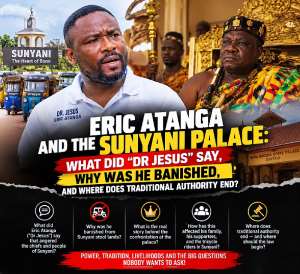
Introduction: When a dispute over a route becomes a question of authority
A disagreement over where tricycle operators should ply their trade in Sunyani has developed into a controversy with implications far beyond the daily operations of commercial transport.
At its centre is Yaw Eric Atanga, popularly known as “Dr Jesus”, the Sunyani Municipal Chairman of the National Union of Tricycle Operators of Ghana (NUTOG). According to reports by Sompa Online published between 7 and 9 October 2026, Atanga appealed for the relaxation of restrictions affecting Pragyia riders, described those restrictions as unfair, and called on the Sunyani Municipal Assembly to provide dedicated stations and routes. Two days after the first report, Sompa Online reported that the Sunyani Traditional Council had banished him from operating on Sunyani stool lands. The report said the order followed his appearance before the Council at the Nana Bosoma Royal Palace. "Sompa Online, 7 October 2026"
The reported sequence raises difficult questions. What precisely did Atanga do beyond publicly challenging an operational restriction? Was the decision based on a breach of customary law, alleged disrespect, repeated non-compliance, or some other conduct? Was the punishment confined to his commercial activities, or does it carry wider consequences for his residence and family?
These questions matter because traditional authority is an important part of Ghana's social and constitutional order. Equally important are the rights of individuals, the protection of livelihoods, the rule of law and the need for fair procedures.
This is not an argument that chiefs must have no authority over their traditional areas. Nor is it a claim that commercial operators should be permitted to ignore legitimate safety regulations. It is an examination of whether the available evidence adequately explains a reported sanction with potentially serious consequences.
The facts must lead the argument, not the other way around.
1. Who is Yaw Eric Atanga, and why has he become central to this dispute?
The available reporting identifies Yaw Eric Atanga as the Sunyani Municipal Chairman of NUTOG and a Pragyia tricycle operator. Sompa Online also identifies him by the nickname “Dr Jesus”. His role places him at the intersection of two interests: the economic survival of tricycle operators and the regulation of transport within Sunyani.
As a municipal chairman of a transport operators' association, he would ordinarily be expected to communicate members' concerns, engage authorities and advocate for workable operating arrangements. In the 7 October report, he did precisely that in public: he asked the Traditional Council to allow riders to use the Sunyani Masom Masom market route and urged the Municipal Assembly to provide dedicated stations and routes.
That establishes something important about his public role. He was not merely discussing his private business; he was speaking about restrictions affecting a category of workers.
But the available reports do not establish how long Atanga has lived or worked in Sunyani. They do not provide his residential history, his employment record, the size of his membership, or an independently verified account of his relationships with residents, fellow operators and traditional authorities.
Those gaps must not be filled with speculation.
It would be tempting to construct a personality profile around the controversy, describing him as stubborn, confrontational, disrespectful or outspoken. Yet a single public disagreement cannot establish a person's character. Likewise, a nickname, even one associated with religious activity, tells us nothing reliable about his private conduct.
The responsible questions are more precise: What is his record as an association leader? Have previous disputes involving him been documented? Were complaints made against him before this incident? If so, what evidence supports those complaints, and did he have an opportunity to respond?
Until those questions are answered, the public should distinguish Atanga's documented statements from unverified claims about his personality.
2. How the dispute developed: A chronology of the reported events
The sequence reported by Sompa Online provides the clearest available starting point.
7 October 2026: The appeal. Atanga reportedly asked the Sunyani Traditional Council to allow Pragyia riders to operate along the Masom Masom market route. He said the restrictions were slowing their economic activities and described the order as unfair. He also called on the Municipal Assembly to provide designated stations and routes.
8 October 2026: The Council's position. The Council's Communications Officer, Atta Akoto Senior, told Sompa FM's Adea Akyi Abia programme that restrictions on Pragyia operations would remain in force. He said some riders were causing a nuisance in Sunyani and indicated that the Council intended to organise training for operators. He also warned that offenders would face sanctions.
9 October 2026: The reported banishment. Sompa Online reported that Paramount Chief Odeefour Ogyeamansan Boahen Korkor II, who is also identified as President of the Sunyani Traditional Council, issued an order barring Atanga from operating on Sunyani stool lands after he was summoned to the Nana Bosoma Royal Palace. The report says Atanga had pleaded for mercy.
This chronology establishes the reported sequence, but it does not conclusively establish causation.
Did Atanga face the sanction because he criticised the restrictions publicly? Was there a separate allegation about his conduct or compliance with the rules? Did the Council consider earlier incidents that have not been reported?
The timing makes the relationship between his appeal and the sanction an important subject of investigation. It does not, by itself, prove that the chief punished him merely for expressing an opinion.
That distinction is essential to a fair article.
3. What exactly did Atanga say that angered the palace?
This is arguably the most important unanswered question in the entire controversy.
The published report of 7 October attributes two substantive positions to Atanga: that the restrictions were unfair because they were slowing the riders' economic activities, and that the Municipal Assembly should provide designated stations and routes.
Those statements constitute criticism of a policy and a request for an alternative arrangement. On the evidence available in those reports, they do not establish that he insulted the chief, threatened the palace, incited disorder or deliberately defied a lawful order.
Yet the 9 October report says he was summoned before the Council and subsequently barred from operating on stool lands.
Where, then, is the complete account of the alleged offence?
Was Atanga accused of using insulting words? Was he alleged to have disregarded a direct instruction? Did the palace object to the substance of his public remarks, the manner in which he delivered them, or conduct unrelated to the radio interview?
The public deserves a clear answer because the difference between criticism and misconduct is substantial.
If he made statements beyond those quoted in the media, the Council should identify them accurately. If the complaint concerned disrespect, the exact words and surrounding circumstances matter. If the allegation concerned operational disobedience, the particular instruction, the evidence of non-compliance and the applicable customary rules should be explained.
It would be irresponsible to invent a confrontation or attribute words to Atanga that have not been independently verified.
The same standard must apply to the palace. No fair investigation should assume that an authority acted out of anger, retaliation or wounded pride without evidence.
The central demand is simple: publish or explain the specific conduct that justified the sanction.
4. Why were Pragyia riders restricted in the first place?
The dispute cannot be understood solely as a confrontation between one operator and one traditional authority. It also concerns how a growing urban transport sector should operate.
Pragyia tricycles provide transport and income opportunities. For their operators, restrictions on access to busy streets and market routes can affect customer numbers, daily earnings and the ability to repay vehicle loans or support dependants. Atanga's appeal, as reported, specifically raised the economic consequences.
The Traditional Council, meanwhile, said some riders were causing a nuisance and maintained its restrictions on principal streets. Its communications officer also referred to training for riders. "Sompa Online, 8 October 2026"
That is the public rationale reported so far. It should be taken seriously, but it also requires examination.
What exactly constituted the nuisance? Were there documented complaints about dangerous driving, congestion, obstruction of markets, parking, noise or other conduct? How many incidents were recorded, over what period, and by whom? Were the concerns concentrated among particular operators or attributed to the sector as a whole?
Were riders consulted before the restrictions were introduced? Were designated loading points considered? Was there a traffic assessment involving the Municipal Assembly, transport regulators and police? Were other commercial vehicles subject to comparable rules?
The answers would help determine whether the restrictions address a clearly identified public problem and whether they are appropriately designed.
There is also a practical question: if training is necessary, why not make training, licensing compliance, designated stations and enforceable operating rules central to the solution?
Restrictions may be justified where safety, congestion or public order requires them. But their effectiveness depends on clear rules, consistent enforcement and realistic alternatives for people whose livelihoods are affected.
The public should not be forced to choose between orderly streets and economic survival. A well-designed transport policy ought to pursue both.
5. Why did this happen now?
The timing deserves scrutiny, although it must not be treated as proof of retaliation.
The reports appeared within three consecutive days: Atanga's appeal on 7 October, the Council's reaffirmation of the restrictions on 8 October, and the reported banishment on 9 October.
That sequence raises several questions.
Was the palace already considering action against Atanga before his radio interview? Had he previously received a warning? Was the summons issued because of the interview, because of an alleged violation of the operating rules, or because of an earlier dispute? Did the Council consider the possible consequences of removing an association chairman from his work?
The Council's chronology of events, together with any summons, minutes, written decision or prior warning, would help answer these questions.
There may be facts that explain the timing fully. There may also be important context absent from the public reports. Neither possibility should be prejudged.
But when a severe sanction follows a public appeal within days, the need for a transparent explanation becomes stronger, not weaker.
The question is not whether the palace may regulate conduct within its traditional area. It is whether the reason for this particular decision can be clearly stated and independently examined.
6. What happened inside the palace? What did Atanga say to the chief?
The report of 9 October states that Atanga was summoned before the Council at the Nana Bosoma Royal Palace and had pleaded for mercy before the banishment order was issued.
Beyond that limited account, the public record available here does not establish a verbatim exchange between Atanga and the chief.
There is no independently verified transcript before us establishing the precise words used by either party, whether Atanga admitted a specific offence, whether he apologised for particular remarks, or whether the Council explained the legal or customary basis of its decision.
This matters because a palace hearing can be described very differently depending on who recounts it.
A request for mercy could be an apology, an appeal for leniency, an attempt to settle a misunderstanding, or a plea made in recognition of the authority of the Council. Without the full context, it should not be presented as proof of guilt.
Likewise, an account of a disrespectful posture, hostile language or defiance would require reliable evidence. None should be attributed to Atanga merely because the reported outcome was severe.
The essential questions are these:
- Who summoned Atanga, and what reason was given for the summons?
- Was he informed of the allegations before appearing?
- Who was present during the proceedings?
- Was he permitted to explain his position fully?
- Were witnesses heard, and was any evidence of misconduct presented?
- Was he told the precise sanction being considered and its consequences?
- Was a record made of the proceedings and decision?
- Was he informed of any right to seek reconsideration or challenge the order?
These are not questions designed to undermine traditional authority. They are questions that help distinguish an accountable decision from one whose grounds remain unclear.
The palace should be given an opportunity to provide its account, and Atanga should be asked to describe the hearing in his own words. A balanced investigation cannot responsibly substitute either party's unverified account for evidence.
7. The historical background: Traditional authority and modern Ghana
To understand the stakes, it is necessary to place the dispute within Ghana's longer relationship between customary governance and constitutional government.
Chieftaincy predates the modern Ghanaian state. Traditional authorities have historically played roles in landholding, dispute settlement, community organisation, customary law, identity and the maintenance of social order. In many communities, the authority of a stool is inseparable from the history and identity of the people it represents.
Sunyani's traditional institutions therefore cannot be understood simply as private organisations issuing instructions to members. They form part of a broader customary system with historical and cultural significance.
The constitutional settlement recognises that reality. Article 270 of the 1992 Constitution guarantees the institution of chieftaincy, together with traditional councils established by customary law and usage. The Chieftaincy Act, 2008 (Act 759), also provides a statutory framework for specified chieftaincy functions and proceedings.
But the recognition of traditional authority does not mean every decision made in its name is automatically beyond legal scrutiny.
Ghana's constitutional system recognises both customary institutions and the rights of individuals. The challenge is to preserve legitimate customary authority while ensuring that decisions affecting people are grounded in applicable law, established custom and fair procedures.
This balance becomes especially important when a sanction affects a person's ability to earn an income, participate in community life or remain in a place where they have longstanding personal and economic ties.
The question is not whether tradition should survive modernity. It is how traditional authority can exercise its responsibilities in a constitutional democracy in which public safety, dignity, livelihoods and accountability all matter.
The Atanga controversy brings that question into sharp focus.
By:
Patrick Belebang Yagsori
0240292413
[email protected]

 Govt to distribute first batch of 129 vehicles to MMDCEs in 12 regions
 UG Vice-Chancellor calls for oral exams, project-based assessment to deal with A...
 'I will use everything I have to clear my name' – Obuasi SHTS headmaster fights ...
 NPA to strengthen ties with UMaT to drive downstream petroleum sector
 'Report school abuse directly to Education Ministry' – Deputy Minister tells stu...
 'It's a curse on you' – Water Minister badmouths 'malware' workers sabotaging Gh...
 Tap water no longer drinkable near South Africa capital
 96 health facilities under construction in Ashanti Region
 GoldBod reforms create 4,866 direct jobs in less than two years — Sammy Gyamfi


