




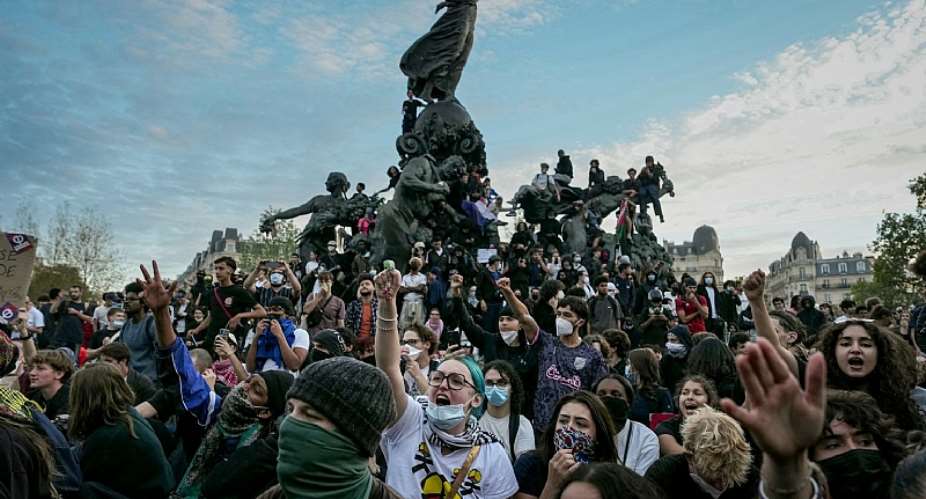
The student protests across various parts of France are blowing out of proportion as they have metamorphosed into something else different from their earlier objectives, that is, bringing government attention to some of the harsh realities that they continued to experience on a day-to-day basis. In mid-September, a protest started at Exupéry High School in Créteil, a Paris suburb, against the deplorable learning conditions that they are faced with. More than 1,020 high schools were negatively affected by strikes or protests, including 222 blockades, according to the Ministry of Education on Monday, the 28th of September.
The protests across France by high schoolers, in other words, lycéens in French, stemmed from schools being undersourced, most especially public schools, including dilapidated facilities or infrastructures, insufficient staff, overcrowded classrooms and exhausting school days. According to relevant sources such as Le Monde, roughly it is estimated that 65 education staff and 170 students have been injured since the start of the movement, said Education Minister Édouard Geffray. The Education Minister has informed the public that approximately 141 schools nationwide remain shut due to the current situation that the country is dealing with, as the mounting pressure makes it impossible for schools to operate effectively.
This is on the grounds that there are several blockades being carried out by high schoolers who hold the view that if their demands cannot be addressed, then there is no need for other schools to operate as it would be grossly unjust. About two or three days ago, the British Broadcasting Corporation (BBC) News published on its website that about 200,000 plus people have formed part of the protest. Moreover, it also reported that a 14-year-old boy got injured in his jaw, including some portion of his upper teeth got broken and four of his lower teeth were removed due to police brutality as he was wrongly treated.
Additionally, it was also reported that a 15-year-old boy was beaten severely, which resulted in him having a disability. Yet, there are still investigations ongoing to see how best to rightly authenticate the flow of information that is coming in as it relates to casualties. However, it is widely displayed in mainstream media the way in which protesters are being dispersed, such as the forceful use of tear gas, batons, and among other things. Interestingly, the protest has drawn widespread international concern as the manner and form in which the matter is being handled by the government reflects something contrary to the tenets of democracy.
That speaks volumes about the protection of freedom of speech, the right to assemble anytime and anywhere to express one’s grievances with the way in which things are going in terms of governance, human rights protection, and other related things. Democracy objects to whatever violations of a person’s fundamental and human rights. It does not say that when one disagrees with the way in which things are happening and decides to protest, he or she should be tear-gassed, beaten with batons, let alone say incarcerated. Democracy, in simple terms, “is the government of the people, by the people and for the people”, as Abraham Lincoln defined it. It is solely meant to foster the interests of the people.
A finding published by Reuters shows that nearly 10% of teaching hours are unstaffed at French state-owned schools, according to Education Ministry figures, prompting a growing wave of wealthier parents planning on abandoning the public sector in favour of private schooling which, in turn, risks deepening social inequality. There have been broader concerns in France that the schooling system is losing to other countries and failing in its core objective to enable children from disadvantaged backgrounds to climb the social ladder. Performance gaps are increasingly growing between highly advantaged and highly disadvantaged students, and overall scores in reading comprehension and mathematics, according to the PISA report, which evaluates students nationwide.
Be that as it may, the opposition leader of France Unbowed Party, Jean-Luc Mélenchon, a far-left candidate for France, described and denounced police actions as “savagery” and repressive. Moreover, he has been accused by other political opponents of stoking violence and promoting wrong in order to get support for his presidential bid. Political leaders who have opposing views to what Mélenchon thinks criticised the actions of the protesters, calling it a complete disregard for what is right and further urging police to take drastic measures in order to deal with the situation.
But frankly speaking, the exchange of verbal attacks by political leaders, most especially Mélenchon, does not in any way mean that he’s there to defend the interest of the students; rather, it is intended to win the sentiments of the students who are mostly young people from ages 15–24. The same applies to those who have contrary views to what he thinks. After mounting pressure from the students, the government has finally decided to make some interventions, starting with sending 3,000 teachers into classrooms, even though the teachers have not started work effectively. In the midst of this intervention, protests continued, including yesterday, on 9 October.
The students are saying that since the government has finally succumbed to one of their demands, no matter how small the intervention might seem, they are going to continue engaging the government until all of their demands are met. Also, the unrest has spread to neighbouring Belgium where about a dozen schools closed in Liège, a day after violence in the city and approximately six arrests. These are the recent developments so far regarding the student protests in France to the best of my knowledge.
To that very end, the situation in France is one that we must pay keen attention to as it has the propensity to turn things the other way around, which will not be a good sign for France as a society. The government needs to act decisively in seeing how best to amicably resolve the issues raised by the students, such as schools being undersourced, dilapidated facilities or infrastructures, teacher shortages, overcrowded classrooms and exhausting school days. These matters must be addressed effectively and immediately. It is the right of the students to protest for a better learning system and environment.
We do agree that the government is clothed with the responsibility of coming up with measures to protect public safety, but when these measures turn into the brutalisation of peaceful and ordinary citizens, it no longer becomes measures to protect public safety, but rather putting fear in ordinary citizens to not stand up for their rights, and a crackdown on dissent. So, the government in France should let citizens exercise their constitutional and democratic rights. Protest is not a crime, but rather, it is a democratic right.
Let the space be created where people will freely assemble and express their grievances with the national government without having to fear being tear-gassed, beaten with batons, and so forth. By this practise, we are going to build a society where democracy will flourish, and people will see themselves as being included, as their voices will matter on issues as they relate to the forward march of the country.

 Ms. Emelia Affi Agbenyo must honourably resign as new EC Deputy Chairperson to p...
 Why have US-Ukraine relations soured ahead of the midterms?
 Govt to meet Free Zones Authority, Trade Ministry over Customs Act concerns
 Kojo Bamba was never my driver or bodyguard — Nana B
 Ekow Assafuah petitions OSP to probe alleged World Cup visa facilitation irregul...
 Africa attracting wrong waste management solutions – GAIA report
 Summon Kofi Adams, GTA boss over 2026 World Cup visa scandal — NPP tells Parliam...
 Obuasi SHS headmaster accused of sexual abuse is NDC constituency secretary – Ma...
 Family demands answers over death of 14-year-old student at Abomosu STEM SHS
 Osahen Afenyo-Markin reflects on loneliness of public service, says survival is ...


