




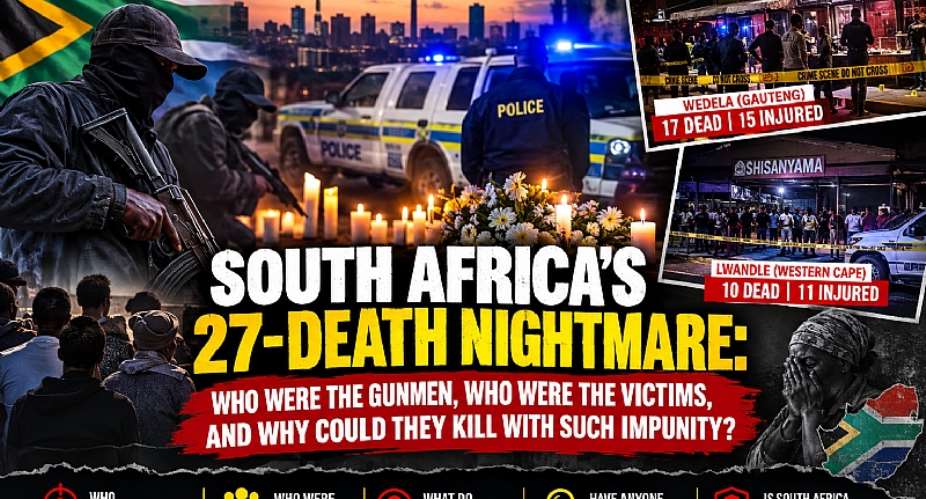
Twenty-seven people are dead.
Twenty-six others are receiving medical treatment for gunshot wounds.
Two separate locations. Two separate attacks. Multiple gunmen. Automatic weapons. A country already battling organised crime, illegal firearms, gang violence and kidnapping now has another question to confront:
How many more people must die before South Africans can genuinely feel that the state is protecting them?
The latest killings occurred within hours of one another in Gauteng and the Western Cape, after another mass shooting in KwaZulu-Natal days earlier left 11 people dead.
But while the numbers are horrifying, the questions behind them may be even more disturbing.
Who were the attackers?
Who were the victims?
Was this random killing, robbery, gang warfare, an illegal-mining dispute or something else?
And why are heavily armed men repeatedly able to enter places where ordinary people gather, open fire and disappear?
TWO MASS SHOOTINGS, 27 DEAD
The first attack happened at about 9:30 p.m. on Saturday, September 26, at a tavern in Wedela, in Gauteng's West Rand, southwest of Johannesburg.
According to police, eight armed men arrived carrying AK-47 rifles and pistols.
Patrons were drinking both outside and inside the tavern.
The attackers reportedly opened fire on people outside before entering the establishment and continuing the shooting.
When the violence ended, 17 people 13 men and four women were dead.
Another 15 people had suffered gunshot wounds.
Police said emergency medical personnel pronounced all 17 dead at the scene.
The suspects allegedly searched some patrons and took their mobile phones before escaping in two unidentified vehicles. Two vehicles were also reportedly set alight.
Police have opened 17 murder cases, 15 attempted-murder cases and two malicious-damage-to-property cases.
And, at the time of the latest reports, no arrests had been made.
That alone raises an uncomfortable question:
How could eight heavily armed men carry out a prolonged attack at a populated tavern, search victims, allegedly steal their phones, burn vehicles and escape without being immediately intercepted?
THEN CAME LWANDLE
Hours later, another shooting unfolded in Lwandle, near Cape Town.
At approximately 1:46 a.m. on Sunday, gunmen entered an entertainment venue that also operates as a shisanyama and opened fire on patrons.
Ten people were killed.
Eleven others were wounded.
Five victims died at the scene, while another five later died after being transported to medical facilities.
Western Cape police have opened murder and attempted-murder cases and established a multidisciplinary investigative team led by serious violent-crime detectives.
But again, no arrests had been announced.
And once again, the identities of the deceased had not been publicly released because police said their next of kin first had to be informed.
So, at present, anyone circulating a list claiming to contain the names of all 27 victims should be treated with extreme caution.
WHO ARE THE 27 VICTIMS?
This is one of the most important unanswered questions.
At the time of publication, authorities had confirmed the number, sex and circumstances of the deaths, but had not publicly released the full names of the 27 deceased victims.
That means it is impossible to responsibly provide a verified list of their names, occupations, hometowns or family backgrounds.
What is known about the Wedela victims is that the 17 dead included 13 males and four females.
Gauteng police have also indicated that most of those killed and injured were South Africans, while one victim was Ethiopian and others were from Lesotho.
But nationality is not the same thing as identity.
The public still needs to know, when families have been formally notified:
Who were these people?
Were they miners?
Taxi operators?
Business owners?
Students?
Construction workers?
Unemployed young people?
Parents?
Breadwinners?
Friends who simply went out for an evening?
Every victim represents a human life not merely another number added to South Africa's murder statistics.
WHAT ACTUALLY KILLED THEM?
The available police and emergency-service reports indicate that the deaths resulted from gunshot injuries.
In Wedela, all 17 victims were declared dead at the scene.
In Lwandle, five died at the scene and five others later died after being transported to medical facilities.
However, detailed individual medical findings, including forensic post-mortem reports specifying the precise injuries suffered by each victim, have not yet been publicly released.
Therefore, it would be irresponsible to invent individual causes of death beyond what authorities have confirmed.
The evidence available so far points overwhelmingly to fatal firearm injuries.
But the public deserves more than numbers.
Once forensic examinations are completed, investigators should be able to establish the nature and trajectory of the wounds, the firearms involved where recoverable, and other evidence that could help reconstruct exactly what happened.
WHO ARE THE GUNMEN?
At present, the public does not know their names.
In Wedela, police are searching for eight unidentified armed men.
In Lwandle, police have described the attackers as gunmen but have not publicly confirmed their number or identities.
This distinction is important.
They should not be publicly labelled as members of a particular gang, illegal-mining syndicate or criminal organisation until investigators establish that connection.
There are, however, several lines of investigation.
And this is where the story becomes more complicated.
WAS IT A GANG WAR?
Police have not established a definitive motive for either shooting.
However, the circumstances surrounding the Wedela attack have generated an important theory.
The area has long been affected by illegal mining and criminal networks.
Residents have described gunfire as something they have become accustomed to.
One local resident reportedly said the tavern had experienced another shooting approximately two months earlier and claimed that alleged perpetrators had threatened to return.
That claim remains a resident's account not a judicially established fact.
Gauteng police have also considered robbery as a possible motive, while saying that conflict involving illegal miners, commonly called zama zamas, cannot be ruled out.
The reported removal of patrons' cellphones strengthens the robbery theory, but it does not automatically prove that robbery was the sole motive.
This raises another question:
Were the patrons themselves the targets or was the tavern targeted because of an individual, business, criminal network or dispute connected to it?
That distinction could fundamentally change the investigation.
WHAT ABOUT LWANDLE?
The situation in Lwandle is even less clear.
Police have not announced a motive.
There has been no official confirmation that the shooting was a gang conflict.
There has been no official confirmation that it was a robbery.
There has been no official confirmation that it was connected to the Wedela massacre.
The two attacks occurred in the same night, but that does not mean they were coordinated.
Investigators must establish whether the incidents are connected or simply represent two separate outbreaks of firearm violence occurring within hours of each other.
That question is crucial.
Are South Africans witnessing a coordinated criminal phenomenon or multiple criminal networks exploiting the same weaknesses in the country's security system?
SOUTH AFRICA HAD ALREADY BEEN WARNED
The 27 deaths did not happen in isolation.
Just five days earlier, on September 22, three gunmen allegedly attacked people gathered inside a house in KwaMakhutha, south of Durban.
Eleven people were killed and three injured.
Police said preliminary investigations showed that some of those victims were already on Crime Intelligence's radar in connection with alleged illegal activities.
Police also said a feud between rival groupings could not be ruled out.
But once again, the motive had not been conclusively established.
That means South Africa has experienced three major mass-shooting incidents within days, leaving at least 38 people dead.
The pattern should concern every law-enforcement agency in the country.
AND THE KIDNAPPING NUMBERS ARE ANOTHER WARNING
The security crisis extends beyond shootings.
Between April and June 2026, South Africa recorded 4,638 kidnapping cases, according to the latest crime statistics.
Gauteng alone accounted for 2,367 cases more than half the national total.
The Gauteng Provincial Legislature has described kidnapping as one of the province's most pressing organised-crime and public-safety challenges.
The problem is therefore not simply that people are being shot.
South Africans are confronting a broader criminal ecosystem involving firearms, hijacking, kidnapping, extortion, organised crime, illegal mining, gangs and other forms of violent crime.
The question becomes:
Is the country fighting individual criminals or the criminal networks that make these crimes possible?
BUT IS CRIME ACTUALLY GETTING WORSE?
There is an important complication.
The government's own crime figures show that some categories of crime have declined.
For January to March 2026, South Africa recorded 5,181 murders, a 9.5% decline compared with the corresponding period of the previous year.
The government also reported reductions in several robbery categories and a small decline in kidnapping during that quarter.
But the acting police minister himself acknowledged the uncomfortable reality: a decline in crime does not mean that South Africans are safe.
The country was still recording about 58 murders every day during that quarter.
That context matters.
The existence of a statistical decline does not make a mass shooting less devastating to the community that experiences it.
And a national reduction does not necessarily mean that residents of particular townships or crime hotspots feel safer.
WHAT IS GOVERNMENT DOING?
The authorities are not doing nothing.
In March 2026, President Cyril Ramaphosa authorised the deployment of 2,200 South African National Defence Force personnel to work with SAPS in combating crime and preserving law and order.
The deployment is intended to support operations against illegal mining and gangsterism across Gauteng, North West, Free State, Eastern Cape and Western Cape.
The government calls the operation Operation Prosper.
Police and soldiers have also conducted raids targeting illegal firearms, illegal mining operations and criminal networks.
In one operation in Gauteng, authorities reported arrests and the seizure of firearms, ammunition and illegal-mining equipment.
These are substantial interventions.
But here is the question that South Africans are entitled to ask:
If thousands of soldiers and police officers are being deployed, why can heavily armed groups still enter taverns and entertainment venues and kill dozens of people?
DOES MILITARY DEPLOYMENT SOLVE THE REAL PROBLEM?
Not necessarily.
Soldiers can provide additional manpower.
They can support patrols, raids and intelligence-led operations.
But organised crime is not simply a battlefield problem.
It is also an intelligence problem.
A firearms-trafficking problem.
A policing problem.
A prosecution problem.
A corruption problem where corruption exists.
A socioeconomic problem.
And, in some communities, a problem involving criminal networks that have operated for years.
If the state repeatedly removes individual criminals but does not dismantle the networks that supply weapons, finance operations and recruit new members, the cycle can continue.
So the deeper question is:
Who supplies these assault rifles?
Where are the weapons coming from?
Who finances the criminal networks?
How are suspects able to move heavily armed groups through communities?
Who provides intelligence to these networks?
And perhaps most importantly:
Why are some communities repeatedly exposed to violence while the state arrives after the bullets have already been fired?
WHAT ABOUT THE CLAIM THAT FOREIGNERS HAVE LEFT?
This part of the debate requires particular caution.
There is no credible evidence in the current reporting that foreigners have "left South Africa" in a way that explains these killings.
In fact, the latest incidents themselves involve people of different nationalities.
The Wedela victims reportedly included South Africans as well as people from Ethiopia and Lesotho.
More importantly, South Africa's violent-crime problem cannot responsibly be reduced to foreigners.
The available evidence points to a much more complicated mixture of organised crime, firearms, gangs, illegal mining, robbery, kidnapping and local criminal networks.
Blaming an entire nationality without evidence risks obscuring the real perpetrators and the systems that enable them.
The question should not simply be:
"Who is foreign?"
It should be:
"Who pulled the trigger, who supplied the weapon, who financed the operation, who knew about the threat, and why did the security system fail to stop it?"
WHAT ARE EYEWITNESSES SAYING?
The emerging eyewitness accounts paint a frightening picture.
At Wedela, residents described gunfire and fear in a community already accustomed to violence.
One resident reportedly said the latest shooting was particularly frightening because the same establishment had previously experienced a shooting.
Police say the attackers fired first at people outside before moving into the tavern.
In Lwandle, the available accounts similarly describe gunmen entering an entertainment venue and opening fire on patrons.
But eyewitness testimony must be treated carefully.
People experiencing a traumatic shooting may remember events differently, and investigators must reconcile those accounts with CCTV footage, ballistic evidence, cellphone records, forensic evidence and other intelligence.
The public therefore needs facts not rumours.
ARE SOUTH AFRICANS SAFE?
That is perhaps the hardest question of all.
The honest answer is that safety varies dramatically by location and circumstance.
Millions of South Africans live normal lives every day.
But the repeated occurrence of mass shootings demonstrates that certain communities face a serious level of violent-crime exposure.
The kidnapping figures add another layer to that insecurity.
And when residents begin treating gunfire as normal, something deeper has already gone wrong.
A society should never become so accustomed to violence that people hear automatic gunfire and simply continue with their evening.
THE QUESTIONS GOVERNMENT MUST ANSWER
The latest tragedy should not end with condolences.
South Africans deserve answers.
How did eight armed men obtain AK-47 rifles and pistols?
Why was a tavern that reportedly had experienced a previous shooting still vulnerable to another attack?
Was the Wedela attack primarily robbery, gang-related violence, illegal-mining conflict or a combination of these factors?
Were the victims deliberately targeted?
Why were two vehicles allegedly burned after the attack?
Were the two shootings connected in any way?
What intelligence did SAPS have before these attacks?
Were any warnings received?
How quickly did police respond after the first emergency calls?
How many illegal firearms are circulating in these communities?
Who supplies them?
Why are criminal networks able to survive repeated police operations?
What happened to previous suspects arrested in similar mass shootings?
How many of the perpetrators of previous mass shootings have actually been convicted?
And perhaps the biggest question:
If the government can deploy thousands of soldiers against organised crime, why are ordinary people still sitting in taverns, attending parties or visiting entertainment venues and suddenly finding themselves trapped in a hail of bullets?
THE 27 DEAD MUST NOT BECOME ANOTHER STATISTIC
There is a danger in reporting mass violence purely through numbers.
Seventeen in Wedela.
Ten in Lwandle.
Twenty-seven in one night.
But behind every number was a person.
Someone's child.
Someone's parent.
Someone's partner.
Someone's friend.
Someone's employee.
Someone's neighbour.
Until the authorities release the names after properly notifying families, the identities of the 27 victims remain an unanswered part of this tragedy.
Until investigators establish the identities and motives of the attackers, the public should resist speculation.
And until the courts determine responsibility, suspected criminals should not be presented as guilty.
But there is one conclusion that does not require speculation:
South Africa has a serious violent-crime problem that cannot be solved merely by counting bodies after the shooting.
Police must investigate.
Intelligence agencies must identify networks before they strike.
Illegal firearms must be traced and removed.
Criminal organisations must be dismantled.
Kidnapping networks must be pursued.
Prosecutors must secure convictions where evidence supports them.
And communities must be able to trust that when they call for help, the state will respond.
Because the ultimate test of public security is not how many soldiers can be deployed after a massacre.
It is whether ordinary citizens can gather at a tavern, attend a party, go to an entertainment venue, drive home or walk through their neighbourhood without wondering whether they will become the next headline.
Twenty-seven people are dead.
The question South Africa now faces is not simply who killed them?
It is:
What has allowed a society to reach the point where so many heavily armed men can repeatedly turn ordinary places into killing grounds and what will finally be done before another 27 families are left asking the same questions?
By:
Patrick Belebang Yagsori
0240292413
[email protected]

 Caucus Warns: ‘If We Lose Our Teachers, We Lose Our Nation’ as Education Crisis ...
 Boeing Projects 18‑Month Timeline for Ghana’s National Airline Revival Under New...
 Legal Expert Questions EOCO’s Conduct, Says MP Had Right to Resist Unlawful Arre...
 Gunmen kill 27 in two shootings in South Africa
 'We shall hold govt feet to the fire of accountability' — Anyidoho on €225m coca...
 ‘Russian sleeper cell’: Can Germany’s far-right AfD be barred from sensitive int...
 Pope Leo XIV visits Lourdes after giant Paris mass to meet clergy abuse victims
 EU unlocks 710 mn euros' aid for crisis-hit communities
 Power cuts, rubble: millions come home to find Sudan's capital unlivable
 At least 16 people killed as Russia and Ukraine trade deadly air strikes


