




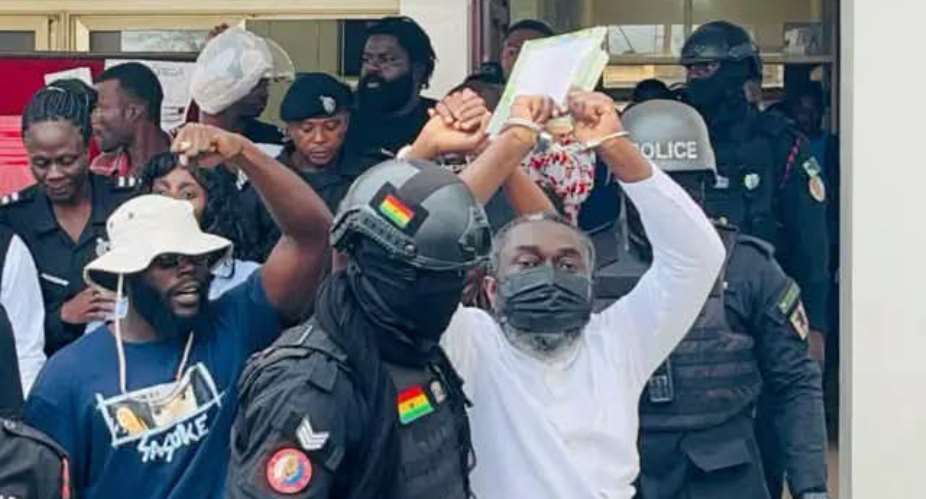
When the Economic and Organised Crime Office (EOCO) attempted to arrest Manhyia South Member of Parliament and lawyer Nana Agyei Baffour Awuah at the Accra High Court on September 23, 2026, the incident immediately became bigger than one politician, one lawyer or one law-enforcement agency.
It became a test of something far more important: whether Ghana's legal profession will defend the principle of due process consistently, regardless of who is in government, who is being arrested and which political colours surround the controversy.
The Ghana Bar Association (GBA) has now spoken.
And its intervention is significant.
The Association said no individual is above the law, but insisted that investigations or enforcement actions involving lawyers particularly lawyers representing clients must respect the Constitution, established legal procedures and professional independence. It also raised concerns about an alleged assault involving another lawyer during the confrontation.
But almost immediately, another lawyer who has had a very different relationship with the Ghanaian state asked an uncomfortable question.
Why now?
Oliver Barker-Vormawor, lawyer and political activist, welcomed the GBA's intervention but accused the Association of having been silent during incidents involving him and other lawyers and activists in previous years.
His argument was devastatingly simple: if the GBA is genuinely defending lawyers and the rule of law, shouldn't that voice be equally loud regardless of which political party controls the government?
That question deserves serious examination.
Not because Oliver must necessarily be right.
But because institutions as important as the GBA should not be afraid of scrutiny.
WHO IS NANA AGYEI BAFFOUR AWUAH?
Nana Agyei Baffour Awuah is not simply another suspect caught in an investigation.
He is a lawyer, Senior Partner of Sarkodie Baffour Awuah & Partners, and the Member of Parliament for Manhyia South on the ticket of the New Patriotic Party (NPP). Parliament's official profile lists him as a member of the Constitutional and Legal Affairs Committee and Vice-Chairperson of the Subsidiary Legislation Committee.
He therefore occupies three important spaces simultaneously:
lawyer, legislator and political actor.
That combination makes the circumstances surrounding his attempted arrest particularly sensitive.
The incident happened after Baffour Awuah had appeared at the High Court as counsel for Salomey Awity Baffoe in the widely discussed "Ghana Jollof" case.
After proceedings, EOCO officials attempted to take him into custody.
Video footage of the confrontation subsequently circulated widely.
Baffour Awuah demanded a warrant and resisted the attempt to take him away.
EOCO later explained that the attempted arrest was connected to an ongoing investigation and that Baffour Awuah had been invited twice in February 2026 to assist with the investigation but had not honoured the invitations.
But there is another side.
Baffour Awuah disputes EOCO's characterization.
According to his response, the February correspondence was addressed to him in his capacity as Senior Partner of his law firm and concerned an investigation involving SIC Life Savings and Loans Company Limited not an investigation into him personally.
He says that after he referred the matter to the Clerk of Parliament, a representative of the law firm subsequently attended three EOCO interrogation sessions on March 4, March 18 and April 30 and submitted a written statement.
He therefore argues that the firm's cooperation had already taken place and that there had been no subsequent invitation before the September confrontation.
That dispute matters.
Because the public should not confuse an allegation, an investigation, an invitation to assist an investigation and a finding of wrongdoing.
As of the information publicly available, EOCO has explained why it wanted Baffour Awuah's attendance; Baffour Awuah has disputed the characterization of his non-attendance.
The facts must ultimately be established through the proper legal process.
THEN CAME THE GHANA BAR ASSOCIATION
The GBA's response was forceful.
It said law enforcement must respect the professional independence of lawyers.
It said arrests on court premises can disrupt judicial operations and undermine the dignity and authority of the courts.
It demanded due process, fairness and respect for constitutional rights.
It further warned that actions interfering with lawyers' ability to represent clients could undermine public confidence in the justice system.
On the surface, this is exactly what one would expect from a professional body representing lawyers.
But Oliver Barker-Vormawor has asked Ghana to look beneath the surface.
And that is where the controversy becomes uncomfortable.
OLIVER BARKER-VORMAWOR'S QUESTION: WHY DID THE BAR REMEMBER BAFFOUR AWUAH?
Barker-Vormawor's criticism is not new.
In 2023, he publicly attacked the GBA over what he described as its silence on alleged military brutalities in Ashaiman. He questioned whether the Association was sufficiently interested in defending human rights outside narrow professional concerns.
Now, after the Baffour Awuah incident, he has returned to the issue.
He argues that the GBA "forgot" that he too was a lawyer when he was arrested during demonstrations and when other lawyers and law students were allegedly manhandled.
He specifically mentioned Timothy Selikem Korku Donkor and Agaaya Adongo and also referred to the case of Ama Governor.
His central accusation is that the GBA's voice appears to become louder or quieter depending on the political environment.
That is a serious accusation.
But it must remain an accusation, not a proven fact.
There is presently no evidence establishing that the GBA is formally working for, controlled by or acting as an arm of either the NPP or the NDC.
Indeed, the GBA itself has repeatedly rejected such claims.
In September 2026, its Public Relations Officer, Saviour Kudze, said the Association was not politically aligned and insisted that it criticises issues regardless of which government is in power.
So the real question is not necessarily:
"Is the GBA an NPP organisation?"
There is insufficient evidence to establish that.
The more difficult question is:
"Why does its public advocacy sometimes create the perception that it is?"
That is a very different question.
THE GBA HAS A LONGER HISTORY THAN GHANA'S CURRENT POLITICAL DIVIDE
To understand why the accusations matter, one must understand the institution being accused.
The origins of Ghana's formal legal system go back to the establishment of the Supreme Court of Judicature of the Gold Coast in 1876.
John Mensah Sarbah became the first Ghanaian to be called to the Bar in 1887.
The Ghana School of Law was established in 1958, and the GBA developed its first formal Constitution and Code of Ethics around the same period.
The GBA itself describes its history as one involving resistance to attempts by governments to control or influence the Association.
That history is important.
Because an institution that claims a tradition of independence cannot merely demand public confidence.
It must continuously earn it.
And that means being willing to answer difficult questions even when those questions come from lawyers who disagree with its leadership.
THE GBA HAS NOT ALWAYS BEEN SILENT
This is where Oliver's argument needs an important qualification.
It would be inaccurate to suggest that the GBA has never defended lawyers or protesters under the previous NPP administration.
During the #OccupyJulorbiHouse demonstrations in September 2023, a lawyer, Richmond Rockson, was arrested and allegedly manhandled while attending to detained protesters.
The Greater Accra Regional Bar condemned his arrest and detention, described the conduct as a breach of constitutional rights and said it would pursue the matter with the national executive of the GBA.
There were also broader GBA interventions around demonstrations.
In October 2023, the Association publicly acknowledged the constitutional right to freedom of assembly and called for dialogue over the designation of security zones during demonstrations.
Therefore, the historical record is more complicated than simply saying:
"GBA speaks when NPP is in opposition and stays silent when NPP is in power."
The record does not support such a simple conclusion.
But neither does it eliminate questions about consistency.
AND THAT IS WHERE THE REAL PROBLEM BEGINS
In 2025, Attorney-General and Minister of Justice Dr Dominic Ayine himself questioned the GBA's consistency.
He argued that although the Bar had played an important role in constitutional matters, its public advocacy outside the courtroom had sometimes lacked consistency.
He pointed specifically to the removal processes involving former CHRAJ Commissioner Loretta Lamptey and former Electoral Commission Chair Charlotte Osei, compared with the Association's intervention in the process involving former Chief Justice Gertrude Torkornoo.
His question was essentially:
What changed?
That is not Oliver Barker-Vormawor speaking.
That is the Attorney-General raising the issue.
And it matters.
Because when people from opposing political camps begin making similar complaints about institutional consistency, the GBA cannot simply dismiss every criticism as partisan politics.
THE NPP'S BAFFOUR AWUAH HAS ALSO DEFENDED THE GBA
Interestingly, Baffour Awuah himself has previously defended the GBA against accusations of political bias.
In September 2026, he rejected claims that the Association only becomes vocal when the NPP is in power.
He argued that the GBA has historically criticised governments and that the NDC, in his view, has sometimes been less receptive to criticism than the NPP.
This produces an extraordinary irony.
The very lawyer at the centre of the latest controversy has previously defended the institution that has now come to his professional defence.
Does that prove political alignment?
No.
But it demonstrates how difficult it is to analyse the GBA through a simple NPP-versus-NDC lens.
THEN THERE IS AMA GOVERNOR
Barker-Vormawor also raises the case of Ama Governor.
The case involved Elorm Ababio, popularly known as Ama Governor, whose call to the Bar was delayed after a complaint alleging conduct unbecoming of a Bar applicant.
The matter became highly controversial.
The General Legal Council eventually permitted her to continue the application process, and she was subsequently called to the Bar in 2024.
But an important distinction must be made.
The body directly responsible for enrolment and admission processes is the General Legal Council, not simply the Ghana Bar Association.
Therefore, blaming the GBA for every decision connected to Ama Governor's call to the Bar risks collapsing two different institutions into one.
Nevertheless, Oliver's larger argument concerns the GBA's willingness or unwillingness to defend lawyers and prospective lawyers facing state or institutional pressure.
That broader question remains legitimate.
WHAT ABOUT ASHAIMAN?
This may be one of the hardest questions for the Bar.
In March 2023, after the death of soldier Trooper Imoro Sherrif, soldiers conducted an operation in Ashaiman during which residents reported brutal treatment and mass arrests.
Community groups called on the government to investigate the alleged abuses and specifically appealed to the Ghana Bar Association, civil society and religious bodies to condemn the alleged violence.
Barker-Vormawor subsequently criticised the GBA for what he described as silence.
This is important because the victims in Ashaiman were not lawyers.
And that raises a fundamental question:
Is the GBA's mandate to defend lawyers—or is it also to defend constitutionalism and the rule of law when ordinary citizens are the victims?
The GBA's own historical account says its annual conferences have considered national political, social and economic matters and that the Association has historically opposed government measures it considered harmful to democracy or the public interest.
If that is the standard, then the public is entitled to ask how consistently it has been applied.
THE MOST DAMAGING QUESTION MAY NOT BE "WHO DOES THE GBA SUPPORT?"
It may be this:
What determines when the GBA speaks?
Is it the identity of the victim?
Is it whether the victim is a lawyer?
Is it whether the incident occurs inside a courtroom?
Is it whether the issue threatens the independence of the legal profession?
Is it whether the matter affects the judiciary?
Is it whether lawyers themselves are physically attacked?
Or is it simply whether the issue reaches a threshold that the leadership considers appropriate for institutional intervention?
If the last explanation is correct, the GBA should explain its criteria.
Because without clear criteria, silence itself becomes politically interpretable.
WHY DOES THE GBA SPEAK ON SOME CASES AND NOT OTHERS?
This is perhaps the question the Association should answer most directly.
Suppose two governments commit comparable violations.
Suppose one government is NPP and the other is NDC.
Suppose the same constitutional principle is implicated.
Should the GBA's response be different?
Clearly not.
The rule of law cannot operate on a political timetable.
A constitutional principle does not become NPP when the NPP is in government and NDC when the NDC takes power.
That is precisely why institutional consistency matters.
THE EIGHT-YEAR QUESTION
Oliver Barker-Vormawor's most politically explosive claim is that the GBA appears to find and lose its voice in political "eight-year cycles."
That is a powerful allegation but proving it requires more than examples.
It requires systematic evidence.
Someone would have to examine GBA statements across successive administrations, classify the issues addressed, identify the political actors involved, compare the seriousness of the events and determine whether the Association's responses were actually inconsistent.
Until such research is done, saying the GBA is partisan goes beyond the available evidence.
But saying that some of its interventions create a perception of selectivity is much easier to defend.
And that perception is now coming from multiple directions.
The Attorney-General raised concerns about selective advocacy in 2025.
Government spokesperson Felix Kwakye Ofosu accused the GBA in 2026 of bias and described it as behaving like an NPP grouping.
The GBA rejected those accusations.
And the Association has now again insisted that it is not politically aligned.
When an institution repeatedly has to defend itself against accusations of political bias, perhaps the most constructive response is not merely to deny the allegation.
Perhaps it is to publish the evidence.
WHY NOT CREATE A PUBLIC "RULE OF LAW RESPONSE REGISTER"?
Here is a question the GBA might consider.
Why not publish every major intervention by the Association involving:
- arrests;
- alleged human-rights violations;
- attacks on lawyers;
- attacks on judges;
- interference with judicial independence;
- demonstrations;
- constitutional controversies;
- alleged abuse of state power?
And beside every intervention, record:
Date.
Government in power.
Political actors involved.
Legal principle affected.
GBA's position.
Action taken.
Outcome.
Then Ghanaians could judge the record for themselves.
No political party could reasonably accuse the Association of selective memory if the evidence were sitting publicly on the table.
THE BAFFOUR AWUAH CASE HAS EXPOSED ANOTHER QUESTION
The GBA is right to defend professional independence.
But professional independence must not become professional immunity.
The Association itself explicitly acknowledged that no individual is above the law.
That principle must apply to Baffour Awuah too.
If EOCO has a lawful investigation, he should answer lawful questions.
If EOCO has lawful authority to compel attendance, that authority should be exercised according to law.
If EOCO acted unlawfully, the courts should determine that.
If the arrest attempt violated constitutional safeguards, that too should be properly established.
The GBA's intervention should therefore never be interpreted as saying:
"Do not investigate lawyers."
It should mean:
"Investigate them lawfully."
That distinction is fundamental.
AND WHAT ABOUT THE OTHER LAWYER?
The GBA also raised concerns about Enoch Anwere Afoakwa, who was seen in circulating footage complaining that he had been assaulted during the confrontation.
That raises another question:
If lawyers are expected to represent suspects, protesters and unpopular individuals, what happens when lawyers themselves become targets while doing that work?
The GBA says such conduct could create a chilling effect across the profession.
That is a legitimate concern.
But then the same principle should apply universally.
Whether the client is a government minister, opposition activist, journalist, protester, businessman, student or ordinary citizen, the lawyer representing that person should be able to do so without intimidation.
That is the standard the Bar should defend.
Every time.
THE GBA HAS ALSO POINTED TO ITS OWN PREVIOUS ACTIONS
The Association says the Baffour Awuah intervention did not emerge from nowhere.
It pointed to earlier concerns raised by President Efua Ghartey.
At the GBA's 2025 annual conference, she warned that lawyers should be able to defend clients of their choice without being heckled or harassed.
The Association also referred to the June 2026 case involving former GBA Vice-President Justice Minka Premo and a young female lawyer who were reportedly detained overnight after going to the BNI to defend a client. The GBA questioned why lawyers defending clients should face such treatment.
This weakens the argument that the Baffour Awuah statement was necessarily a one-off defence of an NPP politician.
There is evidence that the GBA has been increasingly talking about professional independence.
But that creates another challenge:
If this is now the GBA's standard, will it maintain the same intensity when the next government is in power?
That is the real test.
SO, IS THE GHANA BAR ASSOCIATION WORKING FOR A POLITICAL PARTY?
On the evidence currently available, that conclusion cannot responsibly be established.
There are accusations of political bias from different political actors.
There are documented instances where critics have questioned the GBA's consistency.
There are also documented interventions that cut across partisan lines.
And there is the Association's own explicit rejection of political alignment.
Therefore, the evidence supports a debate about perceived selectivity and institutional consistency, not a factual conclusion that the GBA is an appendage of a particular political party.
But perhaps that distinction is precisely what makes this controversy so important.
An institution does not need to actually be partisan for citizens to lose confidence in its neutrality.
Perception matters.
And in constitutional democracy, public confidence in institutions is itself a form of institutional capital.
THE QUESTIONS THE GBA MUST NOW ANSWER
Perhaps the most important outcome of the Baffour Awuah controversy is not whether Oliver Barker-Vormawor wins his argument.
It is whether the GBA is prepared to answer these questions:
1. What objective criteria determine when the GBA issues a public statement?
2. Does the same standard apply when the victim supports the government?
3. Does the same standard apply when the victim opposes the government?
4. How many cases involving alleged violations of lawyers' rights has the GBA publicly addressed over the last ten years?
5. How many did it decline to address?
6. What explains the difference?
7. Does the GBA have a database of its public interventions that citizens can independently examine?
8. When a Regional Bar speaks but the National Bar remains relatively quiet, what determines whether the national leadership adopts the issue?
9. Does the Association consider the rights of ordinary citizens to be part of its mandate beyond protecting the legal profession?
10. If yes, where is the line?
11. If no, why does the GBA describe itself historically as a defender of democracy and the public interest?
12. And perhaps the most uncomfortable question of all: would the GBA issue exactly the same statement if Baffour Awuah belonged to the NDC and an NPP government-controlled institution had attempted the arrest?
That question should not be answered with anger.
It should be answered with evidence.
THE FINAL TEST IS NOT WHAT THE GBA SAYS TODAY
It is what it will say tomorrow.
The easiest time to defend the rule of law is when doing so is popular.
The hardest time is when the person whose rights are being violated is politically unpopular, personally disliked or opposed to the government of the day.
That is when institutions prove whether their principles are genuine.
The Baffour Awuah controversy has therefore given the Ghana Bar Association an opportunity not merely to defend one lawyer, but to establish a consistent standard for the future.
If the Association's position is that lawyers must be protected while performing their professional duties, then that principle should apply to Oliver Barker-Vormawor.
It should apply to lawyers representing protesters.
It should apply to lawyers representing government officials.
It should apply to lawyers representing opposition politicians.
It should apply to lawyers representing accused persons.
It should apply to every lawyer.
And if the Association's position is that the rule of law must be defended, then that principle cannot change when political power changes hands.
Because Ghana's democracy does not need a Bar Association that finds its voice only when the circumstances are convenient.
It needs one whose voice is predictable precisely because its principles are predictable.
That is the real challenge now before the Ghana Bar Association.
Not whether it was right to speak for Baffour Awuah.
But whether it will still speak with the same courage when the next Baffour Awuah is someone the Bar or the government of the day does not like.
And perhaps that is the question Ghana should be asking before the next political cycle begins:
Is the Ghana Bar Association defending lawyers or defending a principle?
Because if it is truly defending a principle, the identity of the government, the lawyer and the political party should never matter.
By:
Patrick Belebang Yagsori
0240292413
[email protected]
 Caucus Warns: ‘If We Lose Our Teachers, We Lose Our Nation’ as Education Crisis ...
 Boeing Projects 18‑Month Timeline for Ghana’s National Airline Revival Under New...
 Legal Expert Questions EOCO’s Conduct, Says MP Had Right to Resist Unlawful Arre...
 Gunmen kill 27 in two shootings in South Africa
 'We shall hold govt feet to the fire of accountability' — Anyidoho on €225m coca...
 ‘Russian sleeper cell’: Can Germany’s far-right AfD be barred from sensitive int...
 Pope Leo XIV visits Lourdes after giant Paris mass to meet clergy abuse victims
 EU unlocks 710 mn euros' aid for crisis-hit communities
 Power cuts, rubble: millions come home to find Sudan's capital unlivable
 At least 16 people killed as Russia and Ukraine trade deadly air strikes


