




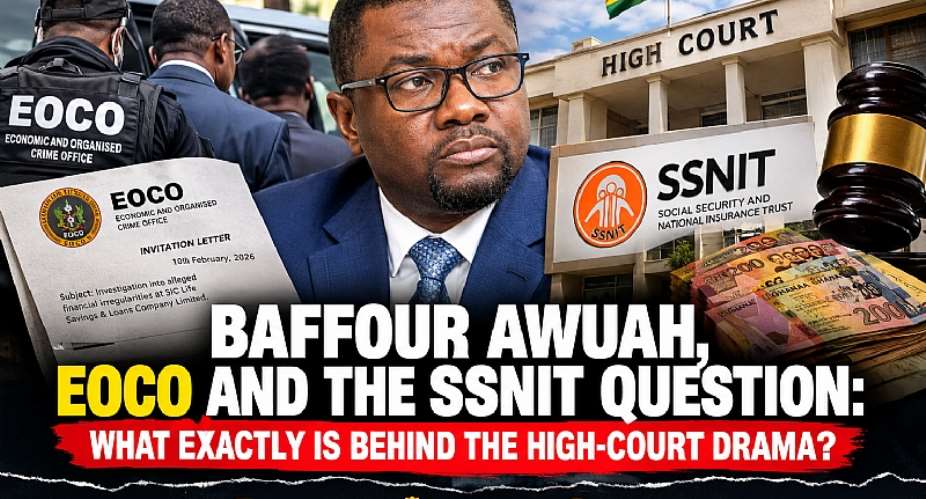
Ghana is once again confronting an uncomfortable question about the relationship between political office, professional responsibility, state investigations and accountability.
At the centre is Nana Agyei Baffour Awuah, the New Patriotic Party (NPP) Member of Parliament for Manhyia South and a lawyer, whose dramatic encounter with officials of the Economic and Organised Crime Office (EOCO) outside the Accra High Court on September 23, 2026, has generated competing narratives.
Was he being unlawfully targeted, as he suggests? Was EOCO simply trying to compel a person it had previously invited to assist an investigation? Or has a relatively straightforward financial investigation now been swallowed by politics, parliamentary privilege and public suspicion?
And perhaps the biggest question: what exactly does EOCO want from Baffour Awuah?
The emerging evidence suggests that the answer is more complicated than the social-media version of the story.
WHO IS NANA AGYEI BAFFOUR AWUAH?
Baffour Awuah is a lawyer and the sitting NPP MP for Manhyia South. He is also the Senior Partner associated with Sarkodie Baffour Awuah & Partners, a law firm that has represented clients including SIC Life Savings and Loans Company Limited.
His political profile has now collided with his professional life.
The September 23 confrontation occurred shortly after he appeared at the High Court as counsel for Salomey Awity Baffoe in the controversial “Ghana Jollof” case. A video of an EOCO operative attempting to take him into custody subsequently circulated widely.
Baffour Awuah said he feared he was being abducted because, according to his account, the woman who approached him did not initially provide identification, proof of authority or an arrest warrant. He said he offered to drive himself to EOCO but objected when he was allegedly asked to enter an EOCO vehicle.
EOCO gives a fundamentally different explanation.
The agency says its officers were acting in connection with an ongoing investigation, after Baffour Awuah failed to honour invitations issued in February 2026.
So which account should Ghanaians believe?
Perhaps the first mistake would be to decide before examining the documents.
WAS BAFFOUR AWUAH REALLY INVITED?
This is where the story becomes particularly interesting.
A seven-month-old EOCO letter surfaced after the attempted arrest.
The letter dated February 10, 2026, was addressed to Baffour Awuah in his capacity as Senior Partner of Sarkodie Baffour Awuah & Partners. It invoked Section 19 of the Economic and Organised Crime Office Act, 2010 (Act 804), and asked him to report to EOCO on February 17 to assist with an investigation.
The investigation, according to the letter, concerned alleged financial irregularities at SIC Life Savings & Loans Company Limited. EOCO said Baffour Awuah's input was important to its inquiry.
Therefore, the assertion that “there was no invitation” is difficult to sustain based on the correspondence that has now entered the public domain.
But there is another side.
Baffour Awuah says the invitation was not directed at him as a criminal suspect. He maintains that the investigation concerned his firm's client, SIC Life Savings and Loans, and that the request was made to him because he was the firm's Senior Partner.
He further says that after he informed EOCO that he had become an MP and referred the matter to the Clerk of Parliament, a representative of the law firm subsequently attended EOCO interrogations on March 4, March 18 and April 30, 2026, provided the requested information and submitted a written statement dated April 30.
That creates an important distinction:
Was EOCO demanding Baffour Awuah personally, or was it seeking information from his law firm?
That question matters enormously.
THEN WHY DID EOCO TRY TO ARREST HIM?
EOCO says the matter did not end with the firm's cooperation.
According to the agency, Baffour Awuah had personally been invited twice in February and did not honour those invitations. It therefore took subsequent steps to secure his attendance. EOCO described the attempted arrest as part of those lawful steps.
EOCO also says that the situation became tense during the attempted arrest and that officers abandoned the operation because continuing could endanger public safety.
The agency maintains that Parliament does not automatically place an MP beyond the reach of an investigation and says it recognises constitutional parliamentary privileges while still insisting that membership of Parliament does not end an investigation.
This raises a constitutional and institutional question that deserves serious public discussion:
Does becoming an MP change a citizen's obligation to cooperate with a lawful financial investigation or does parliamentary privilege only operate in specific circumstances?
That is a question for the Constitution, the courts and legal experts not political rallies.
BUT THEN CAME THE SSNIT BOMBSHELL
The most explosive development came not from EOCO's September statement but from former Tamale Central MP and lawyer Inusah Fuseini.
Speaking on Joy News' PM Express, Fuseini alleged that Baffour Awuah's professional dealings went beyond the SIC Life investigation.
He alleged that Baffour Awuah acted as lawyer for both SSNIT and Equity Loans in negotiations concerning an outstanding debt.
According to Fuseini, Equity Loans had at one point owed SSNIT approximately GH¢14 million.
He alleged that Baffour Awuah negotiated a settlement for both sides, with SSNIT ultimately recovering less than the amount originally owed.
The most serious allegation concerned the lawyer's fees.
Fuseini alleged that the fees were almost half of the amount recovered and further alleged that the fees exceeded legally permissible limits. He also said other transactions involving Baffour Awuah were under investigation.
But an important distinction must be made.
The available reporting does NOT establish that Baffour Awuah personally “took GH¢14 million from SSNIT.”
The GH¢14 million figure refers to the amount that Fuseini says Equity Loans owed SSNIT.
The allegation is instead that Baffour Awuah received legal fees connected to a negotiated settlement and that those fees were allegedly excessive.
Those are two very different claims.
That distinction is crucial if the public is going to discuss this matter responsibly.
SO WHAT DOES INUSAH FUSEINI KNOW?
This may be the most intriguing part of the entire controversy.
Fuseini is not an ordinary commentator. He is himself a lawyer and former Member of Parliament.
He has publicly stated that Baffour Awuah knows why authorities want to speak to him and has argued that if Baffour Awuah is convinced that he committed no offence, he should report to EOCO and clear his name.
Fuseini also insists that the EOCO matter has nothing to do with Baffour Awuah's representation of Salomey Baffoe.
That is significant because the timing of the attempted arrest immediately after Baffour Awuah appeared in the Ghana Jollof case naturally created speculation that the two matters were connected.
Fuseini rejects that interpretation.
So the public is left with a difficult question:
Does Fuseini know information that has not yet been made public, or is he interpreting information already contained in the investigation?
Until EOCO publishes more details or charges are formally laid and tested in court the public cannot responsibly assume the answer.
WHAT EXACTLY HAS EOCO GOT AGAINST HIM?
This is where caution is necessary.
As of the latest publicly available reports, EOCO has confirmed an ongoing investigation concerning alleged financial irregularities at SIC Life Savings & Loans, and the February correspondence demonstrates that Baffour Awuah was asked to assist.
But publicly available reports do not establish that Baffour Awuah has been convicted of, or formally charged with, stealing money from SSNIT.
Likewise, the allegations made by Inusah Fuseini regarding SSNIT and legal fees should be treated as allegations, not established criminal findings.
That distinction matters because an investigation is not a conviction.
And an allegation is not proof.
WHY DOES THE SSNIT CONNECTION MATTER SO MUCH?
SSNIT is not an ordinary private company.
It manages pension contributions and benefits connected to Ghana's social security system. The money involved ultimately relates to workers and pensioners.
That makes every question concerning SSNIT's financial transactions particularly sensitive.
Ghana has previously witnessed intense public debate over SSNIT's investment decisions, including the controversy surrounding the proposed sale of a 60% stake in four SSNIT-owned hotels in 2024. That episode demonstrated just how closely Ghanaians scrutinise decisions involving pension assets.
Therefore, when allegations emerge that a lawyer connected to an SSNIT transaction may have received fees allegedly above permissible limits, the public naturally wants answers.
But there is another question that deserves equal attention:
Where are the documents?
Where is the original SSNIT-Equity agreement?
What amount was actually recovered?
What amount was paid in legal fees?
Who authorised the payment?
What legal-fee rules applied to the transaction?
Was Baffour Awuah representing both parties simultaneously?
Was there written consent?
Did SSNIT approve the arrangement?
Did Equity Loans approve it?
And if the fees were allegedly unlawful, who authorised them?
THE BIGGEST MISUNDERSTANDING: “HE STOLE GH¢14 MILLION”
Social media can turn a complicated financial transaction into one explosive sentence.
But GH¢14 million, based on Fuseini's account, was the amount Equity Loans allegedly owed SSNIT.
It does not mean Baffour Awuah personally collected GH¢14 million.
The allegation is that his fees were nearly half of the amount recovered.
That is a serious allegation in itself, but it must not be transformed into a different accusation.
Ghanaians deserve facts, not exaggerated headlines.
WHY DID BAFFOUR AWUAH RUN?
This is perhaps the question ordinary citizens are asking most loudly.
Baffour Awuah says he believed the situation could have been an abduction because the person approaching him did not adequately establish her authority.
EOCO says it was carrying out a lawful operation.
Both explanations cannot simultaneously describe the entire event in the same way.
But there is a deeper question:
If Baffour Awuah believed he was completely innocent and that the investigation concerned only his firm's client, why not settle the matter by appearing before EOCO through his lawyers and putting his position formally on record?
His camp says, in effect, that the firm had already cooperated.
EOCO says it specifically wanted his attendance.
That dispute should be settled through documents and law not roadside confrontation.
IS THIS AN NPP POLITICAL ATTACK OR AN ACCOUNTABILITY ISSUE?
The NPP's Ashanti Regional Executive Committee has condemned the incident and described it as harassment and intimidation, warning against the use of state security agencies against its members and elected MPs.
That is the political interpretation.
But EOCO's position is different: it says the investigation predates the September confrontation and concerns an ongoing matter.
This creates another uncomfortable question:
Can every investigation involving an opposition politician be dismissed as political persecution?
Equally:
Can every investigation initiated by a government agency automatically be accepted as evidence of guilt?
Neither proposition should become the standard.
The proper test is evidence.
AND WHAT ABOUT THE POLITICS?
Baffour Awuah is an NPP MP.
That fact inevitably gives the matter political dimensions.
But there is an important danger in allowing politics to consume the substance of the investigation.
If there is evidence of financial wrongdoing, the appropriate place to establish it is through investigation, prosecution and, where necessary, trial.
If there is no evidence against him, the same process should provide the opportunity for his name to be cleared.
The real question therefore should not be:
“Is Baffour Awuah NPP?”
It should be:
“What exactly does the evidence show?”
THE QUESTIONS GHANA SHOULD BE ASKING
The most important questions are not necessarily the loudest ones on social media.
1. What exactly was EOCO investigating at SIC Life Savings & Loans?
The February 10 letter identifies alleged financial irregularities, but the public has not yet been presented with the full evidentiary picture.
2. Why was Baffour Awuah personally required to appear if his law firm's representative could provide the information?
Was his personal knowledge considered essential?
3. What happened between April 30 and September 23?
If a representative of the firm submitted a formal statement in April, why did EOCO later attempt to take Baffour Awuah into custody?
4. What is the connection between the SIC Life investigation and the SSNIT allegations?
Are they separate investigations?
Or are they part of a broader inquiry into transactions handled by the lawyer?
5. Who authorised the alleged SSNIT legal fees?
If the fees were above the lawful limit, who approved them?
6. How much money did SSNIT actually recover from Equity Loans?
The public needs the precise figures not political descriptions.
7. How much was paid to the lawyers?
And under what contractual or statutory authority?
8. Was Baffour Awuah legally representing both sides?
If so, what disclosure and consent arrangements existed?
9. What does EOCO mean when it says there are “other transactions” under investigation?
How many transactions?
What institutions are involved?
And are they connected?
10. Why has no complete investigation report been made public?
There may be legitimate confidentiality reasons, but the public deserves clarity about what can legally be disclosed.
THE QUESTION BAFFOUR AWUAH MUST ALSO ANSWER
There is nothing inherently wrong with an accused or investigated person defending himself.
Everyone has the right to due process.
But public office creates an additional responsibility.
If Baffour Awuah maintains that he has done nothing wrong, then one of the strongest ways to demonstrate that position is to cooperate with lawful procedures while challenging anything unlawful through the courts.
The question is not whether he should surrender his rights.
The question is whether his rights and his obligation to cooperate with a lawful investigation can coexist.
They can.
Indeed, that is precisely what due process is designed to achieve.
AND WHAT SHOULD EOCO DO?
EOCO also has responsibilities.
An anti-corruption or organised-crime agency cannot simply say, “Trust us.”
It must ultimately demonstrate that its actions are grounded in law.
If the investigation concerns Baffour Awuah's professional dealings, EOCO should explain, within the limits of investigative confidentiality, the legal basis for requiring his personal attendance.
If there are financial allegations, the evidence should eventually speak for itself.
And if the attempted arrest was lawful, the agency should be prepared to explain the procedure used.
The rule of law must protect citizens from unlawful state action but it must equally prevent public officials from using their positions to frustrate legitimate investigations.
THE PUBLIC ALSO HAS A RESPONSIBILITY
Perhaps the most dangerous development in this saga is how quickly Ghanaians have chosen sides.
Some see a political witch-hunt.
Others see an NPP politician avoiding accountability.
Some believe EOCO has abused its authority.
Others believe Baffour Awuah deliberately avoided investigators.
But how many people making these declarations have actually read the February letters?
How many have seen the April statement?
How many know the details of the SSNIT-Equity transaction?
How many know what EOCO actually wants from Baffour Awuah?
And how many are simply repeating what their political camp has told them?
Are Ghanaians investigating the facts or merely choosing the version of the facts that best suits their politics?
THE REAL TEST IS ACCOUNTABILITY FOR EVERYONE
There is a bigger principle buried beneath the confrontation.
If Baffour Awuah has committed no offence, an investigation should provide the opportunity to establish that.
If there is evidence of wrongdoing, his position as an MP should not make him immune from lawful investigation.
But if EOCO has acted unlawfully, parliamentary status should not be the excuse for silence either.
The same standard must apply to everyone.
NPP politicians should not receive immunity from accountability.
Government agencies should not receive immunity from scrutiny.
Lawyers should not receive immunity because they represent powerful clients.
And political opponents should not be declared guilty simply because an investigation has begun.
The evidence must come first.
THE QUESTIONS GHANA CANNOT RUN AWAY FROM
Perhaps the biggest question is not whether Baffour Awuah ran from EOCO.
It is whether Ghana has once again allowed politics to run faster than evidence.
If the SSNIT allegations are true, where are the documents?
If they are false, why have they been allowed to dominate the public conversation?
If Baffour Awuah was genuinely not the subject of the investigation, why did EOCO require his personal attendance?
If EOCO genuinely needed him, why was there apparently no successful engagement after the firm's representatives appeared?
If he believes the state was attempting to unlawfully abduct him, why not immediately seek judicial protection?
If EOCO believes he ignored lawful invitations, why not transparently explain the legal basis for the attempted arrest?
And perhaps the hardest question of all:
When an elected politician says “I am being persecuted” while an investigative agency says “we are simply doing our job,” should Ghanaians believe either side merely because of their political identity or should the country demand the documents, follow the money and allow the evidence to decide?
Until those questions are answered, the Baffour Awuah controversy remains an investigation surrounded by competing narratives not a proven case of guilt or innocence.
And that distinction may be the most important fact Ghana must not lose in the noise.
By:
Patrick Belebang Yagsori
+233240292413
[email protected]
 Caucus Warns: ‘If We Lose Our Teachers, We Lose Our Nation’ as Education Crisis ...
 Boeing Projects 18‑Month Timeline for Ghana’s National Airline Revival Under New...
 Legal Expert Questions EOCO’s Conduct, Says MP Had Right to Resist Unlawful Arre...
 Gunmen kill 27 in two shootings in South Africa
 'We shall hold govt feet to the fire of accountability' — Anyidoho on €225m coca...
 ‘Russian sleeper cell’: Can Germany’s far-right AfD be barred from sensitive int...
 Pope Leo XIV visits Lourdes after giant Paris mass to meet clergy abuse victims
 EU unlocks 710 mn euros' aid for crisis-hit communities
 Power cuts, rubble: millions come home to find Sudan's capital unlivable
 At least 16 people killed as Russia and Ukraine trade deadly air strikes


