




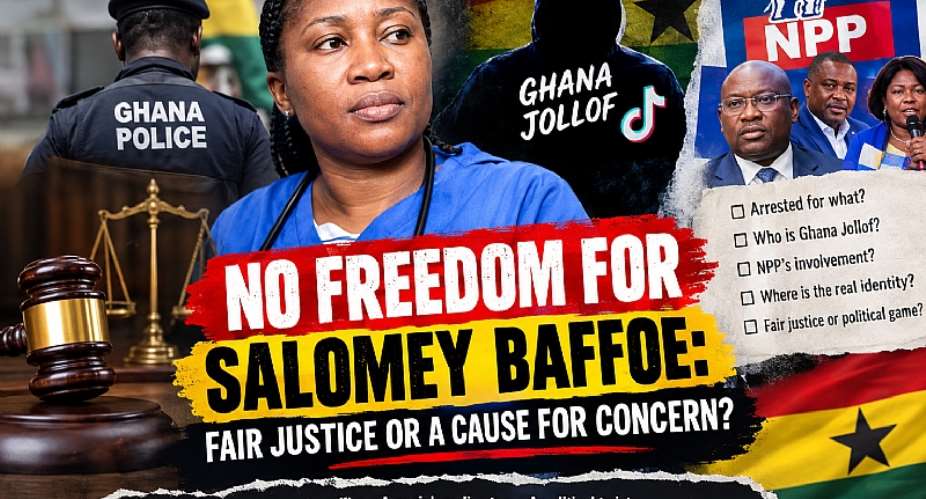
Ghana is once again confronting an uncomfortable question: when the state believes that social-media content threatens public order or national security, where should the line be drawn between legitimate criminal investigation and the protection of constitutional liberty?
The arrest and continued detention of 40-year-old senior nursing officer Salomey Awity Baffoe has transformed what initially appeared to be a social-media investigation into a much larger national debate involving the Ghana Police Service, the National Signals Bureau, the NPP, questions about freedom of expression, alleged political financing, digital evidence and the identity of the controversial TikTok personality known as “Ghana Jollof.”
But there is an important distinction that must be maintained from the beginning: the allegations against Salomey have not been proved in court. She has pleaded not guilty.
And that distinction matters.
WHO IS SALOMEY BAFFOE?
Salomey Awity Baffoe is a 40-year-old senior nursing officer based in Techiman in the Bono East Region and a mother of three.
According to reports, she was arrested at her residence in Hansua, near Techiman, on the night of September 13, 2026, by persons who reportedly identified themselves as National Security operatives. Her family subsequently struggled to establish where she had been taken. Her lawyer later publicly questioned the circumstances surrounding the detention.
The arrest therefore immediately created two separate questions:
What crime was Salomey suspected of committing?
And even more importantly:
Was the procedure used to arrest and detain her consistent with Ghana's constitutional safeguards?
Those are not the same question.
THE WOMAN BEHIND “GHANA JOLLOF”
For months, the identity of the person operating the “Ghana Jollof” TikTok account was not publicly established.
The account became prominent for political commentary and attacks on President John Dramani Mahama, First Lady Lordina Mahama and other government officials.
The Ghana Police Service now says its intelligence identified the operator as 40-year-old Barbara Asantewaa Kodua, who is believed to be living in the United Kingdom. Police subsequently declared her wanted in connection with investigations into alleged false news, incitement to violence and offensive conduct.
Police say she was last seen at the Accra International Airport and is believed to be in the UK.
But there is already an important complication.
Salomey's lawyer has publicly pointed out that an earlier police charge sheet from 2025 reportedly identified another person, Alberta Okrah, as “Ghana Jollof.” The current case identifies Barbara Asantewaa Kodua instead.
That raises a legitimate investigative question:
How did investigators move from one alleged identity behind “Ghana Jollof” to another, and what evidence establishes conclusively that Barbara Asantewaa Kodua is the person operating the account?
The police say their intelligence and forensic evidence establish the identity. But ultimately, the strength of that evidence will have to be tested through the legal process.
SO WHAT EXACTLY IS SALOMEY ACCUSED OF DOING?
This is perhaps the most important part of the case.
Salomey is not charged with being “Ghana Jollof.”
She has been charged with abetment of crime, to wit, publication of false news, under Sections 20(1) and 208 of Ghana's Criminal Offences Act, 1960 (Act 29). She pleaded not guilty.
Section 20 deals with abetment. In broad terms, it criminalises deliberately assisting, facilitating, encouraging or promoting another person's criminal offence.
Section 208 concerns publishing or reproducing a statement, rumour or report that is likely to cause public fear or alarm or disturb public peace, while knowing or having reason to believe that it is false.
The prosecution's case is that Salomey allegedly acted as a liaison for Barbara Asantewaa Kodua and helped recruit people to redistribute videos produced by “Ghana Jollof” across social-media platforms. Police further allege that money was transferred between people involved in the operation.
That is substantially different from simply saying:
“Salomey shared a political opinion.”
The prosecution is alleging something more specific:
that she knowingly helped facilitate the distribution of material that constituted a criminal offence.
Whether that can ultimately be proved is another matter.
WHAT DID “GHANA JOLLOF” ACTUALLY SAY?
The police have referred to several publications, but one allegation has emerged repeatedly.
According to the CID, one video under investigation allegedly claimed that there had been a near coup d'état at Jubilee House.
Police say the video contained claims that President Mahama had angered some soldiers and that there had been an attempt to overthrow the government, with an alleged claim that CCTV footage existed but was being concealed.
The police regard such material as potentially capable of causing fear, alarm and violence.
This distinction is crucial.
Criticising a president is not automatically the same thing as publishing false information capable of causing public panic.
The legal question is therefore not simply whether the content was offensive to government.
The questions are:
Was the information actually false?
Did the publisher know it was false?
Was it likely to cause fear or alarm?
Did Salomey knowingly assist its publication?
What exactly did Salomey do?
Did she know the alleged information was false?
Can the prosecution establish the required connection between her actions and the alleged offence?
Those questions should ultimately be answered by evidence, not political loyalty.
THE FIRST COURT APPEARANCE
When Salomey appeared before the Adentan Circuit Court, she pleaded not guilty to the charge.
The prosecution requested that she remain in custody while investigations continued, citing the nature of the allegations and national-security concerns.
The court denied her bail and remanded her for two weeks, with a further appearance scheduled for September 30.
But controversy immediately followed.
Her lawyers argued that she had already been detained for several days before being brought before court.
One of her lawyers, Enoch Afoakwa, argued that this potentially violated the constitutional requirement that an arrested person be brought before a court within 48 hours.
That argument cannot simply be dismissed as political rhetoric.
Article 14(3) of Ghana's Constitution provides that a person arrested or detained on reasonable suspicion of committing an offence and not released must be brought before a court within 48 hours.
The Supreme Court has also previously emphasised that “within 48 hours” means exactly that and that the courts must be available to deal with questions concerning personal liberty.
Therefore, one of the most important unresolved questions is:
If Salomey was arrested on September 13 and arraigned several days later, what precisely happened during those intervening hours, who had custody of her, and under whose authority?
That question deserves an official, documented answer.
WHY WAS HER SECOND BAIL APPLICATION REFUSED?
This is where the case became even more complicated.
Salomey's lawyers subsequently applied to the High Court for bail.
The prosecution requested additional time to respond, resulting in an adjournment from September 23 to September 24.
On September 24, the High Court refused the bail application.
The court's reasoning is important.
It reportedly held that although the offence was a misdemeanour and generally bailable, bail was not automatic. The court accepted the prosecution's argument that releasing Salomey at that stage created risks relating to the ongoing cyber investigation, including possible interference with witnesses and electronic evidence. The court directed the Republic to expedite its investigations.
So the court did not determine that Salomey was guilty.
It determined that, at that stage of the proceedings, the circumstances justified continued custody while investigations continued.
That distinction is fundamental.
Remand is not conviction.
THE MONEY TRAIL: WHO WAS FUNDING “GHANA JOLLOF”?
Perhaps the most explosive part of the investigation is no longer the TikTok videos themselves.
It is the alleged money trail.
CID Director-General COP Lydia Yaako Donkor told journalists that forensic examination of mobile phones, audio and video files and mobile-money transactions had allegedly revealed significant financial transfers involving Salomey and other people.
Police say influential and high-profile individuals had transferred money to Salomey and that portions of the money were subsequently shared with people connected to the distribution of the content.
Police have also alleged that Barbara Asantewaa Kodua, while in the UK, transferred money to Salomey to support the activities.
But here is a critical distinction that public discussion must respect:
The police have said they know the identities of alleged high-profile sponsors.
They have not publicly established in court that those people committed a crime.
Therefore, it would be irresponsible to publish names merely because the police say they have identified potential financiers.
The proper question is:
If investigators have identified people who allegedly financed criminal activity, what evidence links the money to a criminal purpose, and will those persons be investigated or charged where the evidence warrants it?
An even harder question follows:
If ordinary citizens are arrested for allegedly assisting the circulation of content, why should anyone alleged to have financed the same operation be treated differently?
Oliver Barker-Vormawor has publicly asked a similar question: if the police have identified other people allegedly involved, why have those people not also been arrested?
That question goes directly to the principle of equal application of the law.
AND THEN THERE IS THE NPP
This is where the case moves from criminal investigation into political controversy.
The New Patriotic Party has publicly questioned Salomey's detention, while several prominent NPP figures have also intervened.
Former Vice-President and NPP flagbearer Dr Mahamudu Bawumia called for Salomey's release.
NPP figures including Akosua Manu and Dennis Miracles Aboagye also questioned the circumstances of the arrest and remand.
Salomey's lawyer, Nana Agyei Baffour Awuah, is also an NPP MP and member of the party's legal team.
The NPP's intervention therefore has a clear political dimension.
But does that mean the NPP is saying Ghanaian laws should not apply?
No such blanket position has been established by the party's statements reviewed for this article.
The party's publicly reported argument has principally concerned the circumstances of Salomey's arrest, detention, remand and due process, rather than a declaration that people should be immune from prosecution for spreading false information.
That distinction is important.
A political party can simultaneously accept that false information can be criminally investigated and question whether a particular arrest or detention was lawful and proportionate.
The real test should therefore be:
Would the NPP make the same argument if the accused were openly affiliated with the NDC?
And conversely:
Would the NDC defend exactly the same constitutional principle if one of its supporters were accused of disseminating false information against an NPP government?
Those are uncomfortable questions—but democracy requires them.
ARE NPP MEMBERS CONNECTED TO “GHANA JOLLOF”?
This requires particular caution.
The fact that NPP politicians have defended Salomey does not establish that they funded “Ghana Jollof,” knew about the alleged content, or participated in its publication.
Likewise, the fact that “Ghana Jollof” criticised the Mahama administration does not automatically establish that the account was officially sponsored by the NPP.
No such conclusion has been established by the evidence publicly disclosed so far.
Indeed, the police have said they identified several influential individuals allegedly connected financially to the activities, but they have not publicly identified them in the material reviewed for this article.
Therefore, political affiliation and criminal involvement must not be conflated.
THE BIGGER POLITICAL QUESTION
The NPP's intervention nonetheless creates an important democratic test.
If the party's position is that Salomey's constitutional rights must be respected, then that principle should apply regardless of who occupies Jubilee House.
The NPP cannot reasonably demand due process only when an alleged victim is sympathetic to its political interests.
And the governing side cannot reasonably invoke national security only when the person under investigation criticises it.
The same constitutional standard must apply to everyone.
That is where the real political test lies.
A STRANGE IRONY IN GHANA'S HISTORY OF FREE SPEECH
Ghana has a complicated history with laws regulating speech.
In 2001, Ghana repealed its criminal libel and sedition laws, a major development in the country's press-freedom history.
Yet Section 208 of the Criminal Offences Act remains on the statute books.
The provision is narrower than traditional criminal libel: it concerns false statements, rumours or reports likely to cause public fear or alarm or disturb public peace, where the publisher knows or has reason to believe the information is false.
That creates an important distinction.
Ghana's legal system does not establish a general criminal offence of merely criticising the government.
The critical issue is whether the prosecution can prove the specific legal elements of the offence.
And this is why the Ghana Jollof case matters beyond Salomey herself.
IS THE GOVERNMENT CRIMINALISING CRITICISM OR INVESTIGATING A GENUINE FALSE-NEWS OFFENCE?
That question cannot responsibly be answered by slogans.
If “Ghana Jollof” merely insulted politicians, the state would face a very different constitutional and legal question.
But if investigators can prove that someone deliberately fabricated a false claim about a coup, knowing it was false, and deliberately distributed it to create fear or public disorder, the legal analysis changes significantly.
Likewise, if Salomey knowingly facilitated that conduct, the prosecution must prove it.
Therefore, the central issue is not:
“Did Ghana Jollof criticise Mahama?”
The central issue is:
“Can the State prove the specific criminal allegations against each accused person?”
That is what the courts should ultimately determine.
BUT THE POLICE ALSO HAVE QUESTIONS TO ANSWER
The Police Service says it has strong digital evidence.
It says investigators examined:
mobile phones;
audio files;
video files;
communications;
mobile-money transactions;
relationships between the suspects; and
information allegedly identifying financial supporters.
If that evidence is as strong as described, why should the public have to rely principally on press conferences?
Why not allow the evidence to be presented in court and tested there?
There is another question.
Why was Salomey allegedly taken from her home at night under circumstances that initially left her family uncertain about which state agency had detained her?
Her lawyers and civil-society organisations have raised concerns about the circumstances of the arrest. NETRIGHT, for example, said the reported midnight detention raised due-process and human-rights concerns.
These concerns do not establish that the police acted unlawfully.
But they deserve answers.
THE 48-HOUR QUESTION CANNOT DISAPPEAR
If the reported chronology is accurate, this may become one of the most consequential legal questions in the entire case.
The Constitution says a person arrested upon reasonable suspicion of an offence who is not released must be brought before a court within 48 hours.
The Supreme Court has previously made clear that the 48-hour period is not simply a convenient administrative target.
Therefore:
Who arrested Salomey?
At what exact time?
Where was she taken?
Who authorised the detention?
Was she informed of the reason for her arrest?
When did she first obtain access to a lawyer?
Why was she not brought before a court earlier if she was detained for several days?
These are not partisan questions.
They are constitutional questions.
WHAT ABOUT THE NPP'S LOUD INTERVENTION?
There is another side to this debate.
Could political intervention actually hurt Salomey's case?
Potentially.
Not legally because the court must decide the case on evidence but politically and publicly, partisan commentary can make a criminal case look like a political contest.
When politicians begin making statements before all evidence is publicly tested, the danger is that the public begins judging the case through party colours rather than facts.
The NPP says Salomey's treatment raises serious concerns.
The government and police say the investigation concerns potentially dangerous false information and a wider network.
Both positions can be reported.
But neither political side should substitute political rhetoric for evidence.
AND WHAT ABOUT THE CLAIM THAT NPP PEOPLE ARE DEFENDING “FAKE NEWS”?
This is another question that requires precision.
There is no evidence in the sources reviewed establishing that the NPP as a party has declared that false news should be legal.
What the NPP has publicly questioned is the basis and manner of Salomey's detention.
That is not the same as saying:
“People should be allowed to publish anything.”
The more appropriate democratic question is:
Does Ghana want laws against deliberate false information to be enforced consistently, or selectively depending on whether the accused supports the government or opposition?
That question cuts both ways.
THE “GHANA JOLLOF” IDENTITY MYSTERY IS NOT ENTIRELY OVER
The police now identify Barbara Asantewaa Kodua as the operator.
She is believed to be in the UK and has been declared wanted.
But there is currently no reliable public evidence establishing that she has been arrested in the UK.
In fact, she has publicly spoken about the case and challenged the Ghanaian government to extradite her. She has described Salomey's prosecution as political persecution.
As for international cooperation, the public record reviewed so far shows the Ghanaian authorities believe she is in the UK and have declared her wanted. I have not found reliable evidence of a publicly announced Interpol Red Notice or a confirmed UK arrest operation against her.
That distinction matters.
A Ghanaian wanted notice is not the same thing as an international arrest warrant.
THE HIGH-PROFILE SPONSORS: THE QUESTION EVERYONE IS WAITING FOR
The police have made a remarkable claim:
They say they know the high-profile people allegedly financing the operation.
If that is correct, Ghana now awaits the next chapter.
Who are they?
What amounts were transferred?
When were the transfers made?
What were the payments for?
Were they politicians?
Businesspeople?
Activists?
Ordinary supporters?
Were the payments actually for criminal activity or legitimate personal, political or media-related transactions?
And most importantly:
What evidence proves the purpose of the money?
Money changing hands is not automatically evidence of a crime.
The prosecution must establish the connection between the money and the alleged offence.
THE MOST IMPORTANT QUESTIONS GHANA SHOULD BE ASKING
1. Why was Salomey detained for several days before her first court appearance?
If the reported timeline is correct, the State must explain the legal basis.
2. Why was she arrested before the alleged operator of the account?
If investigators already knew who “Ghana Jollof” was, why was the Ghana-based alleged intermediary arrested first?
3. What exactly did Salomey personally publish?
Was she the author of the alleged false statements or is the prosecution relying on distribution and facilitation?
4. Did Salomey know the alleged information was false?
This is crucial under Section 208.
5. What precisely did the prosecution allege she did to constitute abetment?
“Being friends” is not the same as criminal abetment.
6. Who are the alleged high-profile financiers?
If the police say they know them, will the evidence eventually be tested in court?
7. If the alleged financiers are identified, will the law apply equally to them?
This may be the biggest test of public confidence.
8. Why did the police previously identify another person as “Ghana Jollof”?
Was the earlier identification wrong, or are there multiple people associated with the same identity?
9. What international legal steps have actually been taken to locate Barbara Kodua?
A wanted poster is one thing. International legal cooperation is another.
10. Why did the High Court refuse bail?
The answer is now clear: concerns about interference with witnesses and electronic evidence during the ongoing cyber-related investigation.
But the public should also ask:
How long can “ongoing investigations” continue before the constitutional right to liberty becomes practically meaningless?
AND HERE IS THE HARDEST QUESTION OF ALL
Suppose Salomey is eventually acquitted.
Who will compensate her for the weeks or months of lost freedom?
Who repairs the damage to her reputation?
Who explains to her children why their mother disappeared from their home at night?
And if she is eventually convicted, another question arises:
Will those who publicly defended her apologise or will they simply say they were exercising their democratic right to question state power?
Now reverse it.
If “Ghana Jollof” is eventually proven to have deliberately fabricated dangerous information and financed its distribution, will those who dismissed the investigation as political persecution acknowledge that the authorities had a legitimate case?
That is what evidence-based accountability looks like.
THE NPP MUST ALSO ANSWER ITS OWN QUESTIONS
The NPP is right to demand due process if its concern is constitutional protection.
But the party must also be consistent.
If a similar case occurred under an NPP administration and the accused were an NDC activist, would the party demand exactly the same procedural safeguards?
And if an NDC government believes that deliberately fabricated claims about a coup can endanger national security, would the NPP accept the same legal principle if the political circumstances were reversed?
The answer should not depend on which party occupies power.
Constitutional rights are not NPP rights or NDC rights.
They are Ghanaian rights.
THE POLICE MUST ALSO ACCEPT SCRUTINY
The police cannot demand public confidence merely because they say they have forensic evidence.
If the evidence exists, the judicial process should test it.
If the financial trail exists, it should be properly documented.
If the electronic evidence exists, its authenticity and integrity should be established.
If Salomey knowingly recruited people to circulate material she knew was false, the prosecution must prove it.
If she did not, the court must be free to say so.
That is precisely why courts exist.
SO, IS THERE “NO FREEDOM FOR SALOMEY BAFFOE”?
For now, Salomey remains in custody after the High Court refused bail on September 24, 2026, citing risks associated with ongoing investigations. She is still presumed innocent and has pleaded not guilty.
The next major date is September 30 before the Adentan Circuit Court.
But the case is already bigger than Salomey.
It has become a test of whether Ghana can simultaneously do three things:
fight deliberately dangerous misinformation,
protect legitimate freedom of expression,
and
respect the constitutional rights of suspects.
Ghana does not have to choose one and abandon the others.
It must do all three.
THE FINAL QUESTION GHANA MUST CONFRONT
Perhaps the most uncomfortable question is not whether Salomey should be free or remain in custody.
The question is this:
If the State has enough evidence to identify the alleged “Ghana Jollof” operator, trace money allegedly sent to the operation, identify people who allegedly financed it, examine phones and communications, and establish an alleged distribution network why is Ghana still learning the case primarily through police press conferences rather than through evidence tested openly in court?
And on the other side:
If the investigation is genuinely about protecting national security and public peace, why should political affiliation determine whether citizens believe the law is legitimate?
The Ghana Jollof case therefore presents Ghana with a rare opportunity.
Not to choose between NPP and NDC.
Not to choose between Salomey and the Police.
But to answer a much more fundamental question:
Can Ghana enforce its laws against misinformation without allowing the fight against misinformation itself to become a threat to constitutional liberty?
That is the question the courts must ultimately answer through evidence.
And it is the question every Ghanaian government supporter, opposition supporter, journalist, activist and ordinary citizen should be watching.
Because today it may be “Ghana Jollof.” Tomorrow, it could be someone else.
By:
Patrick Belebang Yagsori
+233240292413
[email protected]

 Caucus Warns: ‘If We Lose Our Teachers, We Lose Our Nation’ as Education Crisis ...
 Boeing Projects 18‑Month Timeline for Ghana’s National Airline Revival Under New...
 Legal Expert Questions EOCO’s Conduct, Says MP Had Right to Resist Unlawful Arre...
 Gunmen kill 27 in two shootings in South Africa
 'We shall hold govt feet to the fire of accountability' — Anyidoho on €225m coca...
 ‘Russian sleeper cell’: Can Germany’s far-right AfD be barred from sensitive int...
 Pope Leo XIV visits Lourdes after giant Paris mass to meet clergy abuse victims
 EU unlocks 710 mn euros' aid for crisis-hit communities
 Power cuts, rubble: millions come home to find Sudan's capital unlivable
 At least 16 people killed as Russia and Ukraine trade deadly air strikes


