




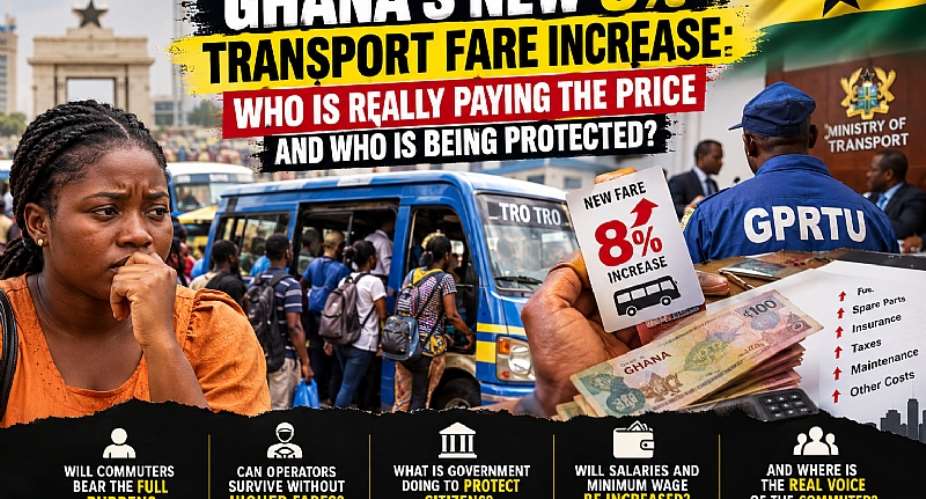
From Saturday, September 26, 2026, commuters across Ghana will face another increase in approved public transport fares. The Ghana Private Road Transport Union (GPRTU) and the Ghana Road Transport Coordinating Council (GRTCC) have announced an 8% upward adjustment, covering shared taxis, intra-city trotros, inter-city services and haulage. The increase follows consultations with the Ministry of Transport between September 8 and 22.
At first glance, 8% may sound modest.
But for the Ghanaian worker who pays transport twice every day, the student travelling to school, the trader moving goods to market, the nurse, teacher, security officer, civil servant, private-sector worker and unemployed graduate depending on public transport, the question is not simply “How much is 8%?”
The bigger question is:
How many times can the ordinary Ghanaian absorb increases before the mathematics of survival simply stops adding up?
And that is where the real national conversation must begin.
THE DECISION THAT CAME AFTER A MUCH BIGGER DEMAND
The new 8% adjustment did not emerge from nowhere.
In early September, the GPRTU proposed a 30% increase, citing rising fuel prices, spare parts, lubricants, insurance, taxes, DVLA charges and other operating costs. The proposal was subsequently subjected to negotiations with government.
On September 8, formal consultations began between the transport unions and the Ministry of Transport.
Government responded by pointing to the broader economic situation and its GH¢2-per-litre intervention on diesel, intended to cushion transport operators and commuters. A joint team involving the Ministry, GPRTU and GRTCC was subsequently established to examine the cost inputs used in determining fares.
The negotiations were not initially straightforward.
As late as September 21, GPRTU maintained that no final agreement had been reached on the proposed 30% increase. By September 22, reports indicated that the union had been pushing for at least 25%, while government had reportedly been discussing a lower range of 10–15%.
Then came the final outcome:
8%.
The operators themselves acknowledge that government intervention on diesel helped to moderate the final adjustment.
That raises an important question:
If government intervention could bring the proposed 30% down to 8%, what exactly would have happened to commuters if there had been no intervention?
And perhaps an even bigger question:
What happens when that intervention ends?
THE HISTORY GHANAIANS SHOULD NOT FORGET
Transport fare increases are not new to Ghana.
In February 2022, commercial transport operators proposed a substantial increase, initially seeking as much as 30%. Following negotiations with government, the increase was reduced to 15% and took effect on February 26.
Barely two months later, another 20% increase was implemented in May 2022 amid sharp increases in fuel prices and other operating costs. At the time, the Consumer Protection Agency described the increase as excessive, while GPRTU argued that operators themselves were under severe financial pressure.
By October 2022, another 19% increase was announced after discussions involving transport operators and the President.
But the story did not move only in one direction.
In December 2022, fares were reduced by 15.3% following negotiations between the Ministry of Transport, GPRTU and GRTCC, after fuel prices declined and commuters demanded relief.
Then came May 2025.
Public transport fares were reduced by 15%, with the Ministry of Transport citing declining fuel prices, a stronger cedi and other economic factors.
In August 2025, a proposed 20% increase was suspended after government and transport stakeholders agreed that broader consultations were necessary. The existing 15% reduction was maintained.
Now, in September 2026, commuters are being asked to accept another 8% increase.
This history presents an uncomfortable reality:
Ghana's transport-fare system is essentially a continuous negotiation between operating costs, commuters' purchasing power and government intervention.
But is the system solving the problem or merely moving it from one negotiation to another?
THE MATHEMATICS MAY BE 8%, BUT THE ECONOMIC EFFECT COULD BE MUCH BIGGER
The approved schedule shows, for example, a shared-taxi journey of up to 20 kilometres rising from GH¢8.50 to GH¢9.20. A GH¢15 trotro fare becomes GH¢16.20, while GH¢20 becomes GH¢21.60. Some inter-city fares also rise substantially in absolute terms—for example, GH¢100 becomes GH¢108 and GH¢300 becomes GH¢324.
But transport is not an isolated household expense.
It is connected to almost everything.
A trader pays to travel to the market.
A farmer pays to transport produce.
A wholesaler pays to move goods.
A food vendor pays for transportation.
A student pays to get to school.
A worker pays to get to work.
A customer eventually pays for all those transportation costs through the price of goods and services.
That is why some residents in Kumasi have already linked transport costs to food prices, with traders saying higher transportation costs are being passed on to consumers.
So the real calculation for a household is not simply:
“My fare has increased by 8%.”
It is:
“How much more will I spend getting to work, buying food, transporting goods, sending my children to school and accessing essential services?”
BUT THERE IS ANOTHER SIDE OF THE STORY: CAN DRIVERS SURVIVE WITHOUT INCREASING FARES?
This is where the public conversation must also be honest.
A commercial vehicle does not run on fuel alone.
Operators have to deal with:
fuel;
engine oil and lubricants;
tyres;
spare parts;
insurance;
DVLA-related charges;
vehicle maintenance;
repairs;
taxes and other operational costs.
GPRTU has repeatedly argued that these expenses have increased and that maintaining fares indefinitely could make commercial transport financially unsustainable.
That argument cannot simply be dismissed.
A driver who cannot cover operating costs eventually has three choices:
increase fares, reduce service, or stop operating.
And when vehicles become unavailable, commuters suffer through longer waiting times, overcrowding and unreliable transportation.
Indeed, transport-sector representatives have recently pointed to the cost of spare parts as one factor affecting vehicle availability.
So the debate cannot honestly be reduced to:
“Drivers are exploiting passengers.”
Nor should it automatically become:
“Passengers must simply pay whatever operators demand.”
There has to be a third position:
A transparent system where the actual cost of operating a vehicle is independently established and the burden is fairly shared.
BUT WHERE IS THE COMMUTER IN THE NEGOTIATION?
This may be the most uncomfortable question.
Government negotiates with transport operators.
Transport unions represent drivers and vehicle owners.
But who sits at the table with equal bargaining power for the passenger?
Yes, government says it considers the plight of commuters.
The communiqué itself says the interests of drivers, commuters and the travelling public were considered.
But consideration is not the same thing as representation.
The question Ghanaian consumers should ask is:
Where is the independent commuter representative during these negotiations?
Should passengers merely be informed of the final decision?
Or should they have a formal voice in the process?
THE MINIMUM WAGE QUESTION: WHAT HAPPENS TO THE WORKER'S PAY?
This is another question that cannot be avoided.
Ghana's 2026 National Daily Minimum Wage is GH¢21.77, representing a 9% increase over the 2025 rate. It took effect on January 1, 2026.
Government and organised labour also agreed to a 9% salary increase for public-sector workers under the Single Spine Salary Structure for 2026.
But here is the critical distinction:
The 8% transport fare increase does not automatically trigger another salary increase.
The existing 2026 wage arrangements are separate from the transport-fare review.
And this creates a legitimate concern for workers:
If transport rises today, food rises tomorrow and other household expenses continue increasing, how much of the worker's income remains after basic survival costs are deducted?
A worker earning a fixed salary does not receive an automatic salary adjustment every time a fare is reviewed.
That is the uncomfortable economic imbalance.
Prices can change quickly. Salaries often do not.
WHAT ARE GHANAIANS SAYING?
The public reaction has not been uniform.
Some commuters understand that drivers are facing genuine increases in operating costs.
Others are angry because they believe every increase eventually ends up on the passenger while reductions sometimes take longer to reach the public.
That concern is not new.
When fares were reduced in May 2025, commuters called for a more transparent and responsive fare-adjustment mechanism, arguing that increases often seemed to appear faster than reductions when fuel prices fell.
And even within the transport sector, reactions to the new 8% adjustment are not completely uniform.
At some terminals, transport representatives questioned whether 8% was enough to address the cost pressures facing operators, while some commuters expressed dissatisfaction over having to pay more.
That tells us something important:
The 8% increase has not necessarily satisfied everyone even those on the transport side.
SO WHO REALLY WON THE NEGOTIATIONS?
Perhaps this is the wrong question.
Because if the driver says the increase is insufficient, the passenger says it is too expensive, and government has to intervene to moderate the cost, then declaring a "winner" misses the bigger problem.
The real question is:
Why does Ghana's transport system repeatedly reach a point where everybody feels squeezed?
If operators cannot make enough money at existing fares, the industry has a structural problem.
If passengers cannot afford the new fares, households have a structural problem.
If government must subsidise fuel to prevent fares from rising sharply, public finances have a structural problem.
If food prices rise because transportation becomes more expensive, the wider economy has a structural problem.
This is therefore much bigger than an 8% fare increase.
THE QUESTIONS GPRTU AND GOVERNMENT MUST ANSWER
Ghanaians deserve answers to difficult questions not just new fare schedules.
1. What exact cost model produced the 8% figure?
Can the public see the calculations?
How much did fuel contribute?
How much did spare parts contribute?
How much did insurance, taxes and maintenance contribute?
And why precisely did those figures produce 8% rather than 10%, 15%, 20% or 25%?
2. Why should commuters carry the entire burden of higher operating costs?
Should government reduce some taxes or levies affecting transport operations?
Should manufacturers and spare-parts suppliers be investigated where prices appear disconnected from broader economic trends?
3. What happens when fuel prices fall?
Will fares automatically fall?
Or will another negotiation be required?
4. Where is the independent commuter voice?
Should a recognised consumer organisation have a formal seat at future fare negotiations?
5. What safeguards exist against overcharging?
The unions have instructed operators to display approved fares and warned that charging above the approved rates will attract sanctions.
But who will monitor thousands of vehicles across Ghana?
And what happens to a passenger who is overcharged?
6. Why are some passengers still paying unofficial fares?
If approved fares exist but passengers sometimes pay more, is the enforcement system actually working?
7. What is government doing beyond temporary fuel interventions?
A diesel intervention can provide immediate relief.
But what is the long-term strategy?
AND GHANAIANS THEMSELVES MUST ASK HARD QUESTIONS
It is easy to blame government.
It is easy to blame GPRTU.
It is easy to blame drivers.
But commuters also have responsibilities.
When a driver charges above the approved fare, do passengers demand receipts or report the incident?
When an operator refuses to display the fare schedule, do commuters challenge it?
When a driver says, “That is the new fare,” does the passenger ask to see the approved schedule?
And perhaps most importantly:
Why do millions of passengers tolerate an informal transport culture in which the rules are sometimes known but rarely enforced consistently?
A transport system cannot become accountable if the public simply accepts whatever happens at the roadside.
THE GOVERNMENT'S BIGGER TEST
Government's responsibility now goes beyond announcing that negotiations have been successful.
It must demonstrate that the intervention actually protects citizens.
That could mean stronger enforcement of approved fares, transparent publication of fare calculations, continued monitoring of fuel prices, support for public transport capacity, action on excessive operating costs and stronger consumer representation.
Government could also explore longer-term measures to reduce the vulnerability of public transport to every movement in fuel prices.
Because if every increase in fuel, insurance, spare parts or taxation eventually becomes another passenger fare increase, then Ghana will remain trapped in the same cycle.
8% TODAY WHAT ABOUT TOMORROW?
There is an important detail in the communiqué that should not be overlooked.
The new 8% is calculated on the approved fares that took effect on May 24, 2025, when fares had been reduced by 15%.
Mathematically, an 8% increase on the reduced 2025 fare does not simply return fares to their pre-May-2025 level.
For example, if an old fare was 100, a 15% reduction would take it to 85. An 8% increase on 85 gives 91.80 not 100.
That distinction matters.
It means the headline “8% increase” does not tell the whole story.
The more important question is:
What has happened to the commuter's total transportation expenditure over the entire period?
And that is the figure economists, policymakers and consumer advocates should be tracking.
THE FINAL QUESTION: CAN GHANA BUILD A TRANSPORT SYSTEM THAT DOES NOT ALWAYS PUT DRIVER AGAINST PASSENGER?
The answer cannot simply be another fare increase every time costs rise.
Neither can it be artificially low fares that make it impossible for operators to maintain their vehicles.
Ghana needs a transport-fare system based on transparent data, predictable reviews, independent verification, effective enforcement and genuine representation for passengers.
The 8% adjustment may have ended the immediate negotiations.
But it has not ended the bigger debate.
Because somewhere tomorrow morning, a worker will stand at a roadside waiting for a trotro.
A student will count coins before entering a vehicle.
A trader will calculate whether transporting goods to market is still profitable.
A parent will wonder whether the new fare means taking something else away from the household budget.
And a driver will look at fuel, spare parts, insurance and maintenance and wonder whether the fare is enough to keep the vehicle on the road.
That is Ghana's real transport dilemma.
The issue is no longer simply whether 8% is too much or too little.
The question Ghana must confront is:
How long can a country continue adjusting transport fares without fundamentally addressing the economic pressures that make both the driver and the passenger feel like victims of the same system?
And perhaps the hardest question of all:
When will Ghana stop treating transport-fare increases as isolated events and start treating affordable, reliable public transportation as a national economic policy?
Because when transport becomes unaffordable, it is not only the passenger who pays. The entire economy eventually pays with them.
By:
Patrick Belebang Yagsori
+233240292413
[email protected]
 Caucus Warns: ‘If We Lose Our Teachers, We Lose Our Nation’ as Education Crisis ...
 Boeing Projects 18‑Month Timeline for Ghana’s National Airline Revival Under New...
 Legal Expert Questions EOCO’s Conduct, Says MP Had Right to Resist Unlawful Arre...
 Gunmen kill 27 in two shootings in South Africa
 'We shall hold govt feet to the fire of accountability' — Anyidoho on €225m coca...
 ‘Russian sleeper cell’: Can Germany’s far-right AfD be barred from sensitive int...
 Pope Leo XIV visits Lourdes after giant Paris mass to meet clergy abuse victims
 EU unlocks 710 mn euros' aid for crisis-hit communities
 Power cuts, rubble: millions come home to find Sudan's capital unlivable
 At least 16 people killed as Russia and Ukraine trade deadly air strikes


