




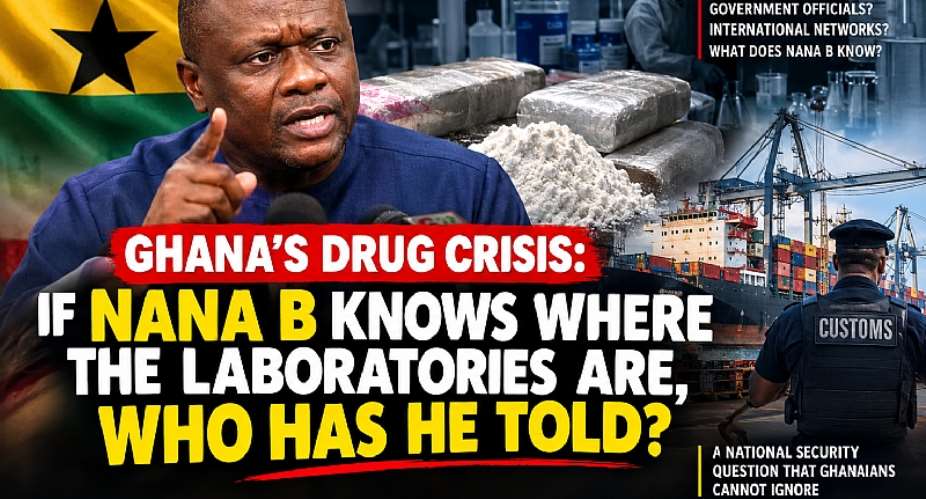
The allegations by NPP National Organiser Henry Nana Boakye have moved Ghana’s narcotics debate from political accusation into the territory of national security. The central question is no longer simply whether Ghana-linked cocaine shipments are real. It is whether anyone possessing credible intelligence about clandestine laboratories and official complicity has a duty to place that information before investigators.
A disturbing question has emerged from Ghana’s latest narcotics controversy:
If the National Organiser of the New Patriotic Party (NPP), Henry Nana Boakye, popularly known as Nana B, says his party has intelligence that drug traffickers have established clandestine laboratories in Ghana, where narcotics are processed for export, what exactly has happened to that intelligence?
On September 22, 2026, Nana B made the allegation at an NPP press conference in Accra.
He claimed that drug traffickers had established laboratories in Ghana and alleged that some government officials were facilitating the movement of narcotics through the country.
He also linked the alleged activity to the growing number of Ghana-linked drug seizures reported in Australia, France, South Africa and elsewhere.
But there is an important distinction that must not be lost in the political noise:
Nana B's allegations are allegations. They are not, by themselves, proof that clandestine cocaine laboratories exist in Ghana or that named government officials are involved.
Reports of the press conference indicate that he did not publicly identify the alleged laboratories, the officials supposedly involved, or provide publicly verifiable evidence supporting those specific claims.
And that is precisely where the national-security questions begin.
IF YOU KNOW, WHY NOT TELL THE INVESTIGATORS?
Suppose, for argument's sake, that Nana B and the NPP genuinely possess credible intelligence.
Suppose they know:
where the laboratories are located;
who operates them;
who finances them;
who supplies the drugs;
which officials allegedly facilitate their movement;
which ports, warehouses or companies are involved;
how the narcotics leave Ghana;
and who ultimately receives them abroad.
That would not merely be political information.
It would potentially be intelligence of enormous national-security importance.
So the question Ghana deserves to ask is simple:
Who received that information?
Was it given to the Narcotics Control Commission (NACOC)?
Was it given to the Police Service?
Was it given to the National Intelligence Bureau?
Was it given to Customs?
Was it submitted to the National Security authorities?
Was it communicated to the Presidency?
Was it given to Parliament?
Or was the first major public disclosure a political press conference?
These questions matter because intelligence is valuable not simply because someone possesses it, but because competent institutions can verify, corroborate and act upon it.
Interestingly, NDC Deputy Director of Elections and IT Rashid Tanko-Computer has publicly called for persons making such allegations to share their information with security agencies.
That invitation raises another question:
If the information exists, will it now be formally handed over?
GHANA CANNOT AFFORD TO TREAT THIS AS JUST NPP VERSUS NDC
The temptation in Ghanaian politics is to reduce almost everything to party colours.
NPP says government has failed.
NDC says the opposition should produce its intelligence.
Government points to investigations.
Opposition points to seizures.
And meanwhile, the people allegedly operating the criminal networks may remain outside the political argument altogether.
But cocaine trafficking does not belong to the NPP.
It does not belong to the NDC.
It belongs to criminal networks.
And if officials are involved, they must be investigated regardless of their political affiliation.
That is why this story must be treated as a national-security issue rather than merely a partisan controversy.
THE €225 MILLION QUESTION
There is already a very serious factual basis for concern about Ghana-linked narcotics trafficking.
On September 10, French customs intercepted nearly 3.9 tonnes of suspected cocaine at the Port of Dunkirk. The shipment was concealed in a container carrying plastic waste that had arrived from Ghana. French authorities estimated the value at about €225 million, approximately US$260 million.
The Ghanaian investigation has already produced arrests.
According to the Ghana News Agency, four people Desmond Koranteng Curiel, Musah Atta, Kweku Okyere and Jessica Hartog were remanded in connection with the alleged exportation of the cocaine. A fifth person, Dutch fugitive Jos Leijdekkers, also known as “Bolle Jos,” remains at large.
The prosecution has described the accused persons' occupations as a businessman/business broker, farmer, businessman and beautician respectively. It has also said investigations are continuing to identify other people allegedly connected to the shipment.
Earlier, NACOC announced the arrest of three suspects following the French seizure and said the suspects were alleged to have represented or facilitated the activities of Leijdekkers in Ghana.
These cases are before the courts.
Therefore, nobody should pronounce the accused persons guilty before the judicial process is completed.
But the arrests demonstrate something equally important:
The drug-trafficking allegations are not occurring in a vacuum. There are real international seizures, real investigations and real accused persons before Ghanaian courts.
AND THEN THERE IS THE AUSTRALIAN METHAMPHETAMINE CASE
The French cocaine case is not the only major Ghana-linked narcotics case.
Australian authorities previously intercepted approximately 320 kilograms of methamphetamine concealed in bags of charcoal shipped from Ghana. The shipment was valued at about AU$296 million, or approximately US$208 million.
NACOC subsequently confirmed the arrest of a Ghanaian described as a lead shipper in that case, while investigations continued.
More significantly, NACOC acknowledged that established export procedures were not followed in that case, raising questions about how such a large shipment could pass through Ghana's export system.
That is not a small administrative question.
It goes directly to:
Who inspected the cargo?
Who cleared it?
What procedures were supposed to be followed?
Which procedures were actually followed?
Who had access to the shipment?
Where did the security chain fail?
And perhaps the most important question:
Was it incompetence, corruption, criminal infiltration or some combination of factors?
Those questions require evidence, not political speculation.
SIX PEOPLE ARE ALREADY BEFORE THE COURTS IN THE FRENCH COCAINE CASE
Reports from the September 17 proceedings said six people were remanded in connection with the alleged shipment of nearly four tonnes of cocaine from Ghana to France.
Those named were Francis Narh Amanor, Frank Adu-Boahen, Togbe Agbeti, Andrews Tetteh Amponsah, Daniel Laryea and Helena Akua Denkyi. Four were reported to be linked to the Ghana Revenue Authority and faced allegations concerning the Customs scanning process.
That development makes Nana B's allegations about official complicity especially important to investigate but not automatically true.
There is a crucial difference between:
“Officials have been accused in a particular criminal case”
and
“Government officials are knowingly facilitating an international drug network.”
The first can be tested in court.
The second requires evidence.
THE SCANNING QUESTION CANNOT BE IGNORED
According to reports on the court proceedings, four 40-foot containers linked to the French seizure had been scanned before leaving Ghana.
The reported charge-sheet account says the scan images were flagged as abnormal, yet the containers were cleared and exported.
If that account is ultimately established through the judicial process, Ghana must ask:
Why were abnormal images not sufficient to stop the containers?
Who reviewed the images?
Who authorised clearance?
Were there technological limitations?
Was there human error?
Were procedures deliberately bypassed?
Was anyone bribed?
Was there collusion?
Or was the system simply overwhelmed?
Those questions should be answered through investigation and evidence.
BUT WHERE ARE THE ALLEGED LABORATORIES?
This is perhaps the most consequential part of Nana B's statement.
A trafficking route and a clandestine drug-processing laboratory are not necessarily the same thing.
Ghana-linked shipments being intercepted abroad establish that narcotics have been connected to Ghanaian export routes.
They do not automatically establish that cocaine is being processed in clandestine laboratories inside Ghana.
That is why Nana B's allegation requires verification.
If the NPP has information about laboratories, investigators should want to know:
Where are they?
What buildings are being used?
Who owns or controls those properties?
What substances are being processed?
What equipment is allegedly being used?
Who supplies the raw materials?
Who works there?
How long have the facilities operated?
How are chemicals and equipment acquired?
Where does the finished product go?
Who finances the operation?
Who protects it?
And most importantly:
Who provided the intelligence to Nana B?
That source may be extremely important.
WHO IS THE INFORMANT?
There is no reason for the public to demand that a sensitive intelligence source be publicly exposed.
Indeed, prematurely exposing intelligence sources could endanger lives and compromise investigations.
But there is a difference between public disclosure and confidentially providing information to competent investigators.
If Nana B's source is a confidential informant, security agencies can receive the information without necessarily exposing the person's identity publicly.
That is how serious investigations can work.
The real issue therefore should not be:
“Tell Ghana who your informant is.”
It should be:
“Give the competent investigators enough information to establish whether your intelligence is genuine.”
WHY HOLD A PRESS CONFERENCE?
This is perhaps the hardest political question facing the NPP.
If the party genuinely possesses intelligence capable of dismantling a major international narcotics network, why announce the information publicly before revealing the operational details to investigators?
There may be legitimate political reasons for holding a press conference.
Opposition parties have a democratic right to scrutinise government performance and demand accountability.
The NPP has also called for a bipartisan parliamentary investigation into 12 narcotics-related cases it says are linked to Ghana between 2025 and September 2026. It has additionally called for the removal of several institutional heads.
But national security operates according to a different logic.
Sometimes the most useful information is information that should not be disclosed publicly before investigators can act.
So the difficult question is:
Was the press conference primarily intended to expose a national-security threat, demand institutional accountability, or politically damage the government?
Only the NPP can answer that question.
And it should.
THE NPP ALSO HAS QUESTIONS TO ANSWER
If the NPP says it possesses intelligence, Ghanaians deserve to know whether that intelligence has been formally submitted to the relevant agencies.
If it has not, why?
If it has, when was it submitted?
To whom?
What information was supplied?
Was evidence attached?
Were locations identified?
Were names supplied?
Were financial transactions identified?
Were companies identified?
Were photographs, documents or communications provided?
If the party has done all of this, then the security agencies have a responsibility to investigate.
If it has not, then another question emerges:
Why reveal the existence of sensitive intelligence publicly without simultaneously ensuring that investigators receive the underlying information?
AND THE NDC MUST ALSO ANSWER HARD QUESTIONS
The NDC cannot simply dismiss the allegations as opposition politics.
If any NDC member, government official, appointee, public servant or politically connected individual is found to be participating in narcotics trafficking, the appropriate response should be investigation and prosecution regardless of political affiliation.
The same standard must apply to the NPP.
If an NPP member is involved, investigate.
If an NDC member is involved, investigate.
If an independent businessman is involved, investigate.
If a public servant is involved, investigate.
If a security officer is involved, investigate.
If a politically connected person is involved, investigate.
The cocaine does not carry a party card.
WHAT ARE THE SECURITY AGENCIES DOING?
There is evidence that Ghanaian authorities are not simply sitting idle.
NACOC says suspects in the French cocaine case had been under surveillance for between one and two years, indicating that at least some investigations were based on prolonged intelligence gathering rather than only reacting to foreign seizures.
NACOC has also said it is working with international law-enforcement partners to trace the people, finances and infrastructure behind trafficking networks.
And on September 22, the Northern Regional Police Command announced an intelligence-led operation in Tamale that resulted in five arrests and the recovery of suspected narcotics, firearms, ammunition and cash.
These developments matter because they show that Ghanaian security agencies are conducting operations.
But they do not answer every question.
The public still needs to know:
How many major narcotics cases are currently under investigation?
How many suspects have been arrested?
How many have been charged?
How many cases have reached trial?
How many have resulted in convictions?
How many remain under investigation?
How many alleged financiers and organisers have been identified?
How many public officials have been investigated?
How many security or port personnel have been disciplined?
How much illicit money has been traced or frozen?
These are legitimate national-accountability questions.
THE POLITICAL-PARTY FINANCING QUESTION
Another question deserves careful investigation but should not be based on insinuation.
If individuals eventually convicted of narcotics offences have donated to political parties, investigators and journalists should establish:
Who donated?
How much?
When?
To whom?
Was the money declared?
Was the donor's source of funds known?
Did the party know the donor's business background?
But there is an important principle:
A person's political association does not prove that a political party participated in that person's alleged crime.
That distinction is essential.
Ghana must resist guilt by association.
The proper standard is evidence.
GHANA'S INTERNATIONAL REPUTATION IS NOW PART OF THE STORY
This controversy has implications beyond domestic politics.
When large narcotics consignments are repeatedly associated with a country's exports, international customs and law-enforcement agencies may reasonably increase scrutiny of shipments and routes associated with that country.
That can affect legitimate exporters, freight companies, shipping operators and travellers.
Nana B himself has raised concerns about the reputational consequences of repeated Ghana-linked seizures.
The danger is that legitimate Ghanaian commerce could become collateral damage in a criminal network's activities.
A cocoa exporter should not have to explain why Ghana appears in international drug-trafficking headlines.
A legitimate freight-forwarding company should not automatically be viewed with suspicion.
A Ghanaian traveller should not be treated as a drug courier merely because of nationality.
This is why the state must aggressively distinguish criminal networks from legitimate Ghanaian citizens and businesses.
THE MOST IMPORTANT QUESTION MAY NOT BE WHO IS LYING
Ghana's political conversation may become obsessed with one question:
Is Nana B telling the truth?
That is important.
But there are bigger questions.
If he is right, why were the alleged laboratories not detected?
If he is wrong, where did the information come from?
If government officials are involved, how deeply does the alleged network penetrate state institutions?
If no officials are involved, what evidence supports the allegation?
If the ports are secure, how did millions of dollars' worth of narcotics allegedly pass through?
If the scanners worked, why did the shipments escape detection?
If the scanners failed, why?
If procedures existed, who bypassed them?
If investigations are ongoing, when will the public receive meaningful updates?
And if people are arrested but the financiers remain unidentified, are investigators catching the network or merely catching its visible edges?
THE GREATER NATIONAL-SECURITY DANGER
The greatest danger may not be cocaine itself.
It may be the possibility of criminal networks acquiring influence over legitimate institutions.
Drug-trafficking organisations require logistics.
They require money.
They require transport.
They require documentation.
They require communication.
They require access to ports and borders.
They require people who can look the other way.
Where corruption becomes embedded in those systems, the problem stops being merely a drug problem.
It becomes a state-security problem.
And that is why Nana B's allegation about government officials, if supported by credible evidence, cannot simply be dismissed as partisan rhetoric.
Equally, because the allegation is extraordinarily serious, it cannot simply be accepted because a senior politician made it.
It must be investigated.
GHANA'S PATRIOTISM TEST
Perhaps the most uncomfortable question is not for Nana B.
It is for all Ghanaians.
When a serious national-security issue emerges, do we first ask:
“Is this NPP or NDC?”
Or do we ask:
“What is the truth?”
When a drug suspect is arrested, do we ask:
“Which party does he belong to?”
Or:
“What evidence connects him to the alleged crime?”
When a politician exposes a government failure, do we automatically believe the allegation because we oppose the government?
And when a government official denies it, do we automatically believe the denial because we support the government?
That is how national issues become political football.
And while the politicians fight, organised criminals can potentially continue their operations.
THE QUESTIONS GHANA MUST NOW DEMAND ANSWERS TO
Questions for Nana B and the NPP
1. What specific intelligence does the NPP possess about the alleged laboratories?
2. When was that intelligence obtained?
3. Who supplied it?
4. Has it been formally handed to NACOC, Police, NIB or National Security?
5. Were specific locations identified?
6. Were specific individuals identified?
7. Were government officials identified?
8. What evidence supports the allegation of official complicity?
9. Why was the information publicly announced before the operational details were disclosed to investigators?
10. Will the NPP now provide all credible intelligence to the competent authorities?
Questions for Government and Security Agencies
1. Have Nana B and the NPP been formally invited to provide the intelligence?
2. Are the alleged laboratories known to investigators?
3. Have any such facilities been discovered?
4. Are government officials under investigation?
5. How many major Ghana-linked narcotics cases are currently active?
6. How many suspects have been arrested?
7. How many have been charged?
8. How many cases have resulted in convictions?
9. What happened to the previous investigations?
10. How did major shipments allegedly pass through Ghana's export-control systems?
Questions for Parliament
1. Should the alleged 12 Ghana-linked narcotics cases be independently examined?
2. Should Parliament receive classified briefings from security agencies?
3. Should the investigation be bipartisan?
4. Should Parliament examine Ghana's port-scanning systems?
5. Should political financing linked to individuals convicted of narcotics offences be examined where legally relevant?
6. Should Ghana's international partners be invited to share intelligence?
THE FINAL TEST: FACTS OR POLITICS?
Ghana is now facing a moment that demands unusual seriousness.
There are documented international seizures involving consignments linked to Ghana.
There are Ghanaian investigations.
There are accused persons before the courts.
There are questions about cargo screening.
There are allegations of institutional failures.
And now there is a senior opposition politician claiming that his party possesses intelligence about clandestine laboratories and official complicity.
Every one of these issues deserves investigation.
But Ghana must be careful not to turn criminal investigations into political trials in the media.
Nana B must be willing to provide whatever credible information he possesses to the appropriate authorities.
The NPP must be willing to subject its allegations to evidence.
The NDC and government must be willing to investigate allegations even when they are politically uncomfortable.
NACOC, Police, NIB, Customs, port authorities and other relevant institutions must be willing to account for what they know and what they do not know.
And the courts must ultimately determine criminal guilt based on evidence.
Because the question before Ghana is much bigger than NPP versus NDC.
It is bigger than Mahama versus Nana B.
It is bigger than the next election.
The real question is whether Ghana can protect its ports, borders, institutions, international reputation and citizens from organised narcotics trafficking without allowing the fight against drugs itself to become another weapon in Ghana's partisan political wars.
If Nana B knows where the alleged laboratories are, Ghana needs the evidence.
If he knows which officials are allegedly involved, investigators need the names.
If the information is false, the evidence should expose that too.
And if the laboratories truly exist, the country must ask the most frightening question of all:
How did they manage to operate inside Ghana without the state knowing?
That is the question that should keep Ghana awake.
Because when a country becomes a route for international narcotics trafficking, the issue is no longer merely about drugs.
It is about the integrity of the state itself.
By:
Patrick Belebang Yagsori
+233240292413
[email protected]

 'Ghana Jollof' case is a foolish case – Martin Kpebu tells Police CID
 'I don’t know Kevin Taylor, I will speak to his father to stop him from insultin...
 CPP appeals to Mahama for return of confiscated party property after overthrow o...
 Drug bust: 'Ghana’s reputation is not one party’s reputation’ – Dr. Adomako Kiss...
 ‘What is happening in the media space is horrifying’ – Kwesi Pratt condemns ‘irr...
 Mahama asks MFWA, GJA to lead national dialogue on hate speech
 Teenage pregnancy: Parents ‘too busy’ to notice warning signs – Protect Our Futu...
 NPP intelligence points to cocaine manufacturing in Ghana – Baffour Awuah
 NPP's Obiri Boahen sues two Tiktokers over alleged defamation
 Ghanaian Pastor Rev Emmanuel Boakye-Danquah on the run over alleged counterfeit ...


