




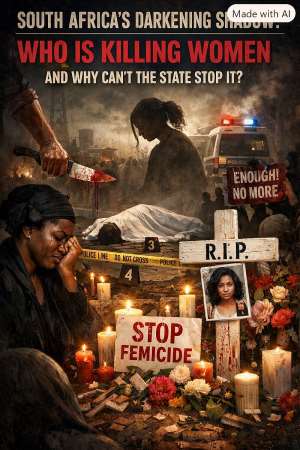
South Africa has reached another frightening moment in its long-running struggle with violence against women.
Between July and September 2026, the discovery of the bodies of eight women in and around Ekurhuleni, east of Johannesburg, has shaken communities and generated fears that something more organised may be happening.
The victims were found in different locations, including Kempton Park, Olifantsfontein, Kwa-Thema and Clayville. Several were reportedly found naked or partially clothed, with indications of physical or sexual violence. Only two of the eight victims had been formally identified in the latest police reporting. One was 38-year-old Elizabeth “Tsontso” Moselakgomo, who disappeared after leaving home for a run and was later found dead.
The police have not confirmed that the killings are connected. Investigators are examining whether they involve one perpetrator, several perpetrators or unrelated crimes. A multidisciplinary investigative team has been assembled to examine the victims' profiles, locations, forensic evidence and possible links.
But for frightened South Africans, one question has become impossible to ignore:
How many women must die before the State knows whether it is confronting a pattern?
THE NUMBER EIGHT AND THE QUESTION THAT CHANGED EVERYTHING
Initially, police were investigating fewer cases. As investigators reviewed the deaths, additional cases were brought into the broader investigation.
The discovery of an eighth body has intensified public concern.
Police say it is still premature to describe the deaths as the work of a serial killer. Acting Police Minister Firoz Cachalia has cautioned against speculation, while investigators continue examining possible connections.
That caution is understandable.
But there is another side to the question.
At what point does caution become unacceptable silence?
If several women disappear or are found dead within the same geographical area, during roughly the same period, under circumstances that investigators themselves describe as sufficiently concerning to justify a specialised investigation, shouldn't the public be given regular, meaningful information about what investigators are discovering?
Not confidential evidence.
Not information that could compromise an investigation.
But enough information to reassure citizens that the State understands what is happening.
HAS ANYONE BEEN ARRESTED?
Yes but the answer requires an important qualification.
Police have confirmed one arrest connected to the first of the cases, involving a woman whose body was discovered in July. The suspect, reportedly her boyfriend, remains in custody. Police have not announced an arrest establishing responsibility for the broader series of deaths.
That distinction matters.
It would be wrong to say that police have arrested nobody.
But it would also be wrong to suggest that authorities have solved the wider mystery.
As of 16 September 2026, investigators were still trying to determine whether the eight cases are connected.
Police have now deployed additional detectives, intelligence personnel, forensic specialists and other resources. A R400,000 reward has also been announced for information that could lead to arrests in connection with the deaths.
The police message is therefore clear:
The investigation is active.
But the public's question is equally clear:
Where are the results?
WHY ARE WOMEN BEING TARGETED?
This is perhaps the most uncomfortable question because nobody should pretend to know the answer before investigators establish the facts.
There is currently no confirmed evidence that the eight women were selected according to one common motive.
However, the circumstances have raised concerns about sexual violence and vulnerability.
Several victims were reportedly found naked or partially clothed, while police have indicated that some cases showed signs of sexual assault.
That raises several possibilities investigators must examine carefully:
Were the victims targeted because they were women?
Were they attacked opportunistically?
Were some specifically followed?
Did the perpetrators know their victims?
Were the victims selected because of where they lived, worked, exercised or travelled?
Were there common vulnerabilities?
Were any victims connected to the same social, employment, transport or criminal networks?
Or are these separate crimes that only appear connected because of their location and timing?
Those questions belong in the investigation not in speculation on social media.
THE HISTORY DID NOT BEGIN IN 2026
South Africa's current crisis did not begin with the first body discovered in Ekurhuleni.
For years, women's organisations, survivors, activists and civil society groups have warned about gender-based violence and femicide.
The 2018 Presidential Summit on GBVF followed years of public pressure and nationwide concern. The government subsequently developed the National Strategic Plan on Gender-Based Violence and Femicide, which came into effect in 2020.
That strategy was built around six pillars:
accountability and leadership; prevention; justice and safety; response and healing; economic empowerment; and research and information management.
In November 2025, the government went further by classifying gender-based violence and femicide as a national disaster, placing primary responsibility for coordinating the national response on the National Executive.
And in July 2026, President Cyril Ramaphosa appointed members of the statutory National Council on Gender-Based Violence and Femicide, created to provide strategic leadership and coordinate the national response.
Yet women are still dying.
And that creates the uncomfortable gap between policy and reality.
GOVERNMENT HAS NOT DONE NOTHING BUT IS IT DOING ENOUGH?
It would be inaccurate to claim that the South African government has done nothing.
It has established strategies, legislation, institutional structures and a national council. The government has also classified GBVF as a national disaster.
The National Council's inaugural meeting in August 2026 identified accountability, coordination, resources and determining the true cost of combating GBVF among its priorities.
The government has also responded directly to the Ekurhuleni killings.
President Ramaphosa said he had been briefed by the police minister and Acting National Police Commissioner and directed that the investigations be prioritised.
The police have increased deployments and specialised investigative resources.
The City of Ekurhuleni has also announced increased metro-police visibility in affected areas. The Commission for Gender Equality has called for urgent safety audits covering lighting, surveillance, transport routes, neglected spaces, police visibility and emergency assistance.
So the question is not simply:
“What is government doing?”
The more difficult question is:
“Are these interventions producing measurable protection for women?”
WHAT ARE SOUTH AFRICANS SAYING?
The reaction has gone far beyond ordinary public concern.
Running clubs have organised memorial runs in honour of Moselakgomo and the other women.
Women have spoken about changing routes, running in groups, sharing their locations and avoiding isolated places.
But activists have challenged the familiar advice that women should simply be more careful.
Their argument is powerful:
Why must women redesign their lives to accommodate criminals?
If a woman cannot safely run, walk, travel or return home without calculating whether an isolated road could become her last journey, then the problem is not merely that women need better safety habits.
It is also a question of public safety.
Activists have demanded more than statements, campaigns and warnings.
And that criticism deserves serious consideration.
THE QUESTION NOBODY SHOULD BE AFRAID TO ASK
If police eventually discover that these killings are connected, investigators will inevitably have to examine whether the pattern could have been detected earlier.
But even if they turn out to be unrelated, another question remains:
Were there warning signs that the system failed to connect?
Consider the information that investigators potentially possess:
Missing-person reports.
Crime-scene evidence.
CCTV footage.
Mobile-phone records.
Vehicle movements.
DNA.
Forensic evidence.
Witness statements.
Police dockets.
Previous domestic-violence complaints.
Known offenders.
Sexual-offender records.
Geographical patterns.
Transport routes.
And information from families.
The question is not whether police have every piece of information.
The question is whether the information is being connected effectively.
WHO IS CONNECTED TO THESE KILLINGS?
At this stage, the honest answer is that the public does not know.
Police have not publicly established that one person or organisation is responsible.
There is no verified evidence currently showing that a criminal syndicate, political organisation, trafficking network or other group is behind the killings.
That distinction is crucial.
In an atmosphere of fear, rumours can quickly become accusations.
But investigators should be asking whether there are connections between:
the victims, their movements, their last known locations, vehicles, communication records, workplaces, social circles, known offenders and crime scenes.
If a connection exists, it needs to be established through evidence.
If there is no connection, authorities need to explain why apparently similar deaths occurred within such a concentrated geographical area.
AND WHO BENEFITS?
This may be one of the most uncomfortable questions of all.
Not because there is evidence that someone is deliberately benefiting from the killings there is currently no established evidence of that.
But every serious investigation should ask whether there are secondary beneficiaries of criminal activity.
Could criminals benefit from creating fear?
Could traffickers exploit vulnerable women?
Could organised criminal networks exploit poorly monitored spaces?
Could corrupt individuals benefit from failures in policing or investigation?
Could perpetrators exploit institutional weaknesses?
Could anyone benefit from missing women disappearing without sufficient investigation?
These are investigative questions, not accusations.
The answer must come from evidence.
But a government serious about protecting women should not be afraid of difficult questions.
WHY DOES IT FEEL AS IF THE GOVERNMENT IS QUIET?
This is another issue requiring nuance.
The government has spoken.
President Ramaphosa has publicly addressed the killings.
The police have held briefings.
The Gauteng Legislature has called for information.
The Commission for Gender Equality has demanded urgent safety measures.
The government has activated additional resources.
Therefore, saying that authorities have literally said nothing would be inaccurate.
But public frustration is understandable when statements do not immediately translate into visible answers.
Citizens do not merely want condolences.
They want information.
They want arrests where evidence permits.
They want prosecutions.
They want convictions where guilt is established.
They want safer streets.
They want functioning investigations.
And they want to know what authorities have learned.
CAN WOMEN TRUST THE POLICE?
This may ultimately become one of the biggest consequences of the Ekurhuleni killings.
Trust is not created by press conferences.
Trust is created when citizens see:
reports being taken seriously;
missing persons being investigated quickly;
evidence being preserved;
suspects being identified;
victims being treated with dignity;
families receiving information;
investigations being completed;
and offenders being brought before the courts.
The Commission for Gender Equality, SAHRC and CRL Rights Commission are currently conducting a joint national inquiry into reporting, victim support, investigation and pre-trial functioning of the criminal justice response to GBVF. The inquiry received an overwhelming public response.
That tells its own story.
People are not merely demanding more policing.
They are questioning whether the entire system is working as it should.
SOUTH AFRICAN WOMEN ARE ALREADY CHANGING THEIR BEHAVIOUR
Perhaps the clearest evidence of fear is not found in government statements.
It is found in what women are doing.
Women are changing running routes.
Women are running in groups.
Women are sharing live locations.
Women are avoiding isolated places.
Women are questioning whether an ordinary journey is worth the risk.
The tragedy is that these precautions may reduce individual risk, but they do not solve the national problem.
A woman should not need a security strategy simply to go for a run.
She should not need to continuously monitor her surroundings simply to walk home.
She should not have to calculate whether she will become another missing-person poster.
Freedom of movement should not come with a survival manual.
THE MARCHES WERE LOUD. WHAT HAPPENED AFTER THE MARCHES?
South Africa has seen women march.
South Africa has seen protests.
South Africa has seen public outrage.
South Africa has seen presidential summits.
South Africa has seen declarations.
South Africa has seen strategies.
South Africa has seen laws.
South Africa has seen committees.
South Africa has seen councils.
And yet, in 2026, women are still being found dead.
This is where the national conversation must become uncomfortable.
What happens after the cameras leave?
What happens after the banners are folded?
What happens after politicians finish speaking?
Who measures whether the promises actually worked?
Who is held accountable when targets are missed?
Who audits police responses?
Who tracks unresolved cases?
Who tells families why investigations are taking years?
Who measures how many women report violence and receive effective protection?
And who loses their position when the system repeatedly fails?
SOUTH AFRICA DOES NOT NEED ANOTHER SLOGAN
The country already has enough slogans.
What South Africa needs is measurable accountability.
How many GBVF cases are reported?
How many are investigated?
How many are referred for prosecution?
How many result in convictions?
How long do investigations take?
How many missing women are located?
How many domestic-violence complaints are followed up?
How many repeat offenders are monitored?
How many police stations have functioning victim-support structures?
How much money is allocated?
How much is actually spent?
What results are achieved?
Those numbers should be publicly accessible.
Because a national crisis cannot be managed by speeches alone.
THE GOVERNMENT MUST ASK QUESTIONS TOO
Perhaps the most important questions are not for the women.
They are for the State.
Why were these women vulnerable in the first place?
Were there missing-person reports that could have been connected earlier?
Did investigators identify geographical patterns before the public did?
Why were several victims found in similar circumstances?
What do the forensic examinations reveal?
Are there common DNA profiles?
Are there common suspects, vehicles, locations or communication patterns?
Were any victims previously known to their attackers?
Are there CCTV blind spots that criminals are exploiting?
Are abandoned spaces becoming hunting grounds?
Are women being failed by policing, urban planning, transport systems or all three?
Are there repeat offenders moving through communities undetected?
How quickly are missing-person reports being investigated?
Is information shared effectively between police stations?
Are investigators adequately resourced?
And most importantly: if the State knew there were warning signs, what did it do with them?
THE EIGHT WOMEN ARE NOT JUST NUMBERS
Behind every police statistic is a person.
A daughter.
A mother.
A sister.
A friend.
A colleague.
A neighbour.
A woman who had plans for tomorrow.
Elizabeth Moselakgomo went out for a run.
She did not know that her ordinary routine would become part of a national conversation about women's safety.
The unidentified women deserve the same attention.
Their families deserve answers.
And their deaths deserve investigations that do not stop when public attention moves somewhere else.
SOUTH AFRICA IS NOT WITHOUT AUTHORITIES BUT WOMEN NEED TO SEE THE STATE WORK
It is important not to describe South Africa as a country without government or law enforcement.
There are institutions working.
There are investigators working.
There are government structures addressing GBVF.
There are civil-society organisations demanding accountability.
There are communities organising.
There are women refusing to remain silent.
But institutions are ultimately judged by what citizens experience.
And right now, many South African women are experiencing something that should concern every democratic government:
fear.
Fear of walking.
Fear of running.
Fear of travelling.
Fear of disappearing.
Fear that if something happens, justice may come too late.
And fear that another woman could become a statistic before authorities understand what happened.
THE REAL TEST HAS BEGUN
The Ekurhuleni investigation may eventually establish that the deaths were connected.
It may establish that they were committed by different people.
It may reveal motives nobody currently understands.
It may produce arrests.
It may expose failures.
Or it may reveal that some of the similarities were coincidental.
Nobody should prejudge the investigation.
But whatever the final findings, South Africa now faces a larger test.
Can the State convert fear into action, evidence into arrests, investigations into prosecutions, and policies into measurable protection?
Because South African women have heard the promises before.
They have marched.
They have protested.
They have spoken.
They have demanded action.
Now the country needs something more powerful than another speech.
It needs answers.
And perhaps the question South Africa should be asking tonight is not simply:
“Who is killing our women?”
It is:
“What did we fail to see before they became victims and what are we going to change before another woman disappears?”
That is the question the police must answer.
That is the question the government must answer.
And ultimately, that is the question every institution responsible for the safety and dignity of South African women must answer.
Because a country cannot call itself safe while its women are constantly calculating whether they will make it home.
By:
Patrick Belebang Yagsori
+233240292413
[email protected]

 Ivorian footballer Malick Yalcouyé falsely accused of lying about his age
 South Africa's president taken ill after BRICS summit
 Chief Justice praising government policies is problematic – Kwesi Pratt
 Police interdict seven officers for allegedly forcing victim to withdraw money f...
 GAF ready to deepen defence cooperation with Russia – Major General Annan
 WHO sees 'encouraging signs' in DR Congo Ebola response but says outbreak 'far f...
 GRA challenges GH¢79.65m Servestar Minwax judgment debt
 Government allocates GH¢1.98bn to school feeding programme in 2026 — Gender Mini...
 DVLA boss calls for modernisation of learner’s licence acquisition process
 EPA shuts down Empire Cement over alleged environmental breaches


