




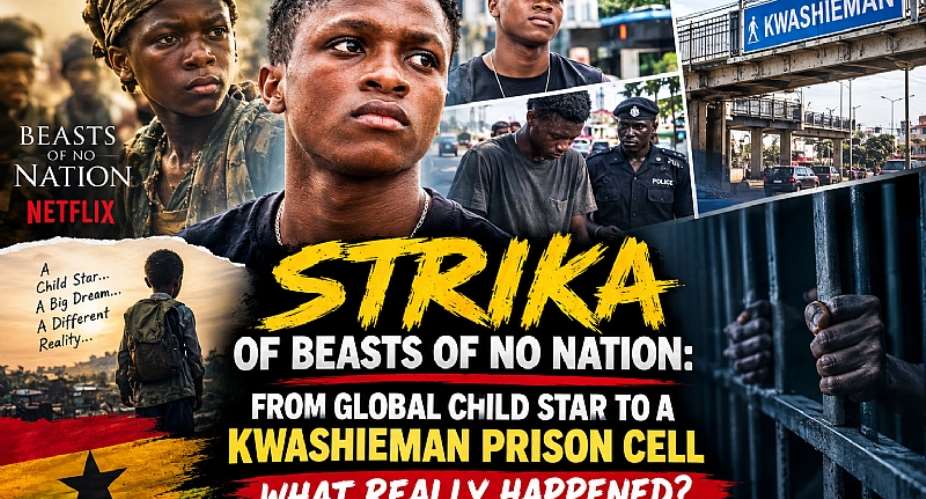
Emmanuel Nii Adom Quaye became famous before he was old enough to understand what fame meant. A decade later, his name is again making headlines not from a film set, but from an alleged theft case involving a public footbridge. Between those two moments lies a story about childhood, poverty, family, money, education, fame, responsibility and a society that may have celebrated a child without adequately preparing him for adulthood.
There are some stories that should not be told merely as celebrity scandals.
The story of Emmanuel Nii Adom Quaye, popularly known as Strika, is one of them.
In 2015, the world saw a young Ghanaian boy on Netflix alongside Idris Elba and Abraham Attah in Cary Joji Fukunaga's Beasts of No Nation. The film was shot in Ghana and received international recognition. Strika's portrayal of a traumatised child soldier was particularly memorable.
But today, in September 2026, his name is appearing in a completely different context.
Reports say Strika was arrested after residents allegedly caught him removing metal railings from the Kwashieman footbridge in Accra, reportedly to sell the material as scrap. A police officer was said to have taken him away for investigation.
And then came reports that he had been sentenced to prison.
But even here, there is a major question that must not be ignored: how long was he actually sentenced to serve?
Some Ghanaian media reports have reported seven years.
But Strika reportedly told his former caretaker, Official Gunshot GH, that a court had sentenced him to one year, with a transfer to Nsawam Prison expected. Pulse Ghana subsequently reported the one-year account and noted that the seven-year claim had not been independently clarified.
As of September 16, 2026, the publicly available reporting therefore contains a serious discrepancy: seven years versus one year.
That alone is something responsible journalism should investigate before repeating one figure as unquestionable fact.
But the bigger question is not simply how many years Strika may spend in prison.
The bigger question is:
How did a child whom the world watched become a young man whom society now watches through the lens of alleged crime?
WHO IS STRIKA?
His real name is Emmanuel Nii Adom Quaye.
Ghanaians came to know him as Strika, the character he played in Beasts of No Nation.
The film was adapted from Uzodinma Iweala's novel and tells the story of children caught in a brutal civil conflict. Abraham Attah played Agu, while Emmanuel Nii Adom Quaye played Strika, another child soldier. Idris Elba played the Commandant.
The irony is almost painful.
In the film, Strika was a child swallowed by circumstances beyond his control.
In real life, years later, his story would become another conversation about what happens when vulnerable children grow up without stable support.
But before we conclude that Strika's present circumstances are simply the result of poverty, bad choices or personal irresponsibility, we need to understand what happened after the cameras stopped rolling.
WHAT HAPPENED AFTER BEASTS OF NO NATION?
This is where the story becomes complicated.
According to casting director Mawuko Kuadzi, both Strika and Abraham Attah received about US$30,000 each connected to the film's earnings. Kuadzi has said Strika's money was placed in a protected account because he was a minor and that arrangements were made for him to access it when he became legally able to do so.
But Strika's own earlier accounts painted a different picture.
In interviews, he complained that he had not received the money he believed was owed to him.
His management rejected the suggestion that his earnings had simply disappeared and said the money had been placed in a trust fund in his name.
There was therefore a controversy that went beyond money.
It became a question of who was responsible for a child who suddenly became financially valuable?
And perhaps even more importantly:
Who was responsible for teaching that child what to do with the money when he eventually became an adult?
THE TWO BOYS WHO STARTED TOGETHER AND ENDED UP SO DIFFERENTLY
Strika and Abraham Attah were both young Ghanaian actors in Beasts of No Nation.
But their post-film journeys became dramatically different.
Abraham continued his education and acting career and later appeared in international productions, including Spider-Man: Homecoming. Strika's path became increasingly unstable.
Strika himself later compared his situation with Abraham's.
He argued that Abraham had a family structure around him that helped manage his career and finances, while he was an orphan whose affairs were handled by different people. He also admitted regretting some of his financial decisions.
That raises an uncomfortable question:
Was the difference between the two boys simply talent and personal choices or did the support structures surrounding them also matter?
Perhaps both.
And that distinction is important.
WHO WERE STRIKA'S REAL PARENTS?
This is one area where the public record needs careful handling.
Strika has himself said that both of his parents died when he was young. In a 2023 interview, he said his mother had ten children but that he did not know his siblings from her side because she died before properly connecting him with them.
More recently, casting director Mawuko Kuadzi has described Strika as an orphan with neither mother nor father alive, saying the production team had to obtain consent from members of his extended family when he was selected for the film. Kuadzi also suggested that the extended family's involvement in his welfare was limited.
That means the question should perhaps not be framed simply as:
"Where are Strika's parents?"
They are reported to have died when he was young.
The more difficult question is:
After his parents died, who became responsible for raising Emmanuel Nii Adom Quaye?
And did that responsibility survive after the child became famous?
DID STRIKA REALLY HAVE FAMILY SUPPORT?
The evidence suggests that his family circumstances were complicated.
Kuadzi has said Strika had relatives but was nevertheless found living on the streets and that the production team intervened to put him in school.
Strika's own account, meanwhile, describes growing up without the parental structure that surrounded many children.
So perhaps the question is not whether he had relatives.
Perhaps it is:
Did he have a stable family system?
Having relatives is not necessarily the same as having guardians who consistently supervise a vulnerable child, manage his money, protect his education and prepare him for adulthood.
That distinction may be crucial to understanding what happened next.
THE DIRECTORS DID TRY SO WHAT WENT WRONG?
It would be unfair to tell the story as though nobody tried to help him.
There is evidence that members of the production and management team attempted to intervene.
After Beasts of No Nation, Strika was reportedly enrolled in school. His accommodation and education were reportedly supported, with the production side and Netflix contributing.
But according to Kuadzi, Strika repeatedly ran away from school.
In 2018, Kuadzi said school authorities had made several efforts to keep him in school and that Strika had even signed an undertaking relating to leaving school, but subsequently absconded again.
That changes the conversation.
It would be too simplistic to say:
"Nobody helped Strika."
But it would also be too simplistic to say:
"Strika refused help, so everything is his fault."
Human lives are rarely that simple.
WHEN THE STREET BECAME HIS REALITY
By 2018, reports emerged showing Strika on the streets of Accra.
He was reported to be hawking and begging for money.
One account said he was staying with his grandmother around North Kaneshie and working with a yam seller.
Strika later said that he had returned to the streets and regretted how he had handled his finances. He reportedly said the money he received did not last long.
The story became national news.
A child who had appeared beside Idris Elba was now struggling to survive on the streets of Accra.
And the question that should have followed was not merely:
"What happened to Strika?"
It should have been:
What happened to the system around Strika?
THE INDUSTRY TRIED AGAIN
Strika was not completely abandoned by the entertainment industry.
There were attempts to bring him back into acting.
He was reportedly given another role in the Ghanaian television series Shatta in 2016.
Years later, he also became involved with the comedy/skit environment associated with Dr Likee and other entertainers. In 2023, reports said Dr Likee had brought him into his crew after another period of difficulty.
Strika also appeared in other Ghanaian productions and was seen again in entertainment content.
But another uncomfortable question emerges:
Was putting Strika back in front of a camera enough to put his life back on track?
Perhaps not.
Because employment is not the same thing as rehabilitation.
A job can provide income.
But a vulnerable young adult may also need stable housing, education, financial management, mentoring, discipline, counselling and a dependable support network.
AND THEN CAME KWASHIEMAN
In August 2026, video footage circulated showing residents confronting Strika at the Kwashieman footbridge.
Reports alleged that he was removing metal railings from the bridge and intended to sell them as scrap.
A police officer was reportedly called to the scene.
The incident immediately became a social-media spectacle.
And this is where society should pause.
Because there are two separate questions:
Did Strika commit the alleged offence?
If a court has convicted him, that is a matter for the justice system.
But there is another question:
What happened in the years between international fame and this alleged offence?
HAS STRIKA REALLY BEEN JAILED FOR SEVEN YEARS?
This requires particular caution.
Several Ghanaian reports published around September 14, 2026 said Strika had been sentenced to seven years after being convicted in connection with the Kwashieman footbridge incident.
However, another account is substantially different.
According to Pulse Ghana, Strika reportedly told his former caretaker that the court had sentenced him to one year and that he was awaiting transfer to Nsawam Prison.
As of the latest reports available, the discrepancy has not been independently resolved through a publicly accessible court record cited by these reports.
Therefore, it would be irresponsible to present seven years as an established fact without qualification.
What can be reported is that Strika has reportedly been convicted and imprisoned, while the exact length of the sentence remains disputed in public reporting.
WHAT DID HE ACTUALLY DO?
According to the reports, the allegation involved removing/cutting metal railings from the Kwashieman pedestrian footbridge in Accra, allegedly with the intention of selling the metal as scrap.
The alleged conduct concerns public infrastructure.
That matters.
A footbridge is not simply scrap metal. It is infrastructure intended to protect pedestrians.
So the seriousness of the alleged offence should not be dismissed merely because the accused person is a former child star.
But neither should his entire life be reduced to one incident.
WHAT ARE GHANAIANS SAYING?
Public reaction has been divided.
Some people argue that fame, poverty or a difficult childhood cannot justify stealing public property.
Others have expressed sympathy and questioned whether imprisonment alone can solve the problems that have followed Strika for years.
Some have asked why someone who once earned international fame and reportedly received substantial compensation could end up in such circumstances.
Others argue that Strika has repeatedly been given opportunities and that personal responsibility must also matter.
Both questions deserve examination.
Because compassion should not mean excusing crime.
And accountability should not mean abandoning a human being.
BUT HERE IS THE QUESTION FEW PEOPLE ARE ASKING
If Strika was given opportunities, why did those opportunities not produce stability?
Was the problem money?
Education?
Family?
Peer influence?
Substance use?
Lack of discipline?
Mental and emotional support?
Poor management?
Or a combination of several factors?
There have been public reports over the years about substance use and difficult behaviour, including Strika's own account that he began smoking marijuana while still very young. He also said he was subjected to counselling after the issue was discovered at school.
But we should be careful not to diagnose his life from media reports.
Instead, the proper question is:
What comprehensive support did a vulnerable child actually receive when his childhood suddenly became an international commercial success?
DID GHANA FAIL STRIKA?
That question is too big to answer with a simple yes or no.
The record shows that individuals did attempt to help him.
The production team reportedly found him, enrolled him in school and protected his earnings.
Managers attempted to supervise him.
Entertainment personalities later gave him opportunities.
Friends and colleagues reportedly maintained contact.
And Strika himself has acknowledged making decisions he regretted.
So there were interventions.
But the outcome still raises questions.
Because if all those interventions existed and the young man nevertheless ended up struggling on the streets and now facing imprisonment, perhaps the problem was not simply the absence of help.
Perhaps the help was not sustained, coordinated or appropriate to his circumstances.
THE $30,000 QUESTION
This may be one of the most important unanswered parts of the story.
If Strika was indeed entitled to approximately US$30,000 from Beasts of No Nation, what ultimately happened to that money?
Management said it was protected in a trust account.
Strika later said he had received money and regretted how he used some of it.
That means the public should resist the temptation to repeat the old claim that the money simply "disappeared."
Instead, the right question is:
What is the documented financial history of Strika's earnings, and when and how did he gain access to them?
That is a question that could potentially be answered with documents rather than speculation.
AND WHAT ABOUT HIS AGE?
There is another problem with many online stories about Strika: inconsistent biographical information.
He was a child when Beasts of No Nation was filmed in Ghana in 2014–2015, and the film was released in 2015.
However, reliable public sources available today do not consistently provide a verified date of birth for Emmanuel Nii Adom Quaye.
Therefore, rather than manufacture an exact age, it is safer to say that Strika is now an adult in his twenties, based on the chronology surrounding his childhood appearance in the 2015 film.
A proper biography should establish his exact birth date from an authoritative document or direct family source before stating a precise age.
WHERE IS STRIKA NOW?
The latest reporting places Strika within the criminal-justice system following the Kwashieman incident.
But precisely where he is being held at this moment is less clear.
His reported conversation with Official Gunshot GH suggested a planned transfer to Nsawam Prison.
However, that should not automatically be treated as confirmation that he has already been transferred there.
Again, the responsible question is:
Where is Emmanuel Nii Adom Quaye currently being held, under what court order, and for what confirmed sentence?
Those are questions that deserve official answers.
THE MOST PAINFUL IRONY
There is something almost haunting about the story.
In Beasts of No Nation, Strika played a boy whose childhood was destroyed by circumstances beyond his control.
His character was not given a normal childhood.
He was surrounded by violence.
He became part of a world where survival replaced innocence.
Then the movie ended.
But perhaps the most disturbing question is this:
Did we ever ask what happened to the real boy after the fictional war ended?
The world watched the movie.
The world applauded the performance.
The world watched Abraham Attah rise.
But what happened when Strika returned to ordinary Ghanaian life?
FROM NETFLIX TO A FOOTBRIDGE: WHAT DOES STRIKA'S STORY SAY ABOUT GHANA?
This is bigger than Emmanuel Nii Adom Quaye.
It raises questions about Ghana's treatment of child performers.
What happens when a child earns tens of thousands of dollars?
Who protects the money?
Who protects the child?
Who ensures education continues?
Who provides mentorship?
Who monitors the child's transition from childhood to adulthood?
Who remains responsible when the production ends?
And perhaps the most important:
Should a child star be treated simply as a source of talent or as a child whose welfare must remain protected after the cameras stop?
THE QUESTIONS GHANA MUST NOW ASK
If Strika has been convicted, accountability must take its course.
But accountability should not end the investigation into his life.
We should ask:
1. Who were Emmanuel Nii Adom Quaye's legal guardians after the death of his parents?
2. What happened to his reported US$30,000?
3. When did he obtain access to the money?
4. How much did he actually receive and spend?
5. Why did repeated attempts to keep him in school fail?
6. What support did the film producers provide after production ended?
7. What support did Ghana's entertainment industry provide?
8. Did his extended family remain involved in his welfare?
9. What happened to his relationship with former colleagues and friends?
10. Was he offered sustainable employment or only temporary appearances?
11. Did anyone provide long-term mentorship?
12. Were there interventions addressing the behavioural and social difficulties reported during his school years?
13. What happened after Dr Likee and other entertainers tried to bring him back into entertainment?
14. What exactly did the court find him guilty of in the Kwashieman case?
15. And why are reports giving the public two completely different prison terms one year and seven years?
THE QUESTION BEHIND ALL THE QUESTIONS
Perhaps the biggest question is not whether Strika should be held accountable if he committed a crime.
He should.
The question is whether prison is the end of Strika's story or merely another chapter in a story that society failed to understand early enough.
A child can be talented without being prepared for fame.
A young person can make terrible decisions without being beyond redemption.
A person can be responsible for his actions while still having a history that deserves understanding.
And a society can demand accountability while asking whether its institutions did enough to prevent vulnerable young people from falling through the cracks.
Strika once stood before millions of viewers as a fictional child soldier.
Today, his real-life story has become a different kind of warning.
The cameras did not create his problems.
But perhaps they revealed something Ghana has not yet learned how to deal with: what happens to children after the world stops watching.
And that is why the Strika story should not end with the words "child star jailed."
The harder story begins after those words.
Because if a child can go from a global film set to the streets and eventually to a prison cell then perhaps the question is not only, "What did Strika do?"
Perhaps Ghana must also ask: "What did we fail to do?"
This article reflects the latest publicly available reporting as of September 16, 2026. The reported prison term is disputed in available media accounts; the seven-year figure should therefore not be treated as independently verified without an official court record.
By:
Patrick Belebang Yagsori
+233240292413
[email protected]
 Ivorian footballer Malick Yalcouyé falsely accused of lying about his age
 South Africa's president taken ill after BRICS summit
 Chief Justice praising government policies is problematic – Kwesi Pratt
 Police interdict seven officers for allegedly forcing victim to withdraw money f...
 GAF ready to deepen defence cooperation with Russia – Major General Annan
 WHO sees 'encouraging signs' in DR Congo Ebola response but says outbreak 'far f...
 GRA challenges GH¢79.65m Servestar Minwax judgment debt
 Government allocates GH¢1.98bn to school feeding programme in 2026 — Gender Mini...
 DVLA boss calls for modernisation of learner’s licence acquisition process
 EPA shuts down Empire Cement over alleged environmental breaches


