




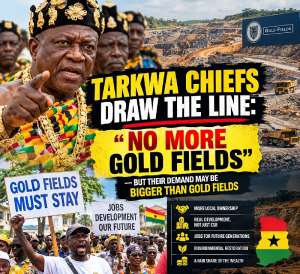
The fight over the future of the Gold Fields Tarkwa Mine has suddenly become much bigger than a mining-lease renewal.
It is now a battle over ownership, development, environmental cost, employment, Ghanaian participation and one uncomfortable question that Ghana has avoided for decades:
When a community gives up its land and natural resources for mining, what exactly does that community have the right to expect in return?
The Apinto Divisional Council has answered that question forcefully.
The chiefs want the Government of Ghana to refuse renewal of Gold Fields' Tarkwa leases when five of them expire in April 2027 and instead create a Ghanaian-owned mining operation in which the state, investors and host communities become genuine partners.
But there is another side of Tarkwa.
Hundreds of residents have marched under the banner “Gold Fields Must Stay,” arguing that the mine provides jobs, business opportunities, infrastructure and household incomes that cannot simply be replaced by political promises of local ownership.
So the question is no longer simply:
Should Gold Fields leave?
The deeper question is:
If Gold Fields stays, what must Ghana renegotiate and if Gold Fields leaves, who exactly is capable of replacing it?
A GOLD-MINING TOWN LONG BEFORE THE CURRENT DISPUTE
Tarkwa's mining story did not begin with Gold Fields.
Commercial mining in the area stretches back to the late nineteenth century. The Abontiakoon concession was worked by several small companies before Amalgamated Banket Area Limited acquired it in 1935. Mining later restarted under the State Gold Mining Corporation in 1961, and the Tarkwa mines were renamed Tarkwa Goldfields Limited in 1963.
Gold Fields' modern relationship with Tarkwa began in 1993, when it signed a management contract with the Government of Ghana to operate the mine. Open-pit expansion followed, and Gold Fields eventually became the dominant operator.
In 2011, Gold Fields acquired IAMGold's 18.9% interest in Tarkwa, leaving Gold Fields with 90% and the Government of Ghana with 10% free-carry ownership.
That means Gold Fields has now been associated with the operation for more than 33 years.
And that history is precisely what makes the current dispute so explosive.
HOW MUCH GOLD HAS COME OUT OF TARKWA?
This is where the debate becomes uncomfortable.
Gold Fields' own 2025 figures show that Tarkwa produced approximately 474,500 ounces of gold in 2025 and generated US$1.643 billion in revenue. In 2024, it produced 537,200 ounces and generated US$1.302 billion in revenue.
Those are only two recent years.
Gold Fields has operated Tarkwa since 1993, meaning the mine has generated enormous economic value over more than three decades.
But here is an important distinction that must not be lost in the political debate:
There is no single publicly reported figure that reliably isolates Gold Fields' cumulative Tarkwa revenue from 1993 to 2026.
Therefore, claims that Gold Fields has made a specific multi-billion-dollar amount solely from Tarkwa since 1993 should be treated cautiously unless supported by audited historical production, sales-price and ownership data.
What we can establish is that the mine remains enormously valuable.
In 2025 alone, Tarkwa generated US$1.64 billion in revenue.
And that raises the question the chiefs are forcing Ghana to confront:
If one mine can generate US$1.64 billion in one year, what percentage of that economic value should remain permanently visible in the communities from which the gold is extracted?
SO HOW MUCH HAS ACTUALLY GONE BACK TO THE COMMUNITIES?
Gold Fields has a substantial answer.
The Gold Fields Ghana Foundation was established in 2004 after the company's Community Development Fund was created in 2002.
Its funding formula is particularly important:
US$1 for every ounce of gold produced, plus 1.5% of pre-tax profit.
According to Gold Fields Ghana, the Foundation had invested more than US$104.3 million between 2004 and 2024. Its latest public figures put the cumulative investment at more than US$109.5 million.
The spending has included:
US$71.5 million on infrastructure;
US$10.1 million on education;
US$4.8 million on health and wellbeing;
US$7.1 million on enterprise development;
US$4.2 million on training;
water and sanitation;
agriculture;
environmental conservation;
sports and other programmes.
Gold Fields also points to the 33-kilometre Tarkwa-Damang road, the Tarkwa and Aboso stadium, more than 52 schools, scholarships, healthcare facilities and other projects as part of its contribution.
And in 2025, Gold Fields said it paid approximately GH¢5.8 billion to the Government of Ghana in taxes, royalties, dividends and other statutory payments, while spending GH¢8.8 billion on local procurement, including GH¢6.5 billion with suppliers from host communities.
So it would be factually wrong to say:
“Gold Fields has done nothing for Tarkwa.”
It clearly has.
But that does not automatically settle the chiefs' argument.
Because the real issue may not be whether Gold Fields has invested.
The question is whether the investment is proportionate to the value extracted and the long-term cost imposed on the host communities.
THE CHIEFS' ARGUMENT: “THE DEVELOPMENT DOES NOT MATCH THE DEGRADATION”
This is the heart of the rebellion.
After inspecting the mine area, the Apinto Divisional Council said more than 4,000 hectares of Apinto land had been degraded, affecting farming, livelihoods and community land.
The chiefs argue that poor roads, inadequate educational infrastructure, insufficient healthcare facilities and youth unemployment remain serious problems despite decades of mining.
Their complaint is not simply:
“Give us more CSR.”
It is much more fundamental.
They say the mining model itself is wrong.
The chiefs want the next phase of mining to move beyond a model in which communities receive projects from companies and instead become partners in ownership, governance and economic benefits.
That is what lies behind the Apinto Shared Prosperity Proposal.
And that phrase deserves serious attention.
WHAT DO THE CHIEFS ACTUALLY WANT?
The proposal is built around four ideas:
Ownership.
Participation.
Governance.
Long-term wealth creation.
The chiefs want a mining arrangement in which Ghanaian interests and specifically the host communities—have a meaningful economic stake rather than simply receiving royalties and corporate social responsibility projects.
Recent reporting indicates that the proposal seeks direct community participation in the ownership, governance and benefits of mining operations.
That is a radically different proposition.
It essentially asks:
Why should a community that carries the environmental and social cost of mining remain merely a beneficiary when the mine itself is a major commercial asset?
BUT THEN TARKWA'S PEOPLE SPOKE—AND THEY DID NOT ALL AGREE WITH THE CHIEFS
This is where the story becomes even more complicated.
In August, residents from Huniso, Samaho, Tebekrom and surrounding communities publicly opposed the chiefs' call for non-renewal.
They said Gold Fields had contributed significantly to development and employment and warned that ending its operations could damage the local economy.
Then came an even larger demonstration.
Hundreds of residents marched under the banner:
“GOLD FIELDS MUST STAY.”
They cited employment, business activity, infrastructure and the economic circulation of mine salaries throughout Tarkwa.
One community representative said Tarkwa had thousands of employees and contractors, with a substantial proportion coming from host communities.
This creates a remarkable contradiction:
The traditional leadership says Gold Fields has not done enough.
Some of the people living in the communities say Gold Fields must not leave.
So who is right?
Perhaps both sides are asking different questions.
The chiefs are asking:
“Are we receiving a fair share of the wealth?”
The workers and businesses are asking:
“What happens to us if the mine disappears?”
Those are not necessarily contradictory questions.
THE SOUTH AFRICAN QUESTION: WHY DOES GOLD FIELDS' HOME COUNTRY OFFER AN INTERESTING COMPARISON?
This comparison must be made carefully because Ghana and South Africa operate under different laws and regulatory systems.
Gold Fields' South Deep mine in South Africa provides a useful comparison.
South Deep's 2025 data show 63% of its workforce came from host communities, compared with approximately 70% at Tarkwa, according to Gold Fields' Ghana disclosure.
But the community-development structure is different.
Between 2020 and 2024, South Deep invested more than R245 million (about US$13.4 million) in Social and Labour Plan projects, excluding R4.7 billion in procurement from host-community businesses.
South Deep also operates through community trusts.
Gold Fields says the South Deep Community Trust and South Deep Education Trust receive annual dividend income from the mine and are designed to support communities beyond simply receiving conventional CSR projects.
That difference deserves attention.
Because the debate in Tarkwa is increasingly moving from:
“How many projects has Gold Fields built?”
to:
“How is ownership and economic value structured so communities can benefit even beyond the life of the mine?”
That is a much more sophisticated question.
THE 2016 GHANA–GOLD FIELDS AGREEMENT: WHAT DID GHANA ACTUALLY AGREE TO?
This is perhaps the most important document in the entire controversy.
In March 2016, Ghana and Gold Fields entered into a Development Agreement covering Tarkwa and Damang. Parliament ratified it.
Among its key provisions were:
corporate tax reduced from 35% to 32.5%;
a sliding-scale royalty regime linked to gold prices;
an 11-year term for Tarkwa and nine years for Damang, subject to renewal provisions;
a commitment for US$500 million of spending at each mine over the applicable period;
and Gold Fields' commitment to fund the Tarkwa-Damang road.
The agreement therefore was not simply:
“Gold Fields gets gold and Ghana gets taxes.”
It was a negotiated investment framework involving fiscal concessions, investment commitments and stability provisions.
The Minerals Commission itself publicly maintains the Development Agreement documents on its website.
And this creates another uncomfortable question:
If Ghana granted fiscal concessions to make the mine attractive and stable for investment, did Ghana negotiate enough enforceable, measurable and community-specific development obligations in return?
That question is directed not only at Gold Fields.
It is also directed at successive Ghanaian governments.
WHAT ABOUT THE MINERALS COMMISSION?
The Minerals Commission is not merely a spectator.
It is the government agency responsible for developing and coordinating mineral-sector policies and monitoring their implementation.
And the Commission has made it clear that the Tarkwa renewal will not simply be automatic.
In May 2026, Minerals Commission Chief Executive Isaac Andrews Tandoh said Gold Fields would have to present its development plans to a technical committee, followed by a ministerial-level presentation before a decision is made.
The Commission has therefore positioned the renewal as a fresh assessment not merely an extension of the old arrangement.
That may be the most important development of all.
Because Ghana now has an opportunity to ask:
What should a modern Tarkwa mining agreement look like?
AND GOLD FIELDS HAS ALREADY CHANGED ITS MESSAGE
Gold Fields is not pretending the concerns do not exist.
The company says it has engaged traditional authorities and communities for more than three decades through the Tarkwa Mine Community Consultative Committee and other platforms.
It disputes the suggestion that its contribution has been insignificant.
Gold Fields says about 70% of Tarkwa's employees are from host communities, that it has invested more than US$110 million through its Foundation, and that it has spent about US$46 million on progressive land rehabilitation since 2016.
More importantly, its new renewal proposal reportedly includes:
increased community investment;
stronger support for local businesses;
skills development;
greater local participation;
expanded local procurement;
and deeper long-term socio-economic value creation.
In other words:
Gold Fields appears to understand that simply saying “we have already built roads and schools” may no longer be enough.
THE MOST IMPORTANT QUESTION: WHY NOW?
Why have the chiefs, after decades of engagement, suddenly reached the point of saying:
“No more Gold Fields”?
There are several possible explanations.
The first is accumulated frustration.
A community may appreciate individual projects while simultaneously believing that the overall economic relationship remains unfair.
The second is the changing national debate about resource ownership.
Ghana is increasingly questioning why strategic natural resources should remain dominated by foreign capital when Ghanaian companies are becoming more capable.
The third is the Damang precedent.
Gold Fields' Damang mine was transferred to the Government of Ghana in April 2026, and the government subsequently awarded the lease to local company Engineers & Planners.
That development changed the conversation.
It demonstrated that Ghanaian ownership is no longer merely a theoretical argument.
But there is also a fourth possibility that nobody should ignore:
Could the disagreement be partly about who controls the economic future of Tarkwa not simply how much development the community receives?
That is the question that needs evidence, not speculation.
AND HERE IS THE QUESTION GHANA SHOULD BE ASKING
If Ghana decides not to renew Gold Fields, what happens next?
Can a Ghanaian company immediately mobilise hundreds of millions of dollars?
Can it maintain thousands of jobs?
Can it finance modern open-pit mining equipment?
Can it meet international environmental standards?
Can it maintain production?
Can it rehabilitate degraded land?
Can it generate billions of cedis in taxes and local procurement?
And perhaps the most important:
Who will finance the transition?
The Damang experience shows that local ownership is possible but it also demonstrates that taking over a major mine requires serious capital, technical capacity, equipment, management and financing. Ghana ultimately selected Engineers & Planners after assessing its financing and technical capabilities.
Therefore, saying “let Ghanaians take over” is only the beginning of the argument.
The next question must be:
Which Ghanaians? With whose money? Under what ownership structure? Who gets the shares? Who appoints management? How are profits distributed? What happens if the company fails? And what safeguards prevent political connections from replacing foreign ownership with politically connected local ownership?
Those questions are uncomfortable.
But they must be asked.
THE QUESTIONS GOLD FIELDS SHOULD ALSO ANSWER
Gold Fields has presented an impressive list of investments.
But transparency demands more than a list of projects.
The company should be challenged to publish, in one accessible document:
1. Total gold produced at Tarkwa since 1993.
2. Total revenue generated from Tarkwa since 1993.
3. Total taxes, royalties and dividends paid to Ghana specifically from Tarkwa.
4. Total capital expenditure at Tarkwa.
5. Total community investment attributable specifically to Tarkwa rather than Tarkwa and Damang combined.
6. Total land disturbed by mining.
7. Total land rehabilitated.
8. The percentage of procurement going directly to businesses owned by people from the host communities.
9. The number of host-community businesses that have grown into independent enterprises because of the mine.
10. How much of the mine's wealth remains in Tarkwa five years after a project or contract ends.
These figures would allow the public to move beyond slogans.
AND THE CHIEFS SHOULD ALSO ANSWER HARD QUESTIONS
The chiefs' argument deserves respect.
But it too must face scrutiny.
If Ghanaian ownership is the answer:
Who exactly will own the proposed mine?
Will the Apinto Traditional Council receive equity?
Will individual communities receive shares?
Will the Government hold the majority?
Will ordinary residents own anything?
How will the shares be transferred?
Who will appoint the board?
How will political interference be prevented?
What happens if the Ghanaian operator cannot raise the money required?
And perhaps the most uncomfortable question:
Is the fight really about community ownership or could “Ghanaian ownership” simply move control from a foreign corporation to a small group of politically and economically powerful Ghanaians?
If the chiefs want genuine shared prosperity, then the ownership structure should be public.
Every Ghanaian should be able to see it.
AND THEN THERE IS THE GH¢5.8 BILLION QUESTION
Gold Fields says it paid about GH¢5.8 billion to the Ghanaian Government in 2025 through corporate taxes, royalties, dividends and other statutory payments.
But where did that money go?
How much returned to the Western Region?
How much reached Tarkwa-Nsuaem?
How much reached the communities directly affected by mining?
And how much disappeared into the national budget with no visible connection to the community from which the mineral wealth originated?
This is where Ghana's debate should become much more sophisticated.
The problem may not only be what mining companies pay.
The problem may also be what governments do with what mining companies pay.
A mining company can pay billions into the national purse while the host community remains dissatisfied.
That does not necessarily prove the company failed.
It may expose a much larger failure in the country's resource-distribution architecture.
THE REAL TARKWA QUESTION
Perhaps the chiefs have accidentally opened a door that Ghana has needed to open for decades.
The debate should not be reduced to:
Gold Fields versus the chiefs.
It should be:
Government + Gold Fields + Chiefs + Communities + Parliament + Minerals Commission + Civil Society
sitting around one table and answering one question:
What should Ghana's mining model look like after 2027?
Gold Fields has already shown that mining can generate enormous economic activity.
The chiefs have reminded Ghana that economic activity does not automatically equal community prosperity.
The workers have reminded the country that foreign investment can create real livelihoods.
The Damang transition has demonstrated that Ghanaian ownership can move from political rhetoric into reality.
And the Minerals Commission has signalled that the Tarkwa renewal will face a fresh regulatory examination rather than an automatic extension.
THE FINAL QUESTION GHANA CANNOT ESCAPE
For more than a century, gold has been extracted from Tarkwa.
Governments have changed.
Mining companies have changed.
Contracts have changed.
Gold prices have changed.
But one thing has remained remarkably consistent:
The gold leaves the ground faster than the argument over who should benefit from it ever gets settled.
Now Tarkwa's chiefs are saying:
Enough.
Some residents are saying:
Don't take Gold Fields away.
Gold Fields is saying:
We have invested, we have created jobs, we have paid taxes, and we are prepared to offer more.
Government is saying:
Renewal will not be automatic.
And Ghana is standing in the middle.
Perhaps the biggest question is not whether Gold Fields should stay or leave.
Perhaps it is this:
If Ghana cannot design a mining agreement that makes the Government, the investor and the host community all feel that they have won, what exactly have more than 100 years of gold mining taught us?
Because if Tarkwa becomes the place where Ghana finally answers that question, the consequences will extend far beyond Tarkwa.
They could determine how Ghana negotiates every major mine that comes after it.
By:
Patrick Belebang Yagsori
+233240292413
[email protected]

 Failing one or two BECE core subjects does not remove student from placement – E...
 Spiritualist found dead in suspected suicide at Assin-Amoabeng
 ‘Bunkpurugu must choose development over violence’ – MP tells residents
 Court orders Ghana Police to file disclosures in Labone robbery case
 Mahama inaugurates five-member Independent Fiscal Council, demands objective ove...
 Trump tells Putin he wants swift end to Ukraine war, Kremlin says
 Poor refereeing destroying Ghana's football — Mahama
 No businessman will sponsor NPP again because of its ‘evil and greedy nature’ – ...
 Failure to jail corrupt NPP officials will haunt NDC in election 2028 – Hopson A...
 Illegal miner who posed as pastor to defile student jailed 15 years

