




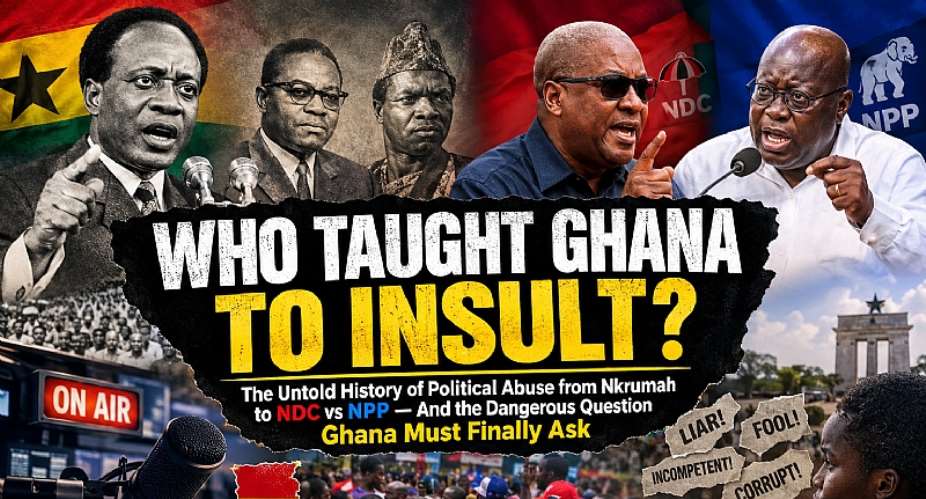
There is a question Ghana has become strangely uncomfortable asking:
When did political disagreement stop being about ideas and become a competition over who could insult the other person more effectively?
And perhaps an even more uncomfortable question:
Are Ghanaian politicians insulting one another because they genuinely disagree about how to develop Ghana or because insults are one of the cheapest and most effective weapons for acquiring and retaining political power?
Listen to political discussions on radio. Watch campaign platforms. Scroll through Facebook, TikTok, X and other social-media platforms.
A politician makes a statement.
An opponent responds.
A supporter becomes angry.
Another communicator fires back.
The argument becomes personal.
Then the insults begin.
And before long, the original policy question has disappeared.
Nobody is discussing jobs.
Nobody is discussing industrialisation.
Nobody is discussing Ghana's debt.
Nobody is discussing the quality of education.
Nobody is discussing why young graduates are unemployed.
Nobody is discussing why Ghana continues to export raw materials while importing finished products.
Instead, millions of citizens are watching two political camps fight over who can humiliate whom.
But how did we get here?
BEFORE NDC AND NPP, THERE WAS ALREADY POLITICAL WARFARE
To understand Ghana's politics of insults, we must go much further back than the National Democratic Congress (NDC) and the New Patriotic Party (NPP).
Neither party existed during the independence struggle.
The political battle that eventually produced independent Ghana was already intensely competitive in the 1940s and 1950s.
On one side was the United Gold Coast Convention (UGCC) and its political tradition. On the other emerged Kwame Nkrumah's Convention People's Party (CPP), founded in 1949.
Nkrumah broke with the UGCC over the pace and character of the struggle for self-government. The famous political contrast became "self-government now" against the more gradual approach associated with the older establishment.
The political struggle was not polite.
Historian George Bob-Milliar's research into nationalist activism between 1946 and 1956 describes intense competition between groups associated with the CPP's grassroots activists and the political establishment. His study specifically examines the confrontation between the "Verandah Boys" and "Reactionary Lawyers" during the pre-independence electoral struggles.
Think about that for a moment.
"Verandah Boys."
"Reactionary Lawyers."
These were not modern NDC-versus-NPP slogans.
They belonged to a much earlier political Ghana.
And they tell us something important:
Political labelling did not begin with social media.
It did not begin with FM radio.
It did not begin with NDC and NPP.
It existed during the struggle that produced independence itself.
WHO WERE THE "VERANDAH BOYS"?
The expression "Verandah Boys" is particularly revealing.
Nkrumah's political movement attracted workers, young activists and ordinary people who were not necessarily members of the traditional political elite.
His opponents reportedly characterised them as "irresponsible and unruly Verandah boys."
Nkrumah himself later referred to this criticism, explaining that opponents had denounced his supporters in those terms while the CPP was fighting colonialism and demanding freedom. Academic work on Ghanaian political vigilantism also records Nkrumah's reference to the description.
So here is one of the fascinating ironies of Ghanaian political history:
An insult became a political identity.
The people being ridiculed transformed the label into part of their political mobilisation.
That should make modern Ghana pause.
Because sometimes political insults do not destroy political movements.
Sometimes they strengthen them.
And sometimes they become part of political folklore.
BUT WHO INSULTED FIRST?
Here is where responsible history must resist the temptation to manufacture a sensational answer.
Was it the CPP?
Was it the UGCC?
Was it a particular politician?
Was there one specific word that marked the beginning of Ghanaian political insults?
The historical evidence does not allow us to identify one individual as the first political insulter in Ghana.
There are records of political accusations, ridicule, labels and hostile descriptions during the colonial period, but establishing the first person who used an "inappropriate" political expression would require evidence that simply does not exist in the historical record available to us.
And this distinction matters.
A newspaper can report that a politician insulted another politician.
A historian can document a particular phrase.
But that is very different from proving:
"This was the first political insult ever used in Ghana."
No serious historical analysis should make that claim without evidence.
THE CPP DID NOT INVENT POLITICAL ABUSE BUT THE POLITICAL CULTURE WAS ALREADY COMBATIVE
The CPP's political struggle was extraordinarily confrontational.
Nkrumah and his supporters attacked colonialism and political opponents with powerful political language.
Opponents, in turn, attacked the CPP and its activists.
Political language was part of political mobilisation.
And perhaps we should understand the historical context.
The Gold Coast was not simply having an argument over who should manage a government department.
The fundamental question was:
Who should control the future of the country?
Should power remain substantially within the colonial system?
Should independence come gradually?
Should it come immediately?
Who represented the ordinary Ghanaian?
Who represented the educated elite?
Who represented workers?
Who represented the traditional authorities?
These were enormous questions.
Political language therefore became a weapon.
THEN CAME INDEPENDENCE
On 6 March 1957, Ghana became independent.
The political struggle did not disappear.
It changed shape.
The CPP became the dominant political force, while opposition forces reorganised.
Eventually, the opposition tradition that emerged from the Danquah-Busia-Dombo political tradition would become historically important to the later formation of the NPP.
Ghana subsequently experienced periods of civilian government, military rule, political bans and constitutional transitions.
So today's NDC-NPP rivalry is not an isolated phenomenon.
It sits on top of decades of political competition.
THEN SOMETHING CHANGED: THE FOURTH REPUBLIC
The modern politics of insults became particularly visible after the restoration of constitutional democracy in 1992 and the beginning of the Fourth Republic in 1993.
This is where the story becomes much more interesting.
The two dominant political forces became the NDC and NPP.
Competition became increasingly intense.
And then another revolution occurred:
RADIO.
The expansion of private radio transformed Ghanaian politics.
A political argument that once might have been heard by several hundred people at a rally could now reach thousands of listeners.
Then tens of thousands.
Then millions.
And political language became mediatized.
University of Ghana linguist Professor Kofi Agyekum published a major academic study in 2004 titled Invective Language in Contemporary Ghanaian Politics. His research examined invective used by activists associated with both the NPP and NDC and considered its social and political effects.
That research is important because it destroys another popular misconception:
Political invective is not a new phenomenon created by today's politicians.
By the early 2000s, it was already serious enough to become a subject of academic research.
WHEN POLITICS BECAME ENTERTAINMENT
Something else happened.
Insults attract attention.
Attention attracts listeners.
Listeners attract advertising.
And political controversy attracts even more attention.
A calm discussion about Ghana's industrial policy may not generate the same excitement as two politicians calling each other names on live radio.
That creates a dangerous incentive.
The politician who explains a complicated economic policy may be ignored.
The politician who makes a provocative accusation may become the headline.
The communicator who calmly explains statistics may receive little attention.
The communicator who insults an opponent may become a social-media sensation.
So perhaps Ghana should ask:
Have we created a political economy in which outrage is more profitable than policy?
WHAT DOES THE EVIDENCE SAY ABOUT NDC AND NPP?
The evidence does not support the simplistic argument that one of the two major parties invented political insults.
Academic research has studied invective among both NDC and NPP activists.
And monitoring by the Media Foundation for West Africa has repeatedly documented abusive language involving actors from both major parties.
In 2016, MFWA monitored 516 programmes on 40 radio stations and recorded 87 incidents of indecent expressions. NPP officials, affiliates and supporters accounted for 27 incidents, while NDC actors accounted for 16. Other parties were also recorded.
In 2020, the picture changed depending on the monitoring period.
During one June monitoring period, MFWA recorded 17 indecent expressions involving NDC actors and 15 involving NPP actors.
During another July monitoring period, NDC actors recorded 27 while NPP actors recorded 13.
And during August–October 2020, MFWA recorded 114 abusive expressions associated with NPP actors compared with 38 associated with NDC actors.
What does this prove?
Not that NPP is inherently abusive.
Not that NDC is inherently abusive.
Rather, it demonstrates something much more uncomfortable:
The problem is bigger than one political party.
It is embedded in Ghana's political communication culture.
THE INSULT HAS BECOME NORMAL
Perhaps the most dangerous development is not that politicians insult each other.
It is that we have begun to accept it as normal.
A politician insults someone.
The crowd cheers.
The radio host laughs.
Social media explodes.
Supporters defend it.
The opponent responds.
Another insult follows.
Then citizens choose sides.
The original issue disappears.
And the cycle continues.
Research on Ghanaian political invective has specifically examined the pragmatic effects of such language and its implications for national development and reconciliation.
Another study of Ghanaian political discourse argues that the use of decent language has increasingly given way to invective in political communication.
So perhaps the real question is not:
"Why do politicians insult each other?"
It is:
"Why do we reward them when they do?"
ARE WE CONFUSING POLITICAL STRENGTH WITH POLITICAL ABUSE?
There is nothing wrong with fierce political debate.
Democracy needs opposition.
Democracy needs criticism.
Democracy needs politicians who can expose corruption, challenge government decisions and question public expenditure.
But criticism is not the same as humiliation.
Calling out a failed policy is not an insult.
Demanding accountability is not disrespect.
Investigating corruption is not political hatred.
Disagreeing with a president does not make someone an enemy of Ghana.
And defending a government does not require attacking everyone who disagrees with it.
The 1992 Constitution gives political parties an important responsibility: they are expected to participate in shaping the political will of the people and disseminating information on political ideas and social and economic programmes of a national character. It also requires political parties to have a national character rather than being based on ethnic, religious or sectional divisions.
That raises a profound question:
Are our political parties fulfilling the constitutional spirit of political debate when their communicators spend more time attacking personalities than explaining programmes?
POWER OR NATIONAL DEVELOPMENT?
Now we reach the question Ghana must be brave enough to ask.
What is politics actually for?
Is it about acquiring power?
Yes.
Political parties exist to compete for political power.
But power is supposed to be a means to an end.
The end should be national development.
Better schools.
Better hospitals.
Better roads.
Jobs.
Industrialisation.
Food security.
Affordable housing.
Reliable electricity.
Digital transformation.
A productive economy.
A functioning justice system.
A dignified life for ordinary citizens.
So what happens when political competition becomes an end in itself?
What happens when winning the next election becomes more important than building the next generation?
WHO BENEFITS FROM THE POLITICAL WAR?
This question may be uncomfortable.
But it deserves to be asked.
When an NDC communicator insults an NPP communicator, who benefits?
When an NPP communicator insults an NDC communicator, who benefits?
Does the unemployed graduate benefit?
Does the struggling trader benefit?
Does the farmer benefit?
Does the teacher benefit?
Does the nurse benefit?
Does the young entrepreneur benefit?
Does Ghana's manufacturing sector benefit?
Does the ordinary taxpayer benefit?
Or does somebody else benefit?
WHILE WE ARE FIGHTING, THE YOUTH ARE WAITING
This may be the most painful part of the entire conversation.
Ghana's youth are not simply watching politics.
They are living with the consequences of political decisions.
The Ghana Statistical Service reported that youth unemployment among people aged 15–35 averaged 21.9% during the first three quarters of 2025, compared with national unemployment of 12.8%.
Even more strikingly, nearly two million young people, representing about 19.5% of the youth population, were classified as not in education, employment or training.
That is not merely a statistic.
Behind every number is a human being.
A graduate.
A young mother.
A young father.
An apprentice.
A university student.
Someone who has completed school but cannot find work.
Someone who has dreams but no capital.
Someone who spends hours scrolling through political arguments while waiting for an opportunity that may never come.
So ask yourself:
What does a 25-year-old unemployed Ghanaian gain when two politicians spend three hours insulting each other on radio?
Nothing.
BUT HAVE GOVERNMENTS DONE NOTHING FOR THE YOUTH?
That would also be unfair.
Successive governments have introduced policies aimed at expanding opportunities.
The Free SHS programme, for example, removed approved fee barriers for eligible students placed in public senior high schools and has expanded access to secondary education.
The Youth Employment Agency was established under the Youth Employment Act, 2015 (Act 887), with a mandate to support young people aged 15–35 through employment, training and internship modules.
Different administrations have also introduced or proposed initiatives around entrepreneurship, skills training, digitalisation, agriculture, apprenticeships and employment.
The NDC's 2024 youth manifesto, for example, proposed measures including a National Apprenticeship Programme, expanded technical and vocational training and its 24-hour economy policy as part of its youth-employment agenda.
These programmes deserve serious evaluation rather than partisan dismissal.
But that leads to an even harder question:
Are these interventions large enough, productive enough and sustainable enough to match the scale of the youth challenge?
And another:
Why does every election cycle appear to produce another promise of jobs when the structural problem remains?
WHAT STANDARD ARE WE LEAVING FOR THE NEXT GENERATION?
Since independence, Ghana has produced extraordinary political achievements.
We became one of Africa's first independent states.
We built universities.
We expanded education.
We developed roads, ports, hospitals and energy infrastructure.
We introduced constitutional democracy.
We have conducted repeated competitive elections.
We have peacefully transferred power between political parties.
These are achievements worth defending.
But development cannot be measured only by the number of elections held.
It must also be measured by the opportunities available to the next generation.
So perhaps the question should be:
What exactly are we leaving behind for the Ghanaian child born today?
A stronger industrial economy?
A better public education system?
More productive jobs?
A cleaner environment?
A stronger currency?
A more accountable state?
Or simply another generation of political arguments?
THE HYPOCRISY GHANA MUST INVESTIGATE WITHOUT INVENTING STORIES
There is a popular claim that politicians send their children abroad while ordinary Ghanaian children remain behind.
That allegation should not simply be repeated as a blanket accusation.
If a particular politician sends a child abroad, that is an individual fact requiring evidence.
But the broader question is legitimate:
Why should any Ghanaian political leader be satisfied with world-class opportunities for his or her family while accepting second-class systems for everyone else?
This question applies equally to NDC and NPP.
If politicians believe foreign education is better, what are they doing to make Ghanaian education equally competitive?
If they seek advanced healthcare abroad, what are they doing to strengthen Ghana's hospitals?
If they invest their children's future in foreign economies, what are they doing to make Ghana's economy attractive enough for the next generation?
This is not about attacking politicians' families.
It is about asking politicians to apply the same standard of public policy to Ghana that they demand for themselves.
THE CHILD WHO LEARNS POLITICS FROM US
There is another danger.
Young Ghanaians are watching.
A teenager sees a political communicator insult another person.
The teenager learns that political success means aggression.
Another sees a politician make an allegation without evidence.
The teenager learns that accusation is more powerful than proof.
Another sees a political supporter abuse someone because of party affiliation.
The teenager learns that disagreement means hatred.
Eventually, the political culture becomes social culture.
We teach young people how to disagree by showing them how we disagree.
If our political leaders cannot debate without humiliation, why should we be surprised when young people cannot disagree peacefully?
WHAT ARE WE REALLY TEACHING THE YOUTH?
Are we teaching them entrepreneurship?
Critical thinking?
Innovation?
Civic responsibility?
Scientific curiosity?
Respect for institutions?
Evidence-based debate?
Or are we teaching them:
"If you cannot defeat the argument, attack the person."
That is a dangerous lesson.
THE RADIO HOST ALSO HAS A QUESTION TO ANSWER
The responsibility does not belong exclusively to politicians.
Media houses have power.
Radio presenters have power.
Editors have power.
Social-media influencers have power.
And audiences have power.
If a presenter allows politicians to insult each other for an hour without bringing the conversation back to policy, the presenter is not merely reporting politics.
The presenter is helping shape political culture.
MFWA's monitoring has repeatedly shown that radio programmes can become platforms for insulting and offensive comments, unsubstantiated allegations, provocative remarks, threats, divisive expressions and other forms of harmful political communication.
So Ghana must ask:
Should the media be neutral spectators of political abuse, or should journalists actively force politicians back to the issues?
AND WHAT ABOUT THE VOTER?
This may be the most uncomfortable question.
Politicians insult because politicians understand incentives.
If insults bring applause, airtime, social-media engagement and political loyalty, there is little reason for some communicators to stop.
So perhaps politicians are not the only problem.
Maybe Ghana gets the political language it rewards.
When a politician discusses policy, do we share it?
When someone presents economic statistics, do we listen?
When a candidate proposes an industrial strategy, do we debate it?
Or do we wait for the next insult?
Perhaps we should ask ourselves:
Have we turned politics into entertainment and then complained that politicians are entertaining us instead of governing us?
THE MOST DANGEROUS INSULT IS NOT A WORD
The most dangerous political insult may not be "fool," "liar," "incompetent" or any other word politicians throw at each other.
The most dangerous insult may be what happens when political insults make citizens stop thinking.
When a citizen supports a politician simply because the politician insulted the citizen's opponent, democracy becomes tribal rather than intellectual.
When party loyalty becomes stronger than national interest, accountability collapses.
When a citizen defends wrongdoing because "my party did it," corruption becomes politically protected.
And when citizens stop asking questions because they are afraid of being labelled NDC or NPP, democracy becomes weaker.
WHAT IF GHANA'S BIGGEST POLITICAL PROBLEM IS NOT NDC OR NPP?
What if the deeper problem is a political culture in which:
party loyalty beats national interest;
personality beats policy;
propaganda beats evidence;
insults beat arguments;
election promises beat long-term planning;
short-term political survival beats national development?
Then changing political parties alone will not solve the problem.
We would simply change the names of the people participating in the same system.
GHANA DOES NOT NEED POLITICS WITHOUT CONFLICT
Let us be clear.
Ghana does not need politicians who agree with each other about everything.
That would be dangerous.
Opposition is necessary.
Criticism is necessary.
Investigative journalism is necessary.
Parliamentary confrontation is necessary.
Citizens must be able to challenge government.
But Ghana needs a different kind of confrontation.
Fight over ideas.
Fight over economic models.
Fight over education policy.
Fight over healthcare.
Fight over corruption.
Fight over industrialisation.
Fight over jobs.
Fight over agricultural productivity.
Fight over infrastructure.
Fight over Ghana's place in the global economy.
But when the argument becomes:
"Your mother..."
"Your father..."
"You are a fool..."
"You are corrupt..."
"Your party..."
then the country has lost the argument.
SO, WHO STARTED THE INSULTS?
History's answer is more complicated than Ghana's political propaganda would like us to believe.
The NDC did not invent political insults.
The NPP did not invent political insults.
The CPP cannot responsibly be declared the first party to use political insults.
Hostile political language existed before independence.
The CPP-UGCC and later CPP-opposition struggles involved fierce political competition and derogatory political labels. The historical record includes terms such as "Verandah Boys" and "Reactionary Lawyers."
What the Fourth Republic did was transform the scale.
Radio amplified it.
Partisan media amplified it.
Television amplified it.
Social media supercharged it.
And ordinary citizens became distributors.
PERHAPS THE QUESTION IS NO LONGER "WHO STARTED?"
Perhaps that is the wrong question.
Perhaps Ghana should now ask:
Who is willing to stop it?
Who among the NDC leadership will say:
"We can defeat the NPP without degrading Ghana."
Who among the NPP leadership will say:
"We can defeat the NDC without destroying political discourse."
Who among political communicators will say:
"I will defend my party with evidence rather than abuse."
Who among radio presenters will say:
"You have two minutes to answer the policy question. Personal attacks will not be allowed."
Who among citizens will say:
"I will not share an insulting political video simply because it attacks the party I dislike."
THE FINAL QUESTION
Ghana has been independent for nearly seven decades.
We have changed governments.
We have survived coups.
We have returned to constitutional rule.
We have held competitive elections.
We have transferred power peacefully.
But the fundamental question remains:
What kind of political culture are we building for the Ghanaian child of 2030, 2040 and 2050?
Will that child inherit a Ghana where political leaders debate ideas with intelligence?
Or a Ghana where political victory means destroying the reputation of the opponent?
Will our children inherit factories, productive farms, modern hospitals, world-class universities and competitive industries?
Or will they inherit recordings of politicians shouting at one another on radio?
Will they inherit institutions stronger than individuals?
Or political parties stronger than institutions?
Will they learn that democracy is about solving problems?
Or that democracy is about defeating the other side at all costs?
And perhaps the most uncomfortable question of all:
If Ghana's political leaders genuinely care about the future of the country, why do we spend so much political energy fighting one another while millions of young Ghanaians are still waiting for the future they were promised?
The Constitution says political parties exist to help shape the political will of the people and communicate national political, social and economic programmes.
That is the standard.
Not insults.
Not humiliation.
Not permanent political warfare.
Ideas.
Accountability.
Development.
National interest.
Ghana does not need politicians who are incapable of fighting.
Ghana needs politicians who know what is worth fighting for.
And perhaps the greatest political revolution Ghana can have today is not changing one party for another.
It is changing the culture of politics itself.
Because if the politicians stop insulting each other tomorrow but Ghanaian citizens continue rewarding them for doing it, the problem will remain.
The question is no longer who insulted first.
The question is: Who will be brave enough to stop?
By:
Patrick Belebang Yagsori
+233240292413
[email protected]

 It will cost about US$20m to repair fibre cuts this year – Communications Minist...
 Aggressive Big Push road projects responsible for 49% of Ghana’s fibre cuts – Sa...
 How 21-year-old man dies after jumping into Volta Lake as cow struggles in canoe
 Over 12,000 national service personnel demand GH¢41 refund as NSA cites missing ...
 September 7: Cedi sells at GHS12.15 on forex market, GHS11.41 on BoG interbank
 Forex gains accounted for more than 50% of SOE profit margins – Kpessa-Whyte adm...
 Justice Baffoe-Bonnie only stopped short chanting party slogan – Prof Kwesi Yank...
 Forgiveness is first step to making Bawumia president in 2028 — COKA tells NPP
 I trust COKA's leadership to restore NPP's strength in Ashanti Region — Bawumia

