




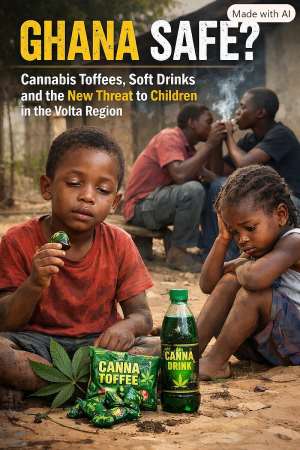
There is something deeply disturbing about the changing face of Ghana's illegal drug trade.
Drugs no longer have to look like drugs.
They can look like a sweet. A bottle of sobolo. An ice cream. A soft drink. An egg. A seemingly ordinary food item.
And that is precisely why Ghana must be asking a much harder question:
If narcotics are increasingly being disguised as ordinary consumer products, how safe are our children and who is watching the supply chain?
Recent developments do not prove that cannabis-infused toffees or soft drinks are being systematically sold to schoolchildren across the Volta Region. That distinction matters. But there is enough verified evidence of illegal cannabis cultivation, drug-laced toffees, drug trafficking and children being drawn into cannabis farms in the region to demand serious investigation rather than complacency.
The warning signs are already there.
The story did not begin yesterday
Ghana has battled cannabis cultivation and trafficking for decades.
The problem has historically involved cultivation, transportation, processing and distribution. The Volta Region has repeatedly appeared in reports concerning cannabis cultivation.
In 2012, police investigations uncovered a large cannabis farm in the Volta Region where authorities said a foreign national had acquired hundreds of acres and employed young people, including schoolchildren, to cultivate cannabis. A joint operation involving the police and the then Narcotics Control Board resulted in arrests and the seizure of suspected cannabis.
More than a decade later, the alarm bells are ringing again.
In July 2025, President of the Volta Regional House of Chiefs, Togbe Tepre Hodo IV, publicly raised concerns about marijuana plantations reportedly spreading in parts of the region.
He identified Vakpo and Wusuta in the North Dayi District and Gbefi in the Kpando Municipality, and reported that some basic-school pupils were abandoning classes to work on marijuana farms for very little money.
That is not merely a drug-control problem.
It is a child-protection problem.
Then came the most frightening part: children were reportedly entering the farms
According to the 2025 reports, the concern was not simply that children were seeing cannabis.
The concern was that some children were reportedly working on the farms themselves.
Togbe Hodo further warned that some children were allegedly being offered cannabis to smoke while working on the farms, potentially exposing them to drug use at a very early age.
Think about that for a moment.
A child who should be sitting in a classroom learning mathematics, science, ICT or English could instead be walking into a cannabis plantation.
And worse:
Could the person paying that child also be the person introducing that child to the drug?
That is the question that cannot be ignored.
Who is actually behind these farms?
This is where the investigation must become much more aggressive.
It is easy to destroy a farm.
It is harder to identify the people who:
finance the cultivation;
provide the seeds;
acquire or control the land;
recruit the children;
pay the labourers;
process the cannabis;
transport it;
store it;
distribute it;
and ultimately collect the money.
A field is not a drug network.
People make the network.
And if authorities only destroy plants without following the money, communications, vehicles, storage facilities and distribution channels, another farm can appear somewhere else.
NACOC has itself demonstrated that investigators are capable of going beyond plantations.
In June 2026, the Commission reported arresting three suspects after an intelligence-led operation at Koleonu, Wegbe and Akplamafu in the Volta Region. The operation targeted a suspected hub involved in the cultivation, processing and distribution of cannabis and hashish oil. The suspects were said to be assisting investigations into wider collaborators and supply routes.
That is the kind of investigation Ghana needs.
Not just: “Where is the farm?”
But:
“Who owns it, who finances it, who supplies it, who buys from it and where does the product finally end up?”
Then there is Aflao and six drug-laced toffees
This is where the story becomes even more uncomfortable.
On May 24, 2025, the Volta Regional Police Command conducted an intelligence-led operation around the Aflao border enclave.
Twenty-six suspects were arrested.
Among the items recovered were suspected Indian hemp, Tramadol, six drug-laced toffees, eight creams suspected to contain narcotic substances and 26 compressed parcels of suspected Indian hemp concealed in a fertiliser sack. Police also recovered significant amounts of Ghanaian and CFA currency.
The suspects were reported to be in police custody pending further investigation and court proceedings.
This should force Ghana to ask:
Who were those toffees intended for?
Were they intended for adults?
Were young people among the customers?
Where were they being sold?
Where were they manufactured?
Who supplied the cannabis?
Who supplied the packaging?
Who supplied the recipes or processing materials?
And most importantly:
Were investigators able to trace the supply chain beyond the people caught carrying the products?
Those questions deserve answers.
But are cannabis toffees actually hooking Volta's children?
Here we must be extremely careful.
There is currently no credible public evidence I found proving that cannabis-infused toffees and soft drinks are being systematically distributed to children throughout the Volta Region.
That allegation should not be presented as an established fact.
But there is evidence that cannabis-infused consumer products are becoming a growing national concern.
In June 2026, NACOC arrested five Central University students over alleged production and sale of cannabis-infused ice cream, sobolo, toffees, pepper and eggs, alongside raw cannabis. The arrests followed intelligence concerning illicit drug activity during a campus celebration.
NACOC subsequently engaged the University of Ghana over concerns about edible products allegedly laced with cannabis being sold to students, particularly around student-centred events.
And in August 2026, NACOC reported another operation at Koforidua Technical University involving ten students allegedly trading cannabis-infused drinks and ice cream during an event.
So the national trend is real enough to demand vigilance.
The question is whether the same method is reaching younger children in communities in the Volta Region.
That question requires evidence-based investigation not rumours.
Do the children even know what they are consuming?
This may be the most frightening question of all.
A child does not necessarily see a narcotic when looking at a sweet.
The child sees:
“Toffee.”
The child sees:
“Sobolo.”
The child sees:
“Ice cream.”
The child sees:
“Drink.”
And that changes the entire nature of the threat.
The danger is not only deliberate drug use.
It could also involve unwitting exposure.
That is why NACOC recently warned students to be cautious about accepting food, sweets, drinks and other edible products from unknown persons, particularly during social events.
But where are the children saying they got them?
This is an area where the public record is surprisingly thin.
I found reports about children allegedly working on cannabis farms in the Volta Region.
I found reports about drug-laced toffees seized at Aflao.
I found reports about cannabis production and storage hubs.
I found national cases involving cannabis-infused foods and drinks.
But I did not find credible published interviews in which identified Volta-region children themselves explained that they bought cannabis toffees or cannabis-infused soft drinks from a particular person or location.
That gap should not be filled with speculation.
It should be filled with investigation.
Authorities should be asking affected children through properly trained child-protection professionals:
Who gave it to you?
Where did you first see it?
What did they call it?
Did you pay for it?
How much?
Where did you meet the person?
Was the person a student, adult, vendor, farmer or stranger?
Did your friends use it?
Did anyone tell you what was inside it?
Did anyone pressure you to try it?
Did the person return to sell more?
Those answers could reveal an entire distribution network.
What exactly is NACOC doing?
It would be unfair to suggest that NACOC is doing nothing.
The Commission has been conducting enforcement operations, public education, school programmes, community sensitisation, counselling and prevention initiatives.
NACOC says its demand-reduction programme includes preventive education, sensitisation programmes, counselling, school outreach and public awareness through traditional and digital media.
In 2026, the Commission also intensified engagement with educational institutions.
In August, NACOC's Director-General warned young people about misconceptions surrounding cannabis, particularly the dangerous idea that because cannabis comes from a plant, it is automatically harmless.
In the Volta Region, NACOC has also participated in youth-focused programmes.
At the UHAS Basic School World Drug Day programme in Ho in June 2026, students, teachers, health professionals, security agencies and social welfare institutions participated in discussions about drug prevention.
And in September 2026, a NACOC officer in the Volta Region told students that factors contributing to drug use included pressure, curiosity, easy availability, limited risk perception and weak parental styles.
So education is happening.
But here is the uncomfortable question:
Is the education moving faster than the drug dealers?
What are children actually being taught?
Good drug education cannot simply be:
“Don't smoke wee.”
Today's threat is more sophisticated.
Children need to understand that drugs can appear as:
sweets;
drinks;
food;
powders;
tablets;
oils;
vapes;
unknown mixtures;
and products deliberately made to resemble ordinary consumer goods.
NACOC has acknowledged the need for evidence-based drug education, teacher involvement, parental participation and early intervention. Its school-prevention guidance also stresses correcting misinformation and creating environments where students can discuss substance-related problems without fear or humiliation.
That is important.
Because if a child is afraid that telling a teacher will result in punishment, suspension or public embarrassment, the child may remain silent.
And what happens when a child knows something?
Ghana must make reporting easier.
Children should know exactly who they can tell if:
someone offers them an unknown sweet;
someone sells drugs near a school;
an older person recruits them into a cannabis farm;
someone pressures them to smoke;
a vendor is selling suspicious food or drinks;
or another student is distributing narcotics.
The message should be simple:
Tell a trusted parent.
Tell a teacher or school counsellor.
Tell school authorities.
Report to the police.
Report to NACOC.
And where a child is involved, the response must prioritise protection and professional support, not simply punishment.
What is Ghana Police doing?
The Volta Regional Police Command has demonstrated that it is capable of intelligence-led enforcement.
The May 2025 Aflao operation resulted in 26 arrests and the seizure of suspected narcotics and drug-laced products.
That is significant.
But enforcement should not stop at the person physically carrying the drugs.
The real target should be the network.
Who is financing it?
Who owns the vehicles?
Who provides the warehouses?
Who controls the farms?
Who collects the money?
Who communicates with buyers?
Who moves the products across communities and borders?
And because Aflao is a border area, the question becomes even more important:
Are traffickers exploiting Ghana's borders to move narcotics, ingredients or finished products into and out of the country?
And what about the Volta Regional authorities?
The Regional House of Chiefs has already raised the alarm.
NACOC has conducted operations.
The Police have conducted arrests.
Schools and other institutions are conducting sensitisation programmes.
But the problem is bigger than any one institution.
If children are genuinely being pulled out of school to work on cannabis farms, then the Regional Coordinating Council, Metropolitan/Municipal/District Assemblies, Ghana Education Service, Social Welfare, traditional authorities, Police and NACOC should have a coordinated child-protection response.
Because destroying cannabis plants without rescuing vulnerable children does not solve the underlying problem.
A child who leaves one farm can be recruited into another.
The cannabis licensing confusion must also be confronted
Ghana's current cannabis regulatory framework allows tightly controlled cultivation of low-THC cannabis for approved medicinal, industrial and research purposes.
Recreational cannabis remains illegal.
NACOC says licensed cultivation is restricted to cannabis containing no more than 0.3% THC, with regulatory controls covering cultivation, processing, storage, transport and distribution.
In July 2026, NACOC announced the first licences to two companies for regulated low-THC cannabis cultivation, while stressing that recreational cannabis remains illegal.
That distinction must be communicated loudly.
Because when citizens hear:
“Cannabis cultivation has been legalised,”
some may misunderstand it to mean:
“Anybody can plant cannabis.”
They cannot.
NACOC has specifically warned that unlicensed cannabis farms remain illegal.
And then came the GH¢1.18 million question
On May 31, 2026, NACOC raided a suspected storage facility at Gbi-Wegbe near Hohoe and seized 2,372.38 kilogrammes of suspected cannabis, estimated by the Commission at a street value of about GH¢1.186 million.
At the time of the reported seizure, no arrest had been made and investigations were continuing to identify people connected to the operation.
Now stop and think.
More than two tonnes of suspected cannabis.
A storage facility.
A reported street value exceeding one million Ghana cedis.
And somewhere in that chain there must be:
cultivators → processors → transporters → storage operators → wholesalers → retailers → consumers.
So the biggest question is not merely:
“How much cannabis did NACOC seize?”
The bigger question is:
“How much did Ghana fail to seize because it had already reached the market?”
The questions authorities cannot afford to avoid
If Ghana is serious about protecting children, these questions should be investigated publicly and systematically:
1. How many cannabis farms currently operate illegally in the Volta Region?
2. How many children have been identified working on them?
3. How many children have been removed from such farms?
4. How many farm owners or financiers have actually been prosecuted?
5. Who supplies the cannabis being processed into edible products?
6. Are illegal cannabis farms supplying the emerging cannabis-edible market?
7. Are children being used as couriers or street-level sellers?
8. Are cannabis-infused sweets or drinks being sold around schools?
9. Have schools in the Volta Region reported suspicious sweets, drinks or food products?
10. How many complaints have NACOC, Police and schools received from children or parents?
11. How many of those complaints resulted in investigations?
12. How many resulted in arrests?
13. How many arrests resulted in convictions?
14. Where are the convicted offenders today?
15. Who is financing the cultivation and processing operations?
16. Are criminal networks using legitimate businesses as fronts?
17. Are social media platforms being used to market cannabis-infused products to young people?
18. Are border communities being adequately monitored?
19. Are teachers trained to identify drug exposure among children?
20. Are parents being taught what today's drug products actually look like?
These are not accusations.
They are questions that responsible authorities should be able to answer.
And perhaps the biggest question: where are the victims?
When we talk about drug seizures, we talk about:
kilograms.
arrests.
farms.
parcels.
street value.
But what about the child?
Where is the child who started working on a cannabis farm?
Where is the pupil who stopped attending school?
Where is the teenager who was allegedly introduced to cannabis by an adult?
Where is the young person whose first drug experience came disguised as something harmless?
What treatment did that child receive?
What counselling was provided?
Was the child returned to school?
Was the family supported?
Was the person who recruited the child prosecuted?
Those are the statistics Ghana should also be publishing.
Is Ghana safe?
That question deserves neither panic nor complacency.
There is no evidence from the sources reviewed that Ghana's children generally are being secretly fed cannabis toffees or cannabis soft drinks.
But there is enough evidence to conclude that Ghana faces a serious and evolving narcotics challenge:
illegal cannabis cultivation exists;
children have reportedly been drawn into cannabis farming in the Volta Region;
suspected cannabis storage and production facilities have been raided;
suspects have been arrested;
drug-laced toffees have been seized in the Volta Region;
cannabis-infused foods and drinks have been implicated in cases involving tertiary students elsewhere;
and NACOC itself has expressed concern about cannabis-infused edible products reaching students.
That is enough to demand vigilance.
Not hysteria.
Vigilance.
The final question Ghana must answer
A country is not truly safe simply because authorities occasionally seize drugs.
A country is safer when criminals are unable to cultivate them freely, children are not recruited into the supply chain, schools can identify emerging threats, parents know what to look for, communities report suspicious activity, police follow the money, NACOC dismantles networks and vulnerable children receive protection.
So perhaps the most uncomfortable question is this:
If we already know that children have been reported working on cannabis farms, if drug-laced toffees have already been seized in the Volta Region, if tonnes of suspected cannabis have been intercepted near Hohoe, and if cannabis-infused foods and drinks are appearing in drug investigations elsewhere in Ghana what exactly are we waiting for before we investigate whether these threats are converging around our youngest citizens?
Because the greatest danger may not be the cannabis plant.
It may be the person who figures out how to put it inside something a child would happily eat or drink.
And when that happens, the question will no longer be:
“Where are the drugs?”
It will be:
“Where were the adults responsible for protecting the children?”
Ghana must answer that question before another generation pays the price.
By:
Patrick Belebang Yagsori
+233240292413
[email protected]

 'The height of absurdity' — Ayew Afriye slams BNI over invitation of Efya Royal ...
 US envoys arrive in Moscow to thrash out plan to end war in Ukraine
 'Chief Justice was talking as a citizen; you have to look at the context in whic...
 Mandatory towing to remove broken-down, stationary vehicles from roads to begin ...
 Domelevo backs OSP probe into alleged GH¢70,000 payment to Appiagyei despite den...
 WAEC releases 2026 WASSCE results, cancels entire results of 861 candidates for ...
 Baffour Agyeman-Duah explains why profitability may not be only reason behind SO...
 Kofi Bentil defends Mahama’s dissolution of nine State Boards
 5-year-old girl dies after falling into water-filled manhole at Winneba
 Sierra Leone ex-president to return after treason case dropped

