




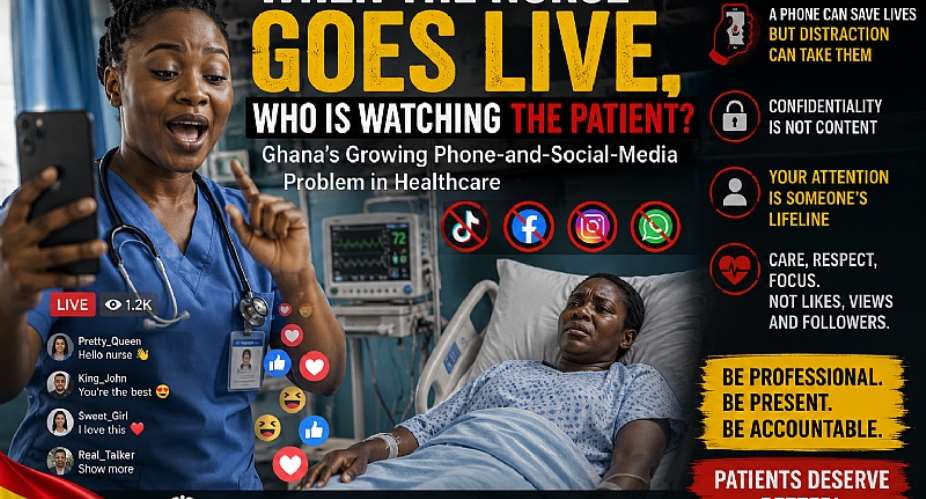
When a healthcare professional is holding a smartphone during working hours, should the patient assume that the phone is being used for healthcare or should the patient worry that attention has shifted from the bedside to TikTok, Facebook, WhatsApp or Instagram?
It is an uncomfortable question.
But perhaps healthcare has reached the point where uncomfortable questions must be asked.
A nurse, midwife, doctor, physician assistant or other health professional is not simply another employee sitting behind a desk. Their decisions can affect whether a patient receives medication on time, whether a deteriorating patient is noticed, whether an emergency is escalated quickly and, in extreme circumstances, whether someone survives.
So what happens when the person entrusted with watching the patient is simultaneously watching a phone screen?
Who comes first the notification or the patient?
The phone itself is not the enemy
Let us be fair.
Healthcare has changed dramatically because of technology.
Mobile phones can help health professionals communicate with colleagues, access medical information, coordinate emergencies, contact laboratories, communicate with supervisors and perform legitimate work-related tasks.
Research involving community health nurses in Ghana has even found that mobile phones can support healthcare delivery, although they also impose costs on health workers who use their personal phones for work.
Therefore, demanding that every health professional completely abandon phones would be simplistic.
The real issue is purpose, timing, concentration, privacy and accountability.
There is a world of difference between a nurse using a phone to contact a doctor about a patient's emergency and a nurse sitting beside a patient scrolling through TikTok.
There is a difference between checking a clinical instruction and going live on Facebook.
There is a difference between taking an authorised work-related photograph and broadcasting a hospital environment to thousands of strangers.
And there is an enormous difference between using technology to save a life and using technology while forgetting that a life is depending on you.
Does every health professional understand the rules governing the profession?
This is perhaps the question Ghana needs to ask.
The Nursing and Midwifery Council's own professional material states that nurses must respect the dignity of patients and hold personal information entrusted to them in confidence. It also places responsibility, accountability and ethical behaviour at the centre of professional practice.
The Ghana Health Service's Code of Conduct also identifies failures involving privacy, confidentiality and the integrity of electronic medical records and ICT systems as disciplinary matters.
And GHS's medical records policy is even clearer: communications and documentation concerning patients are to be treated as confidential, while access to medical records is restricted to persons involved in the patient's management or quality monitoring, subject to the applicable rules.
So perhaps the question isn't simply:
"Do health workers know the rules?"
The more disturbing question is:
If they know the rules, why do some behaviours that appear inconsistent with those rules continue to occur?
Is it ignorance?
Is it inadequate supervision?
Is it weak enforcement?
Is it a generational social-media culture that has blurred the boundary between professional and personal life?
Or have some professionals simply become too comfortable because they believe nobody will hold them accountable?
What happens when the ward becomes a studio?
Imagine this.
A patient is lying on a hospital bed.
A nurse is nearby.
The patient's family expects the nurse to be watching the patient.
But the nurse has opened TikTok Live.
The camera is facing the nurse. Comments are coming in. People are sending gifts. The nurse is responding to viewers.
Then the patient calls:
"Nurse!"
Nothing.
Again:
"Nurse, please!"
The nurse says, "Wait."
But what exactly is the nurse waiting for?
A comment?
A notification?
A virtual gift?
Another follower?
Or the patient?
This is where the conversation becomes much bigger than social media.
Can a health professional genuinely provide undivided attention to a patient while simultaneously producing entertainment content for an online audience?
And if the answer is no, why is it happening inside healthcare facilities?
What if the patient is visible in the background?
This is where confidentiality becomes even more serious.
A healthcare worker may think:
"I am only making a video of myself."
But what is behind the camera?
A patient.
A medical chart.
A prescription.
A bed number.
A relative.
A treatment room.
A person undergoing a procedure.
A patient's voice.
A medical condition.
A name appearing briefly on a document.
A vulnerable person who never agreed to become part of someone's social-media content.
GHS itself has recognised the importance of protecting health information. In May 2026, it held a dedicated programme on the protection of patient information under Ghana's Right to Information framework, including confidentiality obligations and the legal consequences of unlawful disclosure.
GHS has also recently described healthcare information as highly sensitive and said its information-security policies are binding on staff and third-party service providers.
So we need to ask:
Can a person livestream from a clinical environment without creating a privacy risk?
Who authorised the livestream?
Did every patient captured in the background consent?
Was written consent obtained where necessary?
What happens when a patient's medical information accidentally enters the livestream?
And perhaps the hardest question:
If a patient's dignity is compromised for a few seconds on TikTok, who takes responsibility after the video has already been copied, downloaded and redistributed thousands of times?
Ghana has seen warnings before
This is not an entirely new conversation.
In 2023, the Upper East Regional Hospital publicly warned student nurses against TikTok and social-media use during practical work, with hospital administrators describing phone use and chatting during patient-care periods as a problem.
More recently, in July 2026, management of the Upper East Regional Hospital again cautioned National Service personnel against mobile-phone use during working hours, particularly in wards, and warned that unauthorised use could attract disciplinary consequences.
There have also been reports of hospitals taking stronger measures. In 2023, Komfo Anokye Teaching Hospital was reported to have restricted social-media access on its IT systems because of concerns about staff spending working time on platforms such as TikTok.
So the problem is not imaginary.
The question is whether existing interventions are strong enough, consistent enough and widespread enough.
Patients have already been talking
Perhaps the most powerful evidence comes not from administrators but from patients and their families.
A Ghanaian study examining patients' and families' perceptions of nurses and midwives found excessive mobile-phone use among the negative behaviours reported by participants. Some respondents described nurses making lengthy calls or chatting on phones while patients were waiting for attention.
That should concern everybody.
Because when a patient enters a hospital, they are not simply buying a service.
They are often frightened.
They may be in pain.
They may have no idea what is happening to their body.
They may be waiting for someone to tell them whether their condition is serious.
And the person they expect to respond may be staring at a phone.
So what does the patient think?
"Maybe my condition isn't serious."
"Maybe the nurse will attend to me soon."
"Maybe I'm disturbing them."
Or the most frightening thought:
"Does anybody actually care that I am here?"
What if the emergency happens while the professional is distracted?
This is the question nobody wants to answer.
Healthcare is not always predictable.
A patient who looks stable at 10:00 a.m. can deteriorate at 10:05.
A mother's condition can change during labour.
A child can suddenly develop breathing difficulties.
A postoperative patient can develop complications.
A patient waiting for attention can suddenly collapse.
That is why nursing practice includes monitoring patients, recognising changes in their condition, providing emergency care and advocating for patient safety.
So ask yourself:
If a nurse spends five minutes on TikTok and a patient's condition changes during those five minutes, who was watching?
If a patient calls for assistance while a health worker is recording a video, who is responsible for the delay?
If an emergency occurs while a professional is on a personal call, should that be considered merely "phone use" or a professional-performance issue?
And perhaps the most uncomfortable:
How many seconds of distraction are acceptable when someone's life may depend on your attention?
There is no universal magic number.
That is precisely why healthcare facilities need clear rules and active supervision.
But where are the hospital authorities?
This brings us to another uncomfortable question.
It is easy to blame the individual nurse.
But what about the institution?
If a health facility knows that staff routinely use personal phones during patient-care hours, what exactly is management doing?
Are supervisors conducting unannounced checks?
Are there clear policies?
Are staff reminded during orientation?
Are complaints investigated?
Are repeat offenders disciplined?
Are patients given a safe channel to report inappropriate conduct?
Are facility managers monitoring social-media content involving the hospital?
Or does management only react after a video becomes viral?
GHS's own operational guidance expects facilities to orient staff on the Patient Charter, Code of Ethics and customer care, and to use the Code of Conduct and disciplinary procedures when dealing with indiscipline and other offences.
That raises a serious accountability question:
If the rules already exist, is the problem the absence of rules or the absence of enforcement?
And what exactly is the Ministry of Health doing?
The Ministry of Health and Ghana Health Service cannot realistically police every employee's smartphone every minute.
But they can establish a culture of professional accountability.
They can demand that facilities develop and enforce clear phone-use policies.
They can strengthen privacy and confidentiality training.
They can make social-media conduct part of professional orientation and continuing education.
They can clarify when phones are permitted for clinical purposes and when personal use is prohibited.
They can require institutions to investigate credible complaints.
And they can ensure that disciplinary action is not dependent on whether misconduct becomes viral.
GHS is not ignoring digital risks entirely. In 2026 it has been actively working on information-security standards and revising its medical-records strategy to address digital health, data governance, cybersecurity and emerging technologies.
But perhaps Ghana now needs to address a different digital-health problem:
Not merely how health information is protected from hackers but how it is protected from the smartphone in the hands of the person inside the hospital.
What are the professional associations saying?
Professional bodies have a responsibility that goes beyond defending their members.
They must also defend the integrity of the professions.
The Nursing and Midwifery Council has publicly emphasised that professional ethics, human rights, dignity and respect are fundamental to nursing and midwifery care.
The Council has also previously investigated inappropriate social-media conduct involving a nursing student and warned nursing students against using uniforms for unapproved activities.
That is important because professional identity does not disappear when someone opens TikTok.
If you appear in a professional uniform, people associate your conduct with your profession.
So perhaps the professional bodies need to answer:
Should there be a national social-media code specifically addressing health professionals?
Should filming or livestreaming from clinical areas without institutional authorisation attract professional sanctions?
Should repeated phone distraction during patient care be treated as a professional-performance issue?
Should hospitals be required to report serious confidentiality breaches to the relevant regulator?
And perhaps most importantly:
Should professional bodies wait for patients to complain before acting?
"But foreigners use TikTok too"
Someone may respond:
"How many times have you seen a white man or woman in uniform on TikTok?"
That argument needs to be handled carefully.
Social-media use exists everywhere. Healthcare workers in many countries use social platforms professionally and personally.
The issue is not whether a health worker is Ghanaian, white, black, Asian or African.
The issue is professional boundaries.
A nurse can have a TikTok account.
A doctor can have Instagram.
A midwife can create health-education videos.
A healthcare institution can use social media to educate the public.
None of that is inherently wrong.
In fact, professionally produced health education on social media can be extremely valuable.
But the question is:
Are you using social media to serve healthcare, or are you using healthcare premises, patients, uniforms and working hours to serve your social-media career?
That is the line Ghana must define.
We must also be fair to health professionals
This debate should not become an excuse to insult nurses, doctors or other health workers.
Many Ghanaian health professionals work under immense pressure.
They work long shifts.
They deal with emergencies.
They face shortages.
They deal with distressed patients and families.
Many sacrifice enormously to save lives.
And there are countless professionals who are exceptionally dedicated.
The concern is about conduct that places patient safety, attention, dignity or confidentiality at risk.
We must also distinguish between legitimate work-related phone use and recreational use.
A blanket ban could actually interfere with modern healthcare delivery.
What Ghana needs is not an irrational war against smartphones.
Ghana needs professional discipline around smartphones.
The bigger problem is culture
Perhaps the most frightening development is that social media has changed our understanding of what deserves to be recorded.
We now record food.
We record funerals.
We record arguments.
We record accidents.
We record private conversations.
We record people in distress.
And increasingly, some people seem to believe that if something happens, it must become content.
But healthcare is one of the few environments where the human being in front of you may be at their most vulnerable.
The patient may be naked.
The patient may be unconscious.
The patient may be bleeding.
The patient may be giving birth.
The patient may be mentally distressed.
The patient may have just received devastating news.
That person is not content.
The question Ghana must now answer
What kind of healthcare culture are we building?
One where the patient enters a ward and immediately becomes the centre of professional attention?
Or one where the patient competes with WhatsApp messages, TikTok comments, Facebook notifications and Instagram followers?
What happens when "going live" becomes more important than staying alert?
What happens when a nurse becomes more concerned about how many people are watching than how many patients are waiting?
What happens when a hospital's reputation is protected more aggressively than a patient's dignity?
What happens when management sees inappropriate phone use but looks away?
What happens when professional associations defend their members but fail to confront misconduct?
And what happens when patients become too afraid to complain because they believe nothing will change?
Perhaps the most important question of all
A health professional takes an oath.
A patient takes a risk.
The professional walks into the ward with training.
The patient walks into the hospital with trust.
Which one should the professional protect first?
The answer should be obvious.
It should always be the patient.
Technology should help healthcare professionals become better at their jobs not become a reason they are less attentive to the people they were employed to serve.
Ghana Health Service already has a Patient Charter, confidentiality guidance, a Code of Conduct and disciplinary procedures. It also continues to develop policies around information security and digital health.
The challenge now is to make those principles visible at the bedside.
Because a patient should never have to wonder:
"Is the person supposed to be watching me or is the person watching TikTok?"
And perhaps every health facility should place one question where every professional can see it before beginning a shift:
> "If this were your mother, father, child or loved one lying in that bed, would you still be on your phone?"
If the answer is no, then perhaps the phone should already be in the pocket.
Healthcare is not a content studio. A patient is not a follower. A hospital ward is not a TikTok set. And a human life should never have to compete with a notification.
Ghana must wake up before distraction becomes normal and accountability becomes optional.
By:
Patrick Belebang Yagsori
+233240292413
[email protected]

 No more Messi nights for Argentina as skipper says adios to national squad
 ‘Neither East nor West, but forward together’ – Ghana's President renews Nkrumah...
 Ghana records GH¢46.1bn trade surplus in Q1 2026 despite real-term deficit
 Dollarisation of rent: Commissioner accuses BoG of ignoring Rent Control’s call ...
 Gold Coast customers hit streets today over locked-up funds
 Bright Simons explains why SIGA’s GH¢19.8bn SOE profit claim is 'bizarre'
 Election defeat can be life-saver – Former MP
 COCOBOD settles outstanding 2026 DDEP obligations with GH¢2.3bn payment
 OSP has delivered little to Ghanaians despite huge spending – Adomako-Kissi
 AI can replace only lazy lawyers – Justice Asante

