




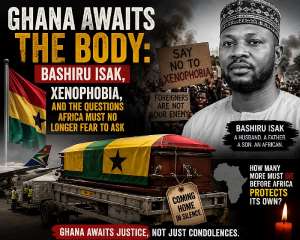
The death of 40-year-old Ghanaian national Bashiru Isak in South Africa is more than a tragic headline. It is a painful reminder that for many Africans living on the continent, crossing a border can sometimes mean crossing into danger. His death has reopened difficult questions about xenophobia, African unity, leadership, justice, and whether the lives of Africans are equally protected in Africa.
Who was Bashiru Isak?
He was not a criminal. The Government of Ghana has described him as a law-abiding citizen, a husband, and a loving father of three children. Like millions of Africans, he travelled in search of opportunity and a better life. He was living in South Africa when he was fatally shot multiple times in Khayelitsha, Cape Town, on June 30, 2026, during demonstrations linked to anti-immigrant campaigns targeting foreign African nationals.
The questions must now begin.
Was Bashiru Isak merely in the wrong place at the wrong time? Was he deliberately targeted because he was Ghanaian or because he was African but not South African? Was his death preventable? Most importantly, if authorities were aware of the growing anti-immigrant tensions, why was adequate protection not provided for vulnerable communities?
The South African police and government have reportedly disputed aspects of the circumstances surrounding his death, including initial claims relating to his identity and whether the killing was directly linked to xenophobic violence. Ghana has strongly rejected false claims regarding his identity and has demanded a transparent investigation.
Perhaps the most troubling development is that Ghana's High Commission and the family reportedly struggled to obtain the official autopsy report from South African authorities, prompting an independent autopsy in Ghana. Why should a grieving family struggle to obtain answers? Why should governments have to fight for basic transparency when one of their citizens has been killed?
The Government of Ghana has facilitated the repatriation of his mortal remains, which arrived in Ghana on July 14, 2026. Senior government officials and family members received his body before it was transferred to the mortuary pending an independent autopsy and burial according to Islamic customs.
Yet, bringing home a dead body cannot become Africa's definition of diplomacy.
What Are Ghanaians Saying?
Many Ghanaians have expressed anger, disappointment, and frustration. For them, Bashiru Isak is not an isolated incident but another chapter in the painful history of xenophobic violence against fellow Africans in South Africa.
There are difficult questions being asked in homes across Ghana:
How many Africans must die before xenophobia is treated as a continental emergency?
Why are Africans becoming unsafe in Africa?
Why do African governments appear more united during summits than during moments of tragedy?
Are economic frustrations being unfairly redirected toward migrants?
These questions are uncomfortable precisely because they are necessary.
What Is South Africa Saying?
South Africa has repeatedly condemned xenophobic attacks and maintains that it possesses constitutional and legal mechanisms to combat discrimination and violence. President Cyril Ramaphosa has previously denounced intolerance and violence against foreign nationals. South African authorities have also deployed police units during recent anti-immigration demonstrations across parts of the country.
However, many Africans are asking whether condemnations alone are enough.
Can governments simply condemn violence after it happens, or should they be judged by their ability to prevent it from happening?
If intelligence services knew anti-immigrant demonstrations were planned, why are foreign nationals still being killed?
Why are migrants still fleeing and seeking evacuation?
Questions are not accusations. They are the foundation of accountability.
Can President Ramaphosa's Words Still Be Trusted?
This question will undoubtedly make some uncomfortable, but it deserves discussion.
Trust is not built through speeches alone. It is built through measurable action.
President Ramaphosa has condemned xenophobia numerous times. Yet violence against foreign nationals continues to occur. The question therefore is not whether his words are sincere but whether his government's actions are sufficient.
Can African leaders continue speaking about African unity while African migrants live in fear?
Can South Africa lead continental initiatives if fellow Africans are afraid to visit, work, or invest there?
Trust must ultimately be earned through justice, prosecutions, and protection not promises.
How Will This Affect Ghana-South Africa Relations?
Diplomatic relations between Ghana and South Africa have already suffered strain. Ghana recently postponed bilateral engagements amid growing concerns surrounding anti-migrant violence. Nearly one thousand Ghanaian nationals have been repatriated from South Africa during emergency exercises.
Diplomacy survives difficult moments, but public trust is much harder to rebuild.
The bigger question is this:
Will future generations of Ghanaians see South Africa as the land of opportunity or the land of uncertainty?
Will South African businesses operating across Africa receive the same hospitality that Africans expect in South Africa?
Africa cannot preach integration while practising exclusion.
The Questions Nobody Wants To Ask
If Bashiru Isak were South African and killed in Ghana, would South Africa demand compensation?
Why do African leaders become louder when tragedies happen outside Africa than when Africans kill Africans?
Has xenophobia quietly become institutionalised through political silence?
Are foreign Africans being used as convenient scapegoats for unemployment and economic hardship?
If African migrants contribute to economies through taxes, labour, and investments, shouldn't governments equally guarantee their safety?
What specific timelines have South African authorities given for arrests and prosecution?
If nobody is prosecuted, what message will that send to future perpetrators?
How many more bodies must return home before xenophobia is declared a continental security threat?
What About Compensation?
At present, Ghana has demanded justice, transparency, investigations, arrests, and prosecution. Publicly available statements have not announced any compensation package for the family of Bashiru Isak.
Should there be compensation?
That question deserves national and continental discussion.
Can governments simply issue condolences when citizens are killed abroad? Should victims' families receive compensation where negligence or failures of protection are established?
Justice must not end at condolences.
Bashiru Isak Was Somebody's Everything
Behind every headline lies an unfinished story.
He was somebody's husband.
Somebody's father.
Somebody's son.
Three children will grow up asking questions that governments cannot easily answer.
No diplomatic statement can replace a father's embrace.
Final Thoughts
This article is not an indictment of all South Africans. Millions of South Africans have stood against xenophobia and defended the dignity of fellow Africans. Their voices matter and deserve recognition. Xenophobia must never become synonymous with an entire people.
But silence is equally dangerous.
The death of Bashiru Isak must become more than another news cycle. Africa owes him that much.
Perhaps the greatest question of all is this:
If an African cannot feel safe in Africa, what exactly does African unity mean?
Ghana now awaits justice not merely the return of a body.
And Africa waits for answers.
By:
Patrick Belebang Yagsori
+233240292413
[email protected]

 ‘We will invoke our unforgiving gods to deal with you’ – Atronie chiefs warn gal...
 272 Ghanaians lured into Russia-Ukraine war, 55 killed – Foreign Minister announ...
 Importers demand action against shipping lines for defying GH¢720 container fee ...
 'Wontumi went overboard, forgive and grant him clemency' — Spokesperson begs Mah...
 Transport unions, Transport Ministry to meet over proposed 30% fare hike
 Ghana probes reported recruitment of nationals into Russia-Ukraine war
 'IMF exit a result of collective efforts, not single event' — Egyapa Mercer
 Minerals Commission orders Earl Group, Small-Scale Miner to halt operations in G...
 GMet forecasts fog, cloudy weather, morning mist and afternoon thunderstorms acr...
 IMF approves final review of $3bn bailout as Ghana completes programme

