




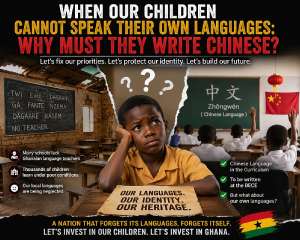
There is nothing wrong with learning Chinese. There is nothing wrong with learning French, Arabic, or any other international language. Knowledge should never be feared. But every nation must ask itself one uncomfortable question: At what cost?
Today, Ghana stands at a difficult crossroads. Our educational system continues to struggle with inadequate classrooms, schools without libraries, communities without teachers, and thousands of children learning under difficult conditions. Yet, we are being told that Chinese language deserves a place in our educational curriculum.
Perhaps the question should not be, "Why Chinese?" Perhaps the real question should be, "Why now?"
If Chinese language is important enough to be taught to Ghanaian children, is Ghanaian language important enough to be properly taught to Ghanaian children?
How many schools in Ghana can proudly say they have qualified Ghanaian language teachers? How many schools in our villages have teachers for Dagbani, Dagaare, Ga, Ewe, Fante, Gonja, Kasem, Nzema, Gurene, or other Ghanaian languages? How many Ghanaian children are punished by circumstance because their schools simply do not have Ghanaian language teachers?
For years, we have been told there are insufficient teachers for our local languages. If we cannot adequately teach our own languages, where shall we find thousands of qualified Chinese language teachers?
Will Ghana train them? How many Ghanaian teachers currently speak Mandarin fluently? How many Colleges of Education are producing Chinese language teachers in sufficient numbers? Who will bear the cost of their training? The taxpayer? The Chinese government? Or both?
And if Chinese teachers are brought into Ghana, where will they teach? Will they stay in the deprived communities of Bongo, Zabzugu, Krachi, Bawku, Salaga, Sefwi-Wiawso, and Nkwanta? Or will they remain comfortably in Accra, Kumasi, Takoradi, and other urban centers while rural children are once again forgotten?
We must ask difficult questions because difficult questions protect the future of nations.
What exactly is Ghana receiving in return? Is this purely educational cooperation or something more strategic? What agreements exist between Ghana and China regarding language education? What long-term benefits have been carefully studied for Ghanaian children?
Will learning Chinese create employment opportunities for our children? If yes, where are those opportunities? Have they been clearly outlined? Have parents been informed about them?
If China considers Ghana an important partner, how many Chinese primary schools are teaching Twi? How many Chinese students are learning Ewe? How many are studying Dagbani, Ga, or Fante? Is cultural exchange flowing equally in both directions, or only in one?
These questions are not born out of hostility towards China. They are born out of love for Ghana.
The greatest nations in the world preserved their languages before exporting their ideas to others. China fiercely protects Mandarin. France protects French. Japan protects Japanese. South Korea protects Korean. Why then should Ghana become comfortable neglecting her own languages?
Language is not merely communication. It is identity. It carries our history, our values, our names, our proverbs, and our ancestors' wisdom. When a nation slowly loses its language, it slowly loses itself.
There are children in Ghana today who cannot properly write simple sentences in their own Ghanaian languages. There are schools where pupils have never been taught Ghanaian languages because teachers are unavailable. Yet, we are debating Chinese examinations.
Shouldn't we first ask whether our children can adequately read, write, and understand their own languages?
Should we not first fix our leaking classrooms before importing new curricular ambitions? Should we not first provide desks for children learning under trees? Should we not first invest in laboratories, libraries, and teacher training?
Are we running before learning how to walk?
No nation develops simply because it teaches foreign languages. Nations develop because they invest wisely in their people, infrastructure, teachers, and priorities.
If Chinese language becomes compulsory or eventually examinable at the BECE level while Ghanaian languages continue to suffer neglect, what message are we sending to our children? That foreign languages are more valuable than their own heritage?
Must a Ghanaian child know Mandarin before mastering his or her mother tongue?
Perhaps the most uncomfortable question of all is this: Are we unconsciously creating educational inequalities? Children in affluent urban schools may have access to qualified teachers and learning resources while children in deprived communities continue struggling with the basics. Are we widening the educational gap in the name of globalization?
This debate is bigger than China. It is about Ghana's priorities.
We should not reject knowledge because it comes from another country. But neither should we embrace foreign ideas without critically asking whether they serve our national interests.
A nation's future is hidden in the questions it dares to ask.
So let us ask them loudly.
- Why can we find room for Chinese when some Ghanaian languages still lack teachers?
- Who will teach Chinese across Ghana's thousands of schools?
- What measurable benefits will Ghanaian children receive?
- How much will implementation cost?
- Will deprived communities equally benefit?
- What are Chinese schools teaching about Ghanaian languages and culture?
- Are we strengthening our educational foundation or merely expanding it without preparation?
- Have we adequately protected Ghana's linguistic heritage before embracing another nation's language?
Finally, before our children write Chinese at the BECE, can we honestly say they have been given every opportunity to learn the languages of their fathers and mothers?
If the answer is no, then perhaps Ghana's first educational responsibility is not Beijing. It is Bolgatanga. It is Ho. It is Wa. It is Tamale. It is Cape Coast. It is Kumasi. It is every village and town where a Ghanaian child waits patiently for quality education.
The future of Ghana will not only be determined by the languages our children learn. It will also be determined by the languages we refuse to forget.
By:
Patrick Belebang Yagsori
+233240292413
[email protected]

 Two sustain gun wounds in Mankrong Nkwanta robbery
 Military personnel deployed to Bawku vehicle crashed STC bus at Nkenkesu
 Bohyen chief appeals for fire station to improve emergency response
 Father jailed 20 years for incest with 17-year-old daughter
 Court jails man 10 years for defiling seven-year-old boy
 'Africa remains rich in promise; our task is to ensure that promise matures into...
 Justin Kodua Launches Bid to Retain NPP General Secretary Post Ahead of Crucial ...
 Zanetor Demands Continental Action: ‘Africa Cannot Progress While Women Live in ...
 Mahama assures transfer of UGMC to University of Ghana
 Wontumi told me he would get 20year jail term before judgment was read – Lawyer ...

