




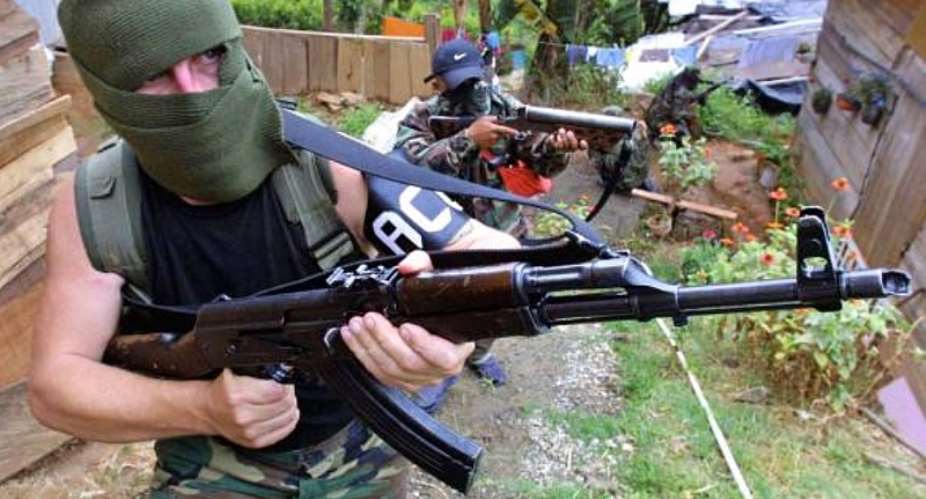
Colombia is once again approaching an election under a familiar and deeply unsettling shadow: armed violence erupting in the same spaces where democracy is supposed to breathe freely.
The reported killing of at least 52 guerrilla fighters in clashes between armed groups in Colombia’s remote regions is not just another security headline. It is a reminder sharp and uncomfortable that the country’s conflict has not ended. It has only changed shape.
And perhaps the most disturbing question is not what happened, but why this still happens at election time.
A Peace That Never Fully Arrived
Since the 2016 peace agreement with the now-defunct FARC, Colombia has been internationally praised as a post-conflict success story.
But on the ground, especially in rural corridors, that narrative has always been incomplete.
What replaced a centralized insurgency was not peace but fragmentation:
Dissident FARC structures that rejected full demobilization
Expansion of the ELN
And a growing ecosystem of criminal networks tied to cocaine trafficking routes
The result is not a single war, but many smaller wars overlapping, shifting, and economically driven.
This Is Not Random Violence. It Is Organized Geography of Power
The clashes that left 52 dead are not isolated eruptions of chaos. They reflect a brutal logic:
Control the land → control coca cultivation → control trafficking routes → control money → control people.
In Colombia’s remote Amazonian and border regions, armed groups often function as:
Tax collectors
Judges
Employers
Enforcers
In other words, they are not simply fighting the state. In many places, they are replacing it.
So the uncomfortable question arises:
If armed groups govern territory more directly than the state, what exactly is being defended in these elections?
Elections Under Pressure: Democracy in a Restricted Geography
Every election in Colombia carries a silent inequality: not all voters participate under the same conditions.
In urban centers, voting is routine. In rural conflict zones, it is conditional.
People must consider:
Who controls the road to the polling station?
Which armed group is watching turnout?
Does voting for a candidate risk retaliation?
This creates a democratic paradox:
Citizens are asked to choose leaders freely in places where freedom of movement is not guaranteed.
And so another question emerges:
Can an election truly represent a nation when parts of that nation vote under coercion, fear, or absence of state protection?
The Timing Nobody Can Ignore
The fact that such intense clashes occur on the eve of elections cannot be dismissed as coincidence.
History shows a pattern:
Armed groups demonstrate strength during political transitions
Territorial disputes intensify when governance is uncertain
Violence becomes a language of influence, not just conflict
So we must ask directly:
Is this violence about territory or about sending a message to the state and the next government?
And if it is a message, who is meant to hear it most loudly: the outgoing administration, the incoming one, or the voters themselves?
The State’s Dilemma: Security Without Presence
The Colombian government continues to respond with a dual strategy:
Military deployments in high-conflict zones
Ongoing attempts at negotiated peace with remaining armed actors
But both approaches face a structural limit.
Military operations can disrupt groups, but rarely dismantle the economic systems that sustain them.
Peace negotiations can reduce violence temporarily, but often do not reach fragmented mid-level commanders who operate independently.
So another uncomfortable question emerges:
Is Colombia fighting symptoms while the underlying economic engine of war remains untouched?
The Deeper Reality: A War That Became an Economy
What makes Colombia’s situation so complex is that violence is no longer only ideological. It is commercial.
The modern conflict is driven by:
Coca cultivation economies
Global drug demand
Territorial taxation systems run by armed groups
Local governance vacuums
In this sense, Colombia is not only dealing with insurgency it is dealing with a parallel economy that rewards armed control.
And so we must ask:
What happens when violence becomes more profitable than peace in certain regions?
The Questions That Must Be Asked but Rarely Are
Beyond the headlines, several critical questions remain largely unspoken in international coverage:
Why do armed groups continue to regenerate faster than peace processes can absorb them?
Are current peace strategies unintentionally encouraging fragmentation rather than ending conflict?
Who benefits economically from the persistence of territorial instability?
Why does rural Colombia remain structurally disconnected from the state after decades of policy promises?
And most importantly: Is Colombia trying to end one war while ignoring the system that keeps producing new ones?
Conclusion: A Democracy Negotiating Its Own Geography
Colombia is not simply facing an election shadowed by violence. It is facing a deeper constitutional tension between formal democracy and informal armed governance.
On paper, the state is sovereign.
In practice, sovereignty is shared, contested, and in some regions, actively enforced by non-state actors.
The deaths of 52 guerrillas are not just a battlefield statistic. They are a signal that Colombia’s conflict remains alive—adapted, decentralized, and deeply embedded in economic reality.
And so the final question lingers beyond the election cycle:
Can democracy fully function in a country where parts of its territory still operate under the logic of armed rule rather than civic law?
Until that question is answered, every election in Colombia will carry not only ballots but echoes of an unfinished war.
By:
Patrick Belebang Yagsori
+233240292413
[email protected]

 Ghana lost 1.1 million ounces of gold to smuggling in 2023 – GHEITI report
 Stranded Ghanaian fishermen narrate how they ate fresh fish, drunk sea water to ...
 How notorious armed robber died on the way whiles leading police to arrest accom...
 'We must continuously improve cargo handling, coordination among port operators'...
 GPHA honours industry players, former leaders and staff at 40th anniversary awar...
 Nii Lante Vanderpuye confident of winning NDC national chairmanship despite Gold...
 Agalga dismisses critics, assures Builsa North of progress on Sandema–Wiaga Road
 NDC Lawra constituency polls: We are not going to disappoint you – Chairman Bati...
 Ghana's President Mahama calls for new West African security accord, stronger AU...


