




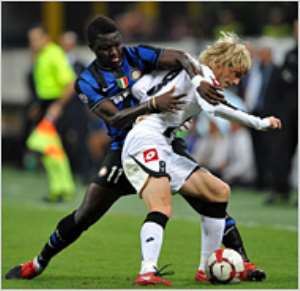
At San Siro in Milan on a Saturday night, the game is three-quarters done, the team is not playing well, and the home crowd needs a focal point for its discontent.
When Inter's coach withdraws a player, he becomes the butt of their discontent. He is Sulley Muntari, and as his number is illuminated, the tifosi whistle and bay at him. Muntari's tears are visible on the big screen.
Sometimes we must ask, why must soccer be such a bear pit?
The fans have a right to show displeasure, but on Saturday it was the team that was failing them. Muntari made some mistakes, but he wasn't alone as Inter's multimillion-dollar side struggled for rhythm and flow.
Eventually, with almost the last kick of the contest, Inter beat Udinese, 2-1.
The relief of that scarcely deserved victory cannot erase the image of Muntari's treatment.
It made one man the scapegoat for a tired, sterile performance, but it appeared more personal, more sinister than that. Muntari is black, and Italy is slow in eradicating racism from its soccer stadia.
Muntari is also Muslim. In today's world, where European clubs field every race, religion, color or creed, this should not make a dime of difference. However, it was Muntari's own boss, his team coach, Jose Mourinho, who made a big deal of the religious factor.
“Muntari had some problems related to Ramadan,” Mourinho told the media in August. “Perhaps its not good for him to be fasting. Ramadan has not arrived at the ideal moment for a player to play a soccer match.”
The comment triggered a heated debate throughout Italy, a debate that Sulleyman Muntari might not be equipped to be the butt of.
He came out of Africa as a boy who could run and chase and kick a ball with sufficient energy for European clubs to covet and trade him.
He was spotted playing for Liberty Professionals in Accra at 16, and it was Udinese that first lured him to Italy. Udinese then sold him on for profit to Portsmouth in England, before Inter paid €16 million, more than $23 million, to bring him back to Serie A.
He has big shoes to fill. Inter is still trying to replace the combative qualities that Patrick Vieira, the aging Frenchman and World Cup winner, gave them.
Muntari's aspirations are twofold: To be loved in Milan, and at 25 to reach his own World Cup, in Africa next summer. When his game is on song, and when he believes in himself, he can do it.
But Milan is unforgiving of its own players. Mourinho is not the most sensitive of mentors, either, as his treatment of Adrian Mutu, a young Romanian player, demonstrated at Chelsea.
Mutu had lifestyle problems when Mourinho arrived there, and the coach ordered a drug test that showed the player had taken cocaine.
Mutu was summarily fired in 2004, and Chelsea did everything it could to prevent his playing again.
Indeed, the club, with help from FIFA, is still trying to ruin Mutu by demanding that he repay the €17 million Chelsea says it lost on his transfer value.
Mourinho is also the coach whose brief encounter with Adriano at Inter ended with that Brazilian quitting Italian soccer for Brazil. Adriano had a drinking problem, he says, following the death of his father, so Inter let him go.
You could argue that it is not the job of a soccer coach to be a counselor, mentor or guide to his flock of players. But taking a cue, perhaps, from Inter's senior players, Mourinho now sounds conciliatory to Muntari.
As the player was ushered from the field Saturday, Dejan Stankovic, his teammate, put a consoling arm around him. “I went through it two years ago,” said Stankovic, a Serbian. “I didn't have a good rapport with the crowd.
“I advised Sulley to plug his ears, and not to give up.”
Mourinho later said: “His teammates were extraordinary with him. The team is a group, and Sulley is loved by them.
“I can only underline that Muntari was back on the pitch tonight, and he did his job, even if he made a few mistakes. I will speak with him so that he doesn't have any problems the next time he returns to this stadium.”
The team that rallied round their colleague also came through a heavy hangover from the long midweek trip to Moscow in the Champions League.
Stankovic gave Inter the lead with a superb goal, Antonio Di Natale, the hottest shot in Serie A at the moment, equalized minutes later, and it took an incredible save by Inter's goalie, Júlio César, to deny Di Natale a second goal.
Then, through stubbornness rather than superiority, Inter squeezed out a winner three minutes into stoppage time. The scorer, Wesley Sneijder, found that goal from an angle so acute, with a shot so precise it seemed almost to defy credibility.
The cheering crowd was oblivious to where Sneijder, a Dutchman sold off by Real Madrid, came from. It might be difficult for Muntari to remember, but he was that hero when he hit the winner against Juventus a year ago — and might be again, given his next goal for that fickle crowd.
What Saturday demonstrated, again, is that players may be mercenaries and they may be enviously rich, but they are human. So, believe it or not, are the managers.
Source: Rob Hughes
 Ghana Christian University College President jailed for contempt of court
 Court strikes out application by defendants to dismiss East Legon property case
 CSOs urge Supreme Court to uphold legality of OSP
 Kpone Katamanso MCE condemns cattle invasion of school in viral video
 President Mahama calls for new Ghana-EU partnership driven by trade, investment ...
 Govt has distributed 1.7 million poultry birds under Nkoko Nkitsinkitsi — John D...
 Adu-Boahene trial: Prosecution witness denies claims of inter-branch fund transf...
 Sales boy captured on CCTV cameras stealing GH¢217,000 from employer jailed 36 m...
 'Non-tariff barriers are hurting African trade' — Trade Minister calls for seaml...
 Lawyer Andy Appiah Kubi dumps Chairman Wontumi ahead of galamsey judgment


