




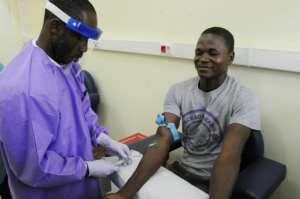
Paris (AFP) - The lucky ones who survive Ebola may suffer potentially blinding vision problems, hearing loss and joint pain for months afterwards, medical experts reported on Wednesday.
Many endured the debilitating after-effects without access to treatment in west African countries stretched beyond their limits by the worst Ebola outbreak in history.
Of 277 survivors examined at a clinic in Sierra Leone, about four months after they were discharged, nearly 80 percent reported joint pain, said the experts.
Sixty percent experienced vision problems, 18 percent suffered eye inflammation that could make them blind, and a quarter reported hearing difficulties.
"The numbers were higher than we initially expected," study lead author Sharmistha Mishra of the University of Toronto told AFP by email.
There had been reports of Ebola after-effects before this outbreak, which started in December 2013.
But the new study, published in The Lancet Infectious Diseases, claimed to be the largest and most detailed yet into the nature of post-Ebola complications, and how widespread they were.
Survivors of the outbreak in Sierra Leone, Liberia and Guinea "are experiencing significant long-term effects with potential for long-term disability including visual loss," said Mishra.
The west African outbreak has killed over 11,300 of more than 28,600 people infected.
In the affected countries, not even primary care is readily accessible, the study authors said. and specialist treatment rare,
Sierra Leone had two ophthalmologists at the time of the outbreak.
- Lasting consequences -
The team had examined Ebola survivors in Port Loko, Sierra Leone, between March 7 and April 24 this year.
They found that the higher a patient's "viral load" had been at the height of their illness, the worse the complications afterwards.
And the team uncovered further evidence that Ebola virus may live on in specialised "sanctuary sites" in the body -- including the eye, where it may be the cause of the vision problems many patients had reported.
While Ebola virus clears from the blood within weeks, the UN's World Health Organization (WHO) has previously said it may persist for up to a year in the eye or semen, and in the breast milk of women infected while pregnant.
The WHO website says transmission by survivors, sexually or otherwise, "appears to be rare".
One of the study authors was American doctor Ian Crozier, who fell ill while treating patients in Sierra Leone, recovered, and in whose eye doctors found Ebola virus months after his hospital discharge.
The team pointed out there had been hardly any care for Ebola survivers in the early part of the outbreak due to the overwhelming and urgent challenge of treating the ill.
"These findings emphasise the importance of ongoing clinical follow-up and care of all patients, starting at discharge from an ETU (Ebola treatment unit)," wrote the authors.
They also underscored "the urgent need for the greater provision of ocular (eye) care."
Commenting on the study, Luke Hunt of the Liverpool School of Tropical Medicine said there was a dire need to rebuild west Africa's shattered health systems.
"The consequences of the world's largest outbreak of EVD extend beyond the immediate effect of the epidemic," he wrote.

 We will remove Affi Agbenyo from EC if NPP returns to power – Kamal-Deen
 Ghana’s economic activity grows 7.4% in July 2026, services lead
 Five remand prisoners remain at large after escape from Konongo police cells
 Burkina Faso bans beauty pageants
 We must praises NDC for stabilising Ghana's economy – Stephen Amoah
 Chairman Wontumi returned to Nsawam as court adjourns bail ruling to November 4
 NDC can retain power in 2028 on Mahama’s records – Kwame Anthony
 October 15: Cedi sells at GHS12.30 on forex market, GHS11.68 on BoG interbank
 Court to rule on Wontumi’s bail pending appeal on November 4
 Police arrest eight in crackdown on suspected drug trade at Okaishie Drug Lane


