




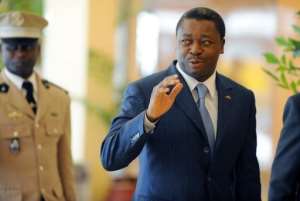
UNITED NATIONS (AFP) - The president of Togo, one of the world's poorest countries, on Monday slammed rich nations who have cut development aid saying it contributes to the spread of terrorism.
President Faure Gnassingbe told a UN Security Council meeting on terrorism in Africa that rich countries had unjustly cut foreign aid since the 2008 financial crisis.
"It is urgent that partner countries honor their promises" on aid, Gnassingbe said. "The crisis does not authorize donor countries to not respect their engagement to reach 0.7% of gross domestic product by 2015."
His attack came ahead of a meeting at the UN headquarters this week of UN panel -- led by Prime Minister David Cameron of Britain, Liberia's President Ellen Johnson Sirleaf and Indonesia's President Susilo Bambang Yudhoyono -- that will set the agenda for the Millennium Development Goals after 2015.
The Togo leader, whose country ranked 159th out of 186 countries in the latest UN human development index, said extra cash is desperately needed to boost security and alleviate poverty which, he said, encourages militant groups operating in countries like Mali and Somalia.
According to a 2012 Organization for Economic Cooperation and Development (OECD) report, international aid fell to 125.6 billion dollars in 2012 -- 0.29% of the gross national income of creditor countries and down from 0.31% in 2011.
"This does not seem just to me when we know that poor countries must take up new challenges for which they are not responsible," said Gnassingbe, who singled out the "frenzied industrialization of rich countries."
The Togo leader, whose country organized the meeting as a president of the 15-nation Security Council for May, said more help had to be given to the poor alongside measures such as greater controls on arms transfers.
"It is only in assuring the well-being of populations, in particular the most poor and the weakest, that they will be less receptive to extremist ideologies and violence," the president said.
While highlighting successes against Islamist militant groups in Mali and Somalia, US ambassador Susan Rice said that Al-Qaeda and its allies are becoming "more diffuse and entrepreneurial" in Africa.
She said African governments must be "wary of repressive approaches, which often fuel the very radicalization they seek to eliminate."
"This requires fighting poverty and corruption. It requires expanding trade and investment, and building critical infrastructure so that African economies can grow sustainably," Rice said.
Governments must improve health and education services, Rice said, "and it requires ensuring that people are able to hold their governments accountable."
 NDC played no key role in Sedina Tamakloe's extradition, NPP did — Ahiagbah
 Seven feared dead in Saturday dawn collision at Zebila
 6th Ministers of State Awards saga: 'It is unfair to suggest all awardees bought...
 I didn't pay money for recognition at 6th Ghana Ministers of State Excellence Aw...
 2026 World Cup: Rescind decision denying Thomas Partey visa in the interest of f...
 June 13: Cedi appreciates, sells at GHS12.30 on forex market, GHS11.06 on BoG in...
 Plea bargains favour the rich and powerful in practice — Arthur Kennedy
 Exim Bank fraud case: I agree that other persons must answer some questions — Ak...
 Exim Bank fraud case: Wontumi must admit guilt before any plea deal — Akwatia MP
 Exim Bank fraud case: 'Wontumi's plea bargain is not an admission of guilt' — Na...



Comments
Why can't togo morge into ghana and ghana can become bigger?