




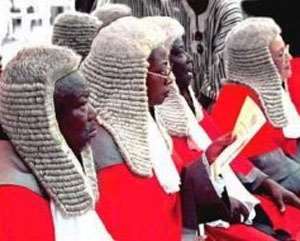
At just about the same time that the leaders of the main opposition New Patriotic Party (NPP) were preparing to launch a legal petition to vigorously contest the results of Election 2012, a survey report was leaked by the Office of the Attorney-General and Minister of Justice, Dr. Benjamin Kunbuor, claiming that an overwhelming majority of Ghanaians had absolutely no confidence in the country's judicial system, and that rank bribery was the proverbial order of the day (See "Ghanaians Losing Confidence in Court System - AG Report" Daily Graphic/Ghanaweb.com 12/19/12).
The figure representing the aforesaid "overwhelming majority" was eerily pegged at 90-percent. Now, dear reader, you know what such predictably curious statistic means when it is alleged to be coming from the NDC-controlled Office of the Attorney-General. You only have to visit the foregrounds of the Supreme Court Building to vividly appreciate what I am alluding to.
Anyway, interestingly, Dr. Kunbuor, the Attorney-General and Minister of Justice, promptly, if also impishly, released a statement vehemently denying that it had caused any such survey report to be conducted, as alleged by the media, let alone facilitated its release to the public at the time that the same was widely reported to have been released (See "AG Denies Commissioning Report on Judicial Corruption" JoyOnline.com/Ghanaweb.com).
Well, as the immortalized sage once said, "The truth often lies somewhere in-between." And that "somewhere in-between," of course, points to the fact that Dr. Kunbuor may be both telling the truth and lying about the same within the same breath. For starters, the man was the third Attorney-General in three years to have been appointed to that office by the now-late President John Evans Atta-Mills; and so, really, one cannot blame him for claiming that he had absolutely no knowledge about either the existence of the survey report or the public release of the same.
On the preceding score, one thing is poignantly clear - and it is the fact that the rapid turnover at the Attorney-General's Office is not evidently doing the nation much good by way of having personnel who are experienced enough and have the requisite mastery of the day-to-day ministration of this cardinal executive institution.
In sum, if the Attorney-General has not had ample time to familiarize himself with the intricate dynamics of his portfolio, then, of course, it stands to reason to take his evaluation of the judicial branch of the executive arm of the government with the proverbial pinch of salt. In this particular instance, perhaps "a bag of salt" would be the more appropriate expression.
Well, it turns out that, indeed, the Attorney-General's Office, in collaboration with the local/field office of the United Nations' Development Program (UNDP) had, indeed, commissioned such a survey assessment of public perception of the Ghanaian judicial system. True, the primary underwriter of the said survey had been the local office of the UNDP; but this undertaking could hardly be said to have been executed on the blindside of the Attorney-General, who has categorically and publicly described this enterprise as a "Baseline Survey" whose concerns and recommendations he intends to fully implement, in order to restore an acceptable level of public confidence in the judicial system.
To his credit, we also need to promptly highlight the fact that according to Dr. Kunbuor, the judicial system was only one "thematic area" among a host of others that the UNDP-sponsored project undertook, although the Minister of Justice does not specifically mention any of the other "thematic areas" of government institutions surveyed by the presumable commission of experts. For me, though, it is rather worrisome that nearly sixty years into the post-colonial era, Ghanaians still have to wait on one of the various agencies of the United Nations to periodically assess and facilitate the overhaul and/or upgrading of our cardinal institutions of governance for us.
Ultimately, though, whether the overwhelming majority of Ghanaians have confidence in the caliber of the men and women in charge of our judicial system is wholly beside the point. For, it goes without saying that any people or nation gets the form, nature and quality of government that it deserves. And Ghana, of course, is far less the exception than the rule.
____________________________________________________
*Kwame Okoampa-Ahoofe, Jr., Ph.D.
Department of English
Nassau Community College of SUNY
Garden City, New York
Feb. 23, 2013
###


 Democracy cannot be inclusive if women are priced out of politics — Prof Audrey ...
 Minority demands full breakdown of reported GH¢10.92bn Accra-Kumasi Expressway e...
 Africa cannot silence the guns while money dominates politics — Dr. Ibn Chambas
 Gov't has not spent GH¢11bn on Accra-Kumasi Expressway project — CAGD
 Lawyers vow to fight on after Kenya court rejects Rastafarians' cannabis bid
 When Revenge Replaces Justice, Democracy Begins to Die... Mansa Musa write
 MDC says 17 doctors suffering mental health conditions; 12 battling substance ab...
 Ghana to conduct independent autopsy on citizen killed in South Africa xenophobi...
 'If there's nothing to hide, don't keep things in the dark' — Manasseh on BoG Go...
 July 16: Cedi sells at GHS12.25 on forex market, GHS11.53 on BoG interbank


Comments
About 77% of the people believe the police and judiciary are bribe takers. The fact is the judiciary is corrupt to the bone so we who live in Ghana know this. Look at some of the convictions and cases and ask if they follow the rule of law. Hypocrites like you sit and judge people in the courts whilst you enrich yourselves and imprison and humiliate the poor and show evidences of zero morality.