




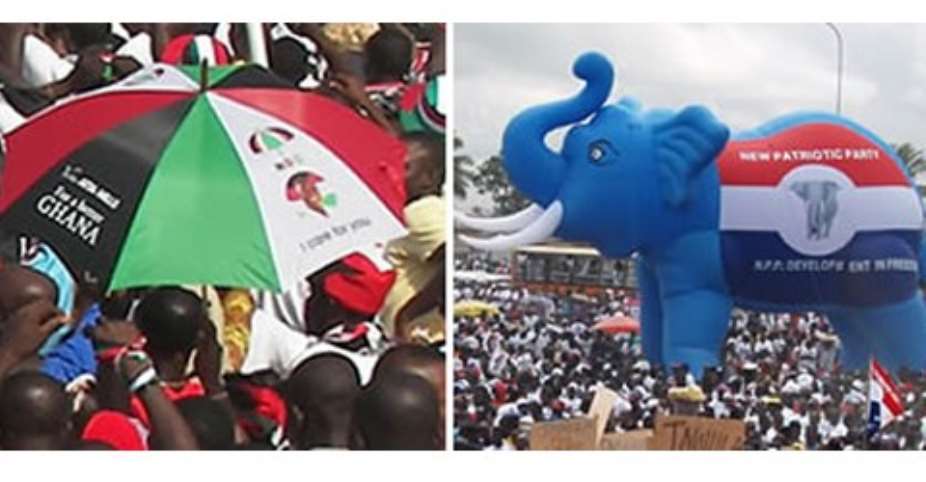
The NPP is not in an enviable position at all, having been put in a situation where it has had to challenge the official results of the 7 December 2012 elections, announced by the Electoral Commission.
For if a political party protests against the results of an election, the natural conclusion people jumps to is that the party is a “sore loser”, a “bad sport” and potential cheat. People want to see the tension created by an election campaign to end quickly. So, anything that threatens to prolong tension or is naturally frowned upon.
And yet, we all know elections are conducted by human beings, and that human beings can and do make mistakes. Some humans, apart from being fallible, are also corruptible. They can, in addition, be incompetent or indifferent to their responsibilities regarding a task they have been contracted to perform.
Now, an election is a matter that concerns the very future stability and socio-economic development of our country. For the Government we elect is the principal actor in our affairs, and there can be no easy route out of the dilemma that presents itself, when one of the main parties that contested an election is dissatisfied with the way it was conducted.
Even by the disputed results, the NPP obtained about 5million votes. So it is duty-bound to do everything in its power to ensure that it actualises the electorate's pact with itself.
Fortunately, our electoral laws make provision for appeal procedures when disputes occur. This is where the NPP faces its biggest challenge. It has to back its accusations with solid facts.
That is not going to be easy, for if the party's suspicions are right, then the rigging that took place was quite subtle and demanded the co-operation of a good number of EC operatives. Can they be easily found out?
The NPP should not make the mistake of thinking it's got time to gather and present its evidence. Already, people are mocking at it, sneering that it wants to bring out “The Stolen Verdict” (Second Edition)! Now, the first edition was well-documented and well presented indeed. But it took weeks to put together, and by the time it came out, it was stale – and more or less irrelevant.
Another question raised by The Stolen Verdict(Vol. 1 published in November 1992) is this: did the NPP actually get its operatives to read that Report? If they did, what lessons did they learn from the detailed instances of vote-rigging that were in there? Measures ought to have been taken to forestall those and other methods of rigging. Really bright polling agents who are so “aware” and alert that nothing can be put over them, should have been used. Did the NPP have such bright people at all the polling stations and collation centres?
If such people were present, how come the NPP now claims that figures were changed whilst being transferred from one colour-type paper(blue) on to another (white)? Were party representatives allowed to satisfy themselves that these papers contained accurate figures, before being transmitted from the collation centres to the EC?
Anyway, we await the presentation of the evidence and the reaction to it of the EC. The EC must react with wisdom and impartiality, but if it fails to do so, there will be other avenues open to the NPP to seek redress.
These must be followed; the NPP should ignore people who want it to “stop crying over spilt milk”, or, in the words of one cliché-laden cynic on the Internet, “desist from swimming upstream!” That is nonsense, of course. The Electoral Commission has statutory duties prescribed for it by the Constitution, and it is the duty of every citizen, or body of citizens to help defend the accurate application of the Constitution.
If the NPP, knowing that there were anomalies in the election process, were to follow the usual Ghanaian fatalistic line and “leave it to God” (fa ma Nyame!) it would be remiss in carrying out its civic duties.
Come to that, it is not as if showing evidence of malpractice to the Electoral Commission violates any rules. Of course, the EC's extremely lofty opinion of itself is legendary. But is this high opinion borne out by how the EC actually operates in practice? For instance, the biometric registration took place about 6 months to the election, and it was discovered then that many of the computers that were used in carrying out the registration, froze on being used. A lot of noise was made about the delays that these malfunctioning machines caused, and most people would have expected that the EC would use the time between the end of registration and the election, to iron out any issues concerning its machines.
Yet come election day and what do we find? Machine malfunctioning! a What? Again? Yes – this time, it was the verification machines that were preventing people from voting. Some people who went to polling stations in the wee hours of the morning, found themselves still there up to noon and after, not having been able to vote. Where machine malfunction didn't occur, election materials arrived late.
One person I spoke to went back home after discovering that there were three queues at his polling station. He begged some people to “guard” his place in the queue for him, while he went back home to find a bite to eat. I don't know whether he eventually managed to vote.
One lady told me she was rejected at first by the verification machine at her polling station. But she decided not to leave. People were washing their fingers with coca cola, because the rumour was that coke could somehow make the machine “read” one's fingerprints properly! This lady says she didn't wash her hands with anything, but when she tried again after waiting for about 2 hours, the machine accepted her and she was able to vote.
Had the EC carried out enough “test runs” with the machines before unleashing them on impatient would-be voters? That is what an efficient EC would have done. It didn't – as far as the evidence on the ground shows – and that is why we had the spectacle of some people having to leave polling stations without voting, after queuing all day, and being told to come back the next day to try and vote! Meanwhile, said the EC, the votes that had already been cast, would be kept in their ballot boxes and taken to police stations, and brought back the next day, for voting to be completed.
We must thank God for the peaceful nature of the Ghanaian people. If this had been some other country, people would have said, “We must vote tonight, because we don't know whether you will allow us to vote tomorrow”
Or they could have said: “The ballot boxes will be tampered with at the police stations, therefore we won't let them be taken away!” Or “count the votes that have been cast already now. Then we shall continue tomorrow!”
These situations caused tension and could have resulted in clashes with the forces of law and order. A
Knowing how fallible it has been, the EC must now be humble enough to listen carefully to any complaints – not just from the NPP – that might be brought to it, and carry out a very thorough AND SPEEDY investigation of them. And the results of the investigations, with full details of what the complaints were, what was found when they were investigated and why the EC came by its decision, placed before the public.
As for those observers – especially those from outside the country – who have been so quick to certify the election as “free and fair” Ghanaians must wish them Godspeed and tell them we know better than many of them. We have been humbled by our mistakes, but we won't compound them by carrying ourselves off with a stiff-neck, unwilling to correct mistakes when they are carefully and rationally pointed out to us. In 1951, the British entrusted us with holding an election under universal adult suffrage for the first time. We passed the test, and held two more elections – in 1954 and 1956 – under very tense political conditions. Again, we passed the test, and were granted our independence in March 1957. Those are the foundations of our electoral successes.
Let us allow natural justice to prevail over our politics this year, too.

 Belarus manufacturers to storm Ghana next week after President's visit
 Government to offer tax incentives for factories located outside Accra
 White House World Cup chief defends visa ban for Somali referee, Iranians
 Talensi DCE courts investors for revival of Pwalugu Tomato Factory
 Manhyia South MP says free speech under threat, cites 17 arrests in 16 months un...
 KATH doctors suspend strike after Otumfuo’s intervention
 Mahama is losing control of his government — NPP Communicator
 Health Minister’s suspension of KATH CEO technically right — Prof Beyuo
 Korle Bu Teaching Hospital conducts Ebola emergency simulation to strengthen fro...
 Abandoned newborn baby found near gutter at Agona Swedru Woaraba


