




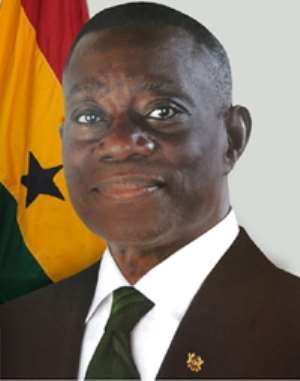
It is one thing for the editor, or even editors, of a newspaper to plead the cause of national unity in the wake of the tragic passing of a sitting president, even as the editors of the New Patriotic Party-leaning Daily Guide sought to do recently (See “National Funeral, Not Party Funeral” Modernghana.com 8/4/12). It is, of course, another thing, altogether, for the government in power, in this instance the Mahama-Arthur-led National Democratic Congress (NDC), to forge an inclusive national spirit and atmosphere, or aura, around the death and funeral of President John Evans Atta-Mills.
So far, other than the largely vacuous pontification to the foregoing effect, there is absolutely no reason for anybody, Ghanaian or non-Ghanaian, to believe and/or conclude that, indeed, Ghanaians have been unified and cathartically rallied around the grieving, mourning and funeral precipitated by the death of President Atta-Mills. One thing, however, ought to be made clear, lest Ghanaians, particularly those below the age of 30, are unduly tempted to fall for the rather vicious and/or mischievous myth that, indeed, President John Evans Atta-Mills, of the populist National Democratic Congress was the first Ghanaian leader to have expired in office. That dubious credit actually belongs to Gen. E. K. Kotoka, who was felled by the assassin's bullet at the location of his statue in the foreground of what is today appropriately known as the Kotoka International Airport (KIA) in our nation's capital of Accra.
The second Ghanaian leader to die in office, also a junta leader, was Gen. F. W. K. Akuffo, who was summarily executed by firing squad in June 1979, together with several other military rulers, by the Rawlings-led Armed Forces Revolutionary Council (AFRC). Maybe it is because of the fact that the chief executioner of Gen. Akuffo is also the founding-patriarch of the so-called National Democratic Congress that the newly-sworn President John Dramani Mahama and his henchmen and women appear to have found it quite convenient not to remember the Akuffo episode, at least not publicly.
But that the 1979 brutal assassination of the eight Ghanaian military and former military rulers/leaders, by essentially the same people presently in power and their staunch and ardent supporters, may very well be the reason why the widely anticipated demise of a long-ailing President Mills appears to have provided a convenient cover for the key NDC operatives to cavalierly write over, as well as facilely write off, the death of Gen. Akuffo, a de facto transitional ruler who was on the verge of healthily returning the country to democratic governance, is all too glaring.
What motivated this writing, however, is the clearly paradoxical fact that while the transitional government of Mr. Mahama claims to be “staging” a “national” funeral and burial in honor of the late President John Evans Atta-Mills, what we actually have in the present instance, is what may be aptly termed as a “state” or “statal” funeral, as opposed to a national funeral. Now, let me briefly explain precisely what the foregoing means. In essence, were it a “national” funeral, the Totobi Quakyi-led Funeral Planning Committee (FPC) would have been at the very least bipartisan in the composition of its membership. What we have here, however, and pathetically, is the Mahama-Arthur government calling all the shots. Thus, in practical terms, what we have here is a purely partisan and “state-“ or government-run funeral and burial program.
I guess what I am trying to observe, here, for the edification of the unsuspecting reader, is the incontrovertible fact that while, indeed, most Ghanaians are desirous of a national leadership centered around the multiethnic and organic unification of interests, what we have here is a purely political affair deviously geared towards capitalizing on the raw grief of potential voters in order to gain a facile head-start in the frenzied lead-up to Election 2012. And this, of course, primarily explains the lurid attempt by President Mahama to turn the one-week commemoration of the passing of President Mills into a self-coronation ritual mischievously packaged as a providentially ordained paradigm shift.
That the adherents of the two major parties have also decided to sport two different cotton-print motifs, seeking to dialectically fault one another for the long-anticipated demise of President Mills, clearly underscores the abject farcicality of the entire funerary affair. To, therefore, claim that this trend of affairs was altogether unexpected is to fatuously play the proverbial peacock. To be certain, it is inescapably Ghanaian! And it is in the context of this prismatic burlesque that the former University of Ghana tax-law professor's funeral ought to be envisaged.
*Kwame Okoampa-Ahoofe, Jr., Ph.D., is Associate Professor of English, Journalism and Creative Writing at Nassau Community College of the State University of New York, Garden City. He is Director of The Sintim-Aboagye Center for Politics and Culture and author of “Ghanaian Politics Today” (Lulu.com, 2008). E-mail: [email protected].

 Roads Ministry needs 1,000 additional staff — Governs Agbodza
 Stop tweeting and brief Parliament on South Africa situation — Patrick Boamah to...
 Roads Minister reassigns Bogoso–Prestea road project to new contractor over dela...
 Government must be held accountable for Black Stars’ poor state — Enam Hadzide
 Any SMS or platform offering discounted DVLA fines is fraudulent — DVLA cautions...
 Gov't resources GBC to acquire Free-to-Air broadcast rights for 2026 FIFA World ...
 Flooding crisis: 'Current NDC gov't the laziest and weakest since 1992' — Miracl...
 President Mahama’s approval rate remains positive at 58.9% — IEA survey shows
 'Take note of Sedina Tamakloe's extradition and come home' — Kwame Jantuah to Of...
 Nigerian evacuees set to arrive in Lagos Thursday amid South Africa xenophobic a...


