




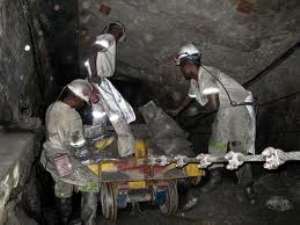
The Minerals Commission says the adoption of new guidelines on corporate social responsibility (CSR) programmes for mining firms would reduce social conflicts in mining communities.
Ghana's Minerals and Mining Act 2006 (Act 703) does not have provision for standard CSR, though companies are undertaking diverse projects to support the socio-economic development of communities.
The Commission has however devised a Guideline to serve as a uniformed benchmark for development and assessment of CSR activities by miners.
Sectoral Policy and Planning Manager, Richard Kofi Afenu, says a participatory approach in carrying out corporate social responsibility programmes by mining companies will offer value for money.
“The communities which are going to be the ultimate beneficiaries should be actively involved in the determination of priorities – what their needs are – so that when the companies are going to provide these projects, they take into consideration the cultural needs of the people, their traditional values; so that ultimately when the programs are carried out they are used to the maximum extent possible”, he stated.
Mr. Afenu spoke to Luv Biz Report at a training programme for the Environmental and Social Committee (ENSOC) of the Ghana Chamber of Mines in Kumasi.
The Commission's CSR Guideline complements applicable binding national and international regulations on corporate social responsibility. It covers areas such as Corporate Governance and Ethics; Human Rights; Employment and Labour; Health and Safety; and Environmental Stewardship.
Other areas are Risk Assessment and Management; Material and Supply Chain Management; Community and Social Development; Stakeholder Engagement; and Compliance.
After various engagements, the Commission expects the mining companies “to hit the ground running” and an annual evaluation would be carried out to assess level of compliance, said Mr. Afenu.
Chief Executive of the Chamber of Mines, Dr. Toni Aubynn said the Chamber is seeking new ways of integrating all aspects of economic, social and environmental benefits and impacts of mining.
“We need to secure a continuing license to operate by implementing socially beneficial and sound environmental practices”, he emphasized.
The Chamber has instituted an annual training programme for its ENSOC, which has been reconstituted to effectively handle environmental and social issues associated with mining.
Dr. Aubynn said the Chamber will continue to pursue the quest for mining to be repositioned as a catalyst for development rather than a source of revenue only.
“When you dig the material, be it gold or manganese or bauxite, it is meaningless unless it is converted in to something useful and meaningful. So we think that the revenue from mining can be used to invest in other activities”, he stated. “As a country we could have a bigger thought and say that may be Tarkwa or Obuasi in about 50 or 100 years there will be no mining, why not try and invest other things there that will support the industry”.
Sustainable development, in his view “is about meeting the needs of people today without compromising the ability of future generations to meet their own needs”.
The Mines Chamber CEO observed that reaching the desired goal of responsible mining requires that the Chamber works with government and other stakeholders to implement principles of co-operative decision-making and shared responsibility for the management of social and environmental issues.
Story by Kofi Adu Domfeh/Luv Fm/Ghana
 NDC played no key role in Sedina Tamakloe's extradition, NPP did — Ahiagbah
 Seven feared dead in Saturday dawn collision at Zebila
 6th Ministers of State Awards saga: 'It is unfair to suggest all awardees bought...
 I didn't pay money for recognition at 6th Ghana Ministers of State Excellence Aw...
 2026 World Cup: Rescind decision denying Thomas Partey visa in the interest of f...
 June 13: Cedi appreciates, sells at GHS12.30 on forex market, GHS11.06 on BoG in...
 Plea bargains favour the rich and powerful in practice — Arthur Kennedy
 Exim Bank fraud case: I agree that other persons must answer some questions — Ak...
 Exim Bank fraud case: Wontumi must admit guilt before any plea deal — Akwatia MP
 Exim Bank fraud case: 'Wontumi's plea bargain is not an admission of guilt' — Na...


