




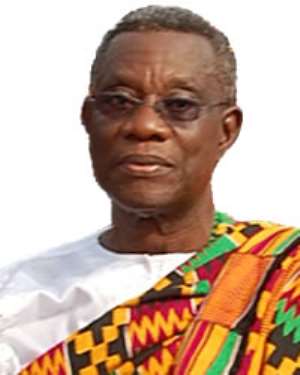
IT was a terse message that flitted across my screen: “President Mills, R I P.!”
I thought it was another Ghanaian joke. In June 2012, rumours had circulated widely that President Mills had died. People believed it until he went public himself and asked, “Do I look like a man who is dead?”
He is even said to have done a jig of the current dance craze, “Azonto”, to demonstrate how well he was. So when it was confirmed that he was indeed dead, I was taken aback. “Oh, poor guy!” was all I could say.
For it was difficult not to be sympathetic towards the late President Mills. A humble and friendly man, he was plucked from the anodyne corridors of the Internal Revenue Service to be inserted into the boiling cauldrons of Ghanaian party politics by Jerry John Rawlings. To have been planted inside the National Democratic Congress (NDC) when one was not an “insider”, was, veritably, to place oneself prone in a bed whose interstices were crafted out of the fangs of vipers.
Was Mills naïve, when in September 1996, he accepted the offer by Rawlings to leave his job as Commissioner of Income Tax and become Vice-President?
The point is that the job of Vice-President had become vacant only because Rawlings had — allegedly – physically assaulted the occupant of the position, Vice-President Kow Nkensen Arkaah. Now Arkaah was 17 years the senior, in age, of Mills and 20 years the senior of Rawlings. If Arkaah had indeed fallen foul of the violent temper of Rawlings, why was it that Mills thought that he could ride on the back of such a 'tiger' and manage to come off safely?
That crucial decision Mills took to replace Arkaah was a big clue to the personality of Mills. He ardently believed that he was a 'man of destiny'. He believed that “nothing happens by chance”. Why had Rawlings chosen to go only to Mills, out of the 25 million people of Ghana, to look for a Vice-President, if it had not been “ordained from above”?
That belief also explains why he was so resilient as to run for the presidency of Ghana three times, after Rawlings had left office. Indeed, when he finally clutched the reins of power in 2009, even he was immensely surprised. It flows from the foregoing, then, that he would resist every move by Rawlings and his wife to swat him off the flag-bearer's perch of the NDC for the 2012 presidential election.
Mills deserves praise for his fortitude, if for little else. In his the years in power, he was constantly ridiculed but he would not allow himself to be riled; he was threatened, but he would not retreat; he was kicked in the butt by the powers that be in his own party, yet he would not budge.
Finally, he took the NDC to the Sunyani congress in July 2011. And he wiped the smiles off the faces of Nana Konadu Agyemang Rawlings and her “FONKAR” supporters, by running away with the vote. He left her clutching a mere 3.7% of the ballot by the delegates.
Was this the comic character, “Mister Ecomini?” Thereafter, Mills resolutely brushed away any sign that he could be reconciled with the Rawlingses. Did he, in fact, see himself as the “instrument” chosen by providence, to cook the goose of the Rawlings family as a self-anointed “dynasty” in the body-politic of Ghana?
In a rather more sinister way, however, the self-confidence of Mills may have been over-stretched into a fatalism that transformed the political realities of Ghana into mere mirages of illusion that floated before his irises. His presidency faced no worse scandal than that of the judgement debt paid to a man called Alfred Agbesi Woyome. Yet Mills imagined he could wave it aside by instituting a half-hearted prosecution against the “small fry” involved with the scandal, while leaving the big guns, with whom he'd evidently been plotting to secure funds for the NDC's 2012 election campaign, tacitly exculpated. He inadvertently let the cat out of the bag when, in a Freudian slip, he protested: “I am not criminally-minded” enough to approve of such payments.
No matter how it ends, the Woyome scandal will remain a stain on the name of Mills and his administration. Even worse was the miscalculation Mills made in presuming that the former Attorney-General, Mr Martin Amidu, would allow himself to be used as a sprinkler who would produce a smokescreen behind which what he, Amidu, came to call the “gargantuan” fraud could be hidden.
But Martin Amidu also believes that he is a man of destiny, and neither threats nor entreaties could divert him from his mission to expose and prosecute his fellow Cabinet Ministers who, he believed, were involved in the scandal. In Amidu, the two conflicting elements of Mills came face to face: the righteous man who wanted to do the correct thing, and the political animal who resorted to PR to protect the party machine. By sacking Amidu and unleashing the forensic capabilities of Amidu on the corruption within his administration, Mills has turned Amidu– ironically – into the national hero Mills could not allow himself to become.
We Ghanaians have a way of visiting the failings of our rulers upon “those who surround them.” It is no doubt a failure of the imagination produced by the obsequiousness characteristic of the system of chieftaincy under which most of us are ruled from birth to death and which we are spectacularly unwilling to adapt in order to safeguard. We see our chiefs behaving in a manner that works against their own interests as well as our own, but out of a misapprehension of the true meaning of “respect”, we allow them to continue the corrupt ways through which they are marching inexorably towards their own extinction.
Thus, we shall no doubt deal with the legacy of President John Atta Mills.
http://www.guardian.co.uk/commentisfree/2012/jul/27/john-atta-mills-ghana
He will be mourned with all the pomp and pageantry at the command of a nation that revels in ceremony for ceremony's sake. Meanwhile attempts will be made to lay many of the instances of incomprehensible incompetence exhibited by his administration at the door of his “lieutenants”. The so-called “Castle Mafia”, especially, will bear the brunt of this, and it does deserve to, because, from every angle, especially in the PR department, it did fail President Mills miserably.
Fortunately for 54-year-old John Dramani Mahama, the former Vice-President who has been sworn in as President to replace Mills, he managed to present himself as a man who was distant from Mills, even though, constitutionally speaking, he was next in line to Mills. Not being an “insider”, he comes to the top carrying hardly any baggage that will make campaigning unmanageable if he is endorsed by the NDC to face Nana Addo Dankwa Akufo-Addo of the New Patriotic Party in the presidential election of December 2012.
The stakes will be very high for that election, because Ghana is on the way to reaping enormous revenues from oil. Whoever is in charge in Accra in 2013 will have a relatively lucrative treasury to play with. This means that we shall have the tools with which to move towards 2020 with greater optimism.
But, of course, tools are as good as the people who wield them. The accession of a new President to power gives us a breathing space in which to pause and ask ourselves whether we have not, of late, been steering our national ship on to the rocks. The uncouth and violent tone of our political discourse; the denigration by ethnic groups of one another; the barefaced rush to acquire property by fair means or foul – do we want to continue in this vein?
President Mahama bears a great responsibility over whether we shall turn a new leaf in our political affairs or not. He can demonstrate his awareness of our need for change by doing a thorough house-cleaning within his own ranks. This must be carried out, in spite of –but also because of – his need to hone his party's machine to assure Ghanaians that if it wins in December 2012, the country will have nothing to fear. For the simple truth is that at the time of his death, Mahama's predecessor had begun to turn Ghana into a laughing stock amongst many of its own people. This state of affairs needs to change.
Urgently.

 BoG's $260 million building: It was Ato Forson who first proposed 'sell-and-leas...
 'We have to do soul-searching' — Mahama orders nationwide flood assessment
 Court orders woman beater to pay GHS5,000 compensation to midwife at Tema Commun...
 Over 12,000 women living with obstetric fistula in Ghana — Asokwa MP
 Mahama secures 1,840 farm equipment deal from Belarus
 Titus Glover slams Mahama’s flood report directive, calls it “waste of energy an...
 We have increased posting of doctors from 12 to 100 to underserved regions in 20...
 'You had the effrontery to call me struggling lawyer, you won't come back to pow...
 Belarus manufacturers to storm Ghana next week after President's visit
 Government to offer tax incentives for factories located outside Accra


