




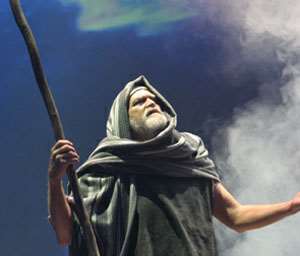
I was invited by a business colleague to an African country recently and he took me to a remote village in the tropical forest to meet an old man, who narrated a very interesting story.
When we got to the place I was astonished to see a very tall man in his seventies coming from the forest with an African buck on his head with a rifle on his back. I later got to know that members of that tribe remained strong even at an advanced age.
That evening we chew the roasted game with herbs near a huge fire. After that delicacy, the old man initially asked me to take an oath not to reveal the location of the village to the world through my paper or another medium. I was also prohibited from taking a picture of the subject matter.
The old man told me that his ancestor was captured by some people from the north of the continent and was taken to Pharaoh's Egypt.
According to him, because of some skills a highly-placed official in then Pharaoh's palace bought him his special assistant.
The old man said that five years in the service of his master, his ancestor met a man called Moses from a tribe called the Hebrew tribe, who were forced to do manual work.
Moses noted that God wanted Pharaoh to release his people to worship him at a place.
'This story I am telling you now happened so many years ago but it was handed down to us from generation to generation,' the old man said.
The septuagenarian said his ancestor was told by his master that Moses formerly lived in Pharaoh's palace but something terrible happened so he escaped.
The ancestor, after seeing the wonders performed by Moses, decided that the moment Pharaoh releases the Hebrews he would also flee back to his native land.
He therefore visited the quarters of the Hebrews and he learnt a lot over there. Furthermore, he cut down a tree and carved it in the form of the rod of Moses.
When Moses ordered the Hebrews to ask jewelry and other materials from the Egyptians, that ancestor also did that and prepared for the dreaded night that Moses talked about.
A day before the night of death, he left his master's home and went to the Hebrew quarters. That night he took part in the Passover meal and when Moses and his people were forced to leave Egypt, he dressed like an Egyptian official and loaded his belongings on a camel and moved out of the cursed land towards the south.
He gave out gold to secure his passage and in a few months he promised to worship the God of Moses and his people.
The ancestor then cleared a place in the forest and erected the rod he brought back from Egypt under a shed and killed a ram.
He designed a beautiful bag with the ram and put a weighted gold inside and hung it beside the erected rod.
Every year, he remembered the escape from Egypt with his family and followed precisely what Moses and his Hebrew tribe did on that fateful night or the night of the living dread.
Before he died, he instructed his children to continue with the ritual which they did religiously until the advent of the white colonialists who invaded the area one day and destroyed the rod or the pole and took away the gold away. The elder of the family at that time cursed the invaders.
Curiously, in 1934, a young white Belgian aged about 24 entered the village and told the people of a very strange and bizarre story.
The young man told them that over the years, any first born who was a male died from strange boils which affected the whole body at the age of thirty.
The young man told the astonished villagers that one day he saw one of his ancestors taking a bag full of gold from a tree in an African village in a dream.
Initially, he did not understand the whole episode but two days later he was looking for something in the family's old cellar when he saw an old animal bag so he took it down and opened it and saw the gold and a written note.
The note described how one of his family members travelled to Africa to steal gold, which had become a curse. He conducted investigation and got to know the precise place his family member stole the gold from.
'Well, the bag had been restored back and the old ritual is being done every year. This time it is done by only one person who has been chosen to do it on behalf of the whole village,' the old man said.
By Amos Amaglo
 NDC played no key role in Sedina Tamakloe's extradition, NPP did — Ahiagbah
 Seven feared dead in Saturday dawn collision at Zebila
 6th Ministers of State Awards saga: 'It is unfair to suggest all awardees bought...
 I didn't pay money for recognition at 6th Ghana Ministers of State Excellence Aw...
 2026 World Cup: Rescind decision denying Thomas Partey visa in the interest of f...
 June 13: Cedi appreciates, sells at GHS12.30 on forex market, GHS11.06 on BoG in...
 Plea bargains favour the rich and powerful in practice — Arthur Kennedy
 Exim Bank fraud case: I agree that other persons must answer some questions — Ak...
 Exim Bank fraud case: Wontumi must admit guilt before any plea deal — Akwatia MP
 Exim Bank fraud case: 'Wontumi's plea bargain is not an admission of guilt' — Na...


