




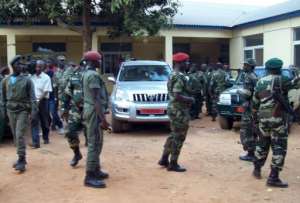
BISSAU (AFP) - Guinea-Bissau's opposition parties were to meet Saturday to form a "unity government", two days after a military coup derailed presidential elections in the west African country.
The coup, in which troops detained Prime Minister Carlos Gomes Junior, the election frontrunner, has been condemned by the United Nations, African Union as well as the US, EU and former colonial ruler Portugal.
Concern was mounting for the well-being of Gomes and of President Raimundo Pereira who the junta says were captured in the power grab Thursday night, and for other members of the toppled government in the putsch-prone nation.
Speaking from Lisbon, the foreign minister of the ousted cabinet, Mamadou Djalo Pires, said his colleagues were now "refugees somewhere" and "in danger of death", adding that "the persecution continues".
The self-styled military command under the army vice chief of staff, General Mamadu Ture Kuruma, had told former ministers to surrender, he said at a Lisbon meeting of the Community of Portuguese Speaking Countries.
The coup leaders -- also including the army, navy and air force chiefs -- had on Friday set out the terms for a "unity government," demanding the defence and interior portfolios for themselves.
They confirmed they had deposed Gomes and Pereira and said they also detained the army chief-of-staff, General Antonio Indjai, pledging: "The three are safe and sound and are under the control of the army."
However, Foreign Minister Pires charged that the apparent detention of Indjai was "a farce" and that "he is responsible for the coup".
Since independence in 1974, Guinea-Bissau's army and state have remained in constant conflict, and no president has ever completed a full term in office. Three have been overthrown and one was assassinated.
The tiny country with a multitude of islands has become a major transit point for cocaine from Latin America to Europe, and the US has accused some senior military figures of involvement in the illicit trade.
The government had pushed military reform efforts, and the junta justified its coup by claiming there had been a "secret deal" with Angola to undermine the army. Angola has 200 troops in the country to promote the reforms.
The coup leaders said on Saturday they had reached an agreement with Luanda for the departure of the Angolan troops. A member of Angola's force confirmed to AFP that the soldiers were waiting for transport home.
But Angola had in any case announced the departure of the force last Monday, a few days before the coup.
Gomes had garnered 49 percent of the vote in the first round on March 18, and campaigning for the second round had been due to start Friday.
Opposition candidates, including ex-president Kumba Yala who would have faced Gomes in the second round, had alleged fraud in the first round and said they would boycott the runoff.
The election came two months after the death of president Malam Bacai Sanha following a long illness.
The junta has said a new government would exclude the toppled ruling party, the African Party for the Independence of Guinea-Bissau and Cape Verde (PAIGC), which has led the country for almost 10 years.
On the streets of the capital, relative calm returned Saturday, two days after troops had fired rocket-propelled grenades at the premier's residence and taken over the PAIGC headquarters and national radio station.
Soldiers could be seen outside public buildings. A night-time curfew remained in place and private radio stations were still off the air.
The international community has roundly condemned the power grab.
The African Union's commission chief Jean Ping condemned the "outrageous acts which undermine the efforts to stabilise the situation in Guinea-Bissau and tarnish the image of the country and Africa."
Current AU chair Benin said it "firmly and without reserve condemns the coup d'etat, which is contrary to the international commitments concerning democracy to which Guinea-Bissau has subscribed."
West African regional group ECOWAS, still grappling with a putsch and rebellion in nearby Mali, also condemned the coup.
Washington, in a travel warning, urged American citizens "to shelter in place and avoid the downtown area of Bissau."
 NDC played no key role in Sedina Tamakloe's extradition, NPP did — Ahiagbah
 Seven feared dead in Saturday dawn collision at Zebila
 6th Ministers of State Awards saga: 'It is unfair to suggest all awardees bought...
 I didn't pay money for recognition at 6th Ghana Ministers of State Excellence Aw...
 2026 World Cup: Rescind decision denying Thomas Partey visa in the interest of f...
 June 13: Cedi appreciates, sells at GHS12.30 on forex market, GHS11.06 on BoG in...
 Plea bargains favour the rich and powerful in practice — Arthur Kennedy
 Exim Bank fraud case: I agree that other persons must answer some questions — Ak...
 Exim Bank fraud case: Wontumi must admit guilt before any plea deal — Akwatia MP
 Exim Bank fraud case: 'Wontumi's plea bargain is not an admission of guilt' — Na...


