




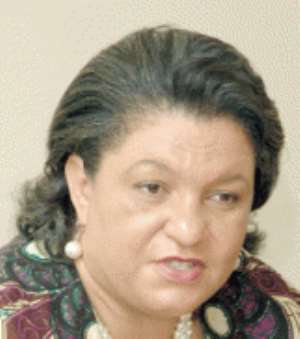
The first ever Commodity Trading Exchange to create a ready market for farmers in the country is expected to be in place by September 2012, the Minister of Trade and Industry, Ms Hanna Tetteh, has disclosed.
She said the trade ministry, which was spearheading the setting up of the Commodity Exchange to contribute to making agriculture an economically viable venture in the country, had received the support of the United Nations Development Programme (UNDP), which is associated with helping to set up a similar infrastructure in Ethiopia.
Speaking in an exclusive interview with the Daily Graphic, Ms Tetteh said the Securities and Exchange Commission (SEC) had already conducted extensive feasibility study on the exchange, which the Trade Ministry was now promoting for it to become a reality.
“The whole idea is to create a trading platform for agricultural commodities so that as farmers improve productivity and quality, they will be a financial incentive for them through an efficient market,” the Trade Minister said, adding that the exchange would start with grains such as rice, maize, soya, sorghum and even groundnuts.
She said the contract for the drafting of the legal framework has been awarded and it was expected that at the pace and momentum that the exercise had gathered, it would be possible to have the exchange in place by September next year.
Other collaborating bodies include the Ministry of Finance and Economic Planning; Ministry of Food and Agriculture; the Attorney General’s Department and the SEC.
Besides guaranteeing ready market and income streams for farmers, the exchange would also serve as an employment avenue for many along the agric value chain. For example, the exchange in Ethiopia which trades in only two commodities – coffee and seseme seeds – is on record to be trading about $50 million a week, a feat far in excess of what the average of $2 million that the Ghana Stock Exchange currently trades a week.
Explaining how the exchange will work, Ms Tetteh said the platform would be modelled around the Ethiopian exchange which operated on the Warehouse Receipt System fused with a Trading Platform.
This is where there are warehouses in different parts of the country into which grains from farmer associations or individual farmers are received, graded according to quality and assigned weights which would be used to price. The farmers are thereafter issued with receipts indicating that they have a certain amount of products in the warehouse available for trading.
When the commodities are traded, they are aware of the amount of grains available countrywide and the types of grades, where the buyers (licensed dealing members) could buy or sell.
To help determine the prices of commodities, the exchange would make use of technology, where farmers in any part of the country could send text messages to designated short codes to instantly access prevailing prices.
The price information would also be in voice messages in local dialects to take away the illiteracy challenge.
Some of the advantages of the warehouse receipt system include assurance of quality and quantity because of the proper system of storage and ascertaining the value.
“We think that it is important to create this kind of system for the trading of the selected grains that we have identified for a start. These are commodities that storage and grading would become easier to do,” the minister said.
The farmers know that once they deposit into the warehouse, and when the goods are bought, they can get the monies the next working day and that they do not have to deal with middle men who only dictate the prices. Under the system, the market would control the price.
The system is also likely to bring on board grains trading companies as brokers and distributors of the commodities across West Africa.
Learning from the Ethiopian example, the Ghana’s commodity exchange would licence people who were already bulk commodity traders of, say a truck load of grains, to become licence dealing members, a system which the Minister was upbeat would help to formalise the operations of many of the middle men and women.
 NDC played no key role in Sedina Tamakloe's extradition, NPP did — Ahiagbah
 Seven feared dead in Saturday dawn collision at Zebila
 6th Ministers of State Awards saga: 'It is unfair to suggest all awardees bought...
 I didn't pay money for recognition at 6th Ghana Ministers of State Excellence Aw...
 2026 World Cup: Rescind decision denying Thomas Partey visa in the interest of f...
 June 13: Cedi appreciates, sells at GHS12.30 on forex market, GHS11.06 on BoG in...
 Plea bargains favour the rich and powerful in practice — Arthur Kennedy
 Exim Bank fraud case: I agree that other persons must answer some questions — Ak...
 Exim Bank fraud case: Wontumi must admit guilt before any plea deal — Akwatia MP
 Exim Bank fraud case: 'Wontumi's plea bargain is not an admission of guilt' — Na...


