




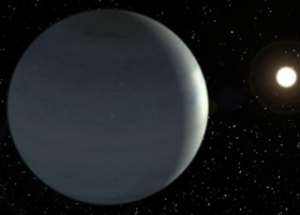
Astronomers have discovered a new planet orbiting a distant star which they say is just like our very own Jupiter.
They believe Corot-9b will become a "Rosetta stone" helping them to understand other "exoplanets" elsewhere in the galaxy.
Dr Hans Deeg from the Institute of Astrophysics of the Canaries in Tenerife said: "Corot-9b is the first exoplanet that really does resemble planets in our solar system."
The planet was detected by the CoRoT space telescope operated by the French space agency, CNES.
Its Sun-like parent star, Corot-9, is 1,500 light years from Earth in the constellation of Serpens, the Snake.
More than 400 exoplanets have been discovered to date but most are so-called "hot Jupiters" - gas giants with surface temperatures of 1,000C or more.
These are the easiest planets to find using the common method of measuring the "wobble" their gravity gives their parent stars.
About 70 exoplanets have been found using a different method which relies on the planet passing in front of its star, or "transiting".
The planet reveals itself by blotting out some of the star's light causing it to dim.
This is how Corot-9b was identified. It took eight hours to pass in front of its star, which provided astronomers with a lot of information.
Corot-9b turned out to be unusual because it was not a "hot" Jupiter. Depending on the extent of reflective clouds in its atmosphere, it has a surface temperature of between -20 and 160C.
Dr Didier Queloz, from the University of Geneva in Switzerland and co-author of the research published in the journal Nature, said: "Our analysis has provided more information on Corot-9b than for other exoplanets of the same type.
"It may open up a new field of research to understand the atmospheres of moderate and low-temperature planets, and in particular a completely new window in our understanding of low-temperature chemistry."
Dr Claire Moutou, from the Astrophysical Laboratory of Marseille, France, another member of the 60-strong international team, said: "It is bound to become a Rosetta stone in exoplanet research." Source: Skynews
 Roads Ministry needs 1,000 additional staff — Governs Agbodza
 Stop tweeting and brief Parliament on South Africa situation — Patrick Boamah to...
 Roads Minister reassigns Bogoso–Prestea road project to new contractor over dela...
 Government must be held accountable for Black Stars’ poor state — Enam Hadzide
 Any SMS or platform offering discounted DVLA fines is fraudulent — DVLA cautions...
 Gov't resources GBC to acquire Free-to-Air broadcast rights for 2026 FIFA World ...
 Flooding crisis: 'Current NDC gov't the laziest and weakest since 1992' — Miracl...
 President Mahama’s approval rate remains positive at 58.9% — IEA survey shows
 'Take note of Sedina Tamakloe's extradition and come home' — Kwame Jantuah to Of...
 Nigerian evacuees set to arrive in Lagos Thursday amid South Africa xenophobic a...


