




In the wake of the utterly unprovoked ambushing of the Togolese national soccer team just before the official opening of the 2010 African Cup of Nations, the Eyadema government promptly and judiciously recalled the team from Angola, in whose Cabinda province rebels fighting the Dos Santos government had launched the deadly attack. When it was all over, the visibly traumatized members of the Togolese national team had lost two officials among its contingent, with several others sustaining various degrees of injuries. The group, it may be recalled, was on a bus traveling to a venue of the tournament.
What is rather infuriating regards the Togolese national team's alleged suspension from the next two Confederation of African Football (CAF)-sponsored tourneys by the Cameroonian-born president of CAF, Mr. Issa Hayatou, on the patently obtuse grounds that in protectively withdrawing its national team from the 27th edition of the African Cup of Nations, the Togolese government had politically and unduly interfered with the sport.
First of all, what we ought to be talking about is precisely why the CAF administrators decided to have this year's tournament staged in Angola, knowing quite well that the country has yet to fully emerge and recover from a protracted civil war that has been raging for decades, particularly if the security of some of the participants could not be guaranteed. And secondly, in the wake of the brutal murder of two Togolese officials and the injuring of several others, as well as the harrowing emotional trauma that the entire nightmarish episode entailed, precisely why nobody appears to be interested in raising the very pertinent question of awarding damages to the victims.
Indeed, what appears to be embarrassingly clear is that Mr. Hayatou, in flagrantly moving to suspend Togo from the tournament, was simply applying the crude technique of preemptive intimidation, whereby rather than maturely take responsibility for the Togolese tragedy, the latter rather would be forced to shift attention from the dire legal and financial implications of the incident into a defensive mode.
Unfortunately for Mr. Hayatou, the onus lies smack-dab in the courtyard of the CAF president, and he had better respond sensibly and productively. Indeed, at the time of the ambush, my gut reaction was for CAF to promptly postpone the tournament and then move the venue to a safer country. On second thoughts, however, I decided that such move would only amount to facilely kowtowing to the criminal desire of these terrorists bent on perpetually regressing the socio-economic development of Angola.
It is also ironic to learn that Mr. Hayatou once served as FIFA's vice-president for security and something called “fair-play,” whatever the latter means. His behavior – or rather gross misbehavior – definitely proves that the substantive CAF president may not be up to the intricate demands of the job, particularly at both the psychological and moral levels, and he may do both the federation and himself much better by promptly doing the most honorably thing – which is simply to tender his resignation.
On the latter score, we wholeheartedly concur with the Second Speaker of the Ghanaian parliament, Prof. Mike Oquaye, that Mr. Hayatou and the entire CAF organization ought to be roundly condemned for gross insensitivity. We would even go further by exhorting the Togolese authorities to take up the matter with FIFA, the parent organization of CAF, especially on the question of damages and the promptly deterrent removal of Mr. Hayatou in order to ensure the restoration of confidence and respectability to CAF. Anyway, could any well-meaning reader fathom what the likely reaction might have been, if the CAF president had been a non-African, or even of Afro-Arab nationality?
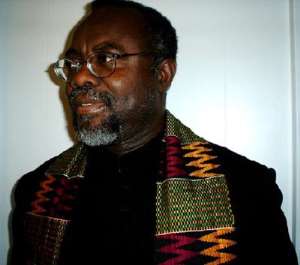
Credit: Kwame Okoampa-Ahoofe, Jr., Ph.D., is Associate Professor of English, Journalism and Creative Writing at Nassau Community College of the State University of New York, Garden City. He is a Governing Board Member of the Accra-based Danquah Institute (DI), the pro-democracy think tank, and the author of 21 books, including “Sounds of Sirens: Essays in African Politics and Culture” (iUniverse.com, 2004). E-mail: [email protected].

 BoG's $260 million building: It was Ato Forson who first proposed 'sell-and-leas...
 'We have to do soul-searching' — Mahama orders nationwide flood assessment
 Court orders woman beater to pay GHS5,000 compensation to midwife at Tema Commun...
 Over 12,000 women living with obstetric fistula in Ghana — Asokwa MP
 Mahama secures 1,840 farm equipment deal from Belarus
 Titus Glover slams Mahama’s flood report directive, calls it “waste of energy an...
 We have increased posting of doctors from 12 to 100 to underserved regions in 20...
 'You had the effrontery to call me struggling lawyer, you won't come back to pow...
 Belarus manufacturers to storm Ghana next week after President's visit
 Government to offer tax incentives for factories located outside Accra


