




Mining companies have called for a national stakeholders' meeting that will involve government, mining communities and civil society groups to help curb illegal mining, which is popularly known as “galamsey.”
They are also calling for regulation of the illegal mining operations to prevent galamsey operators from taking over their concessions.
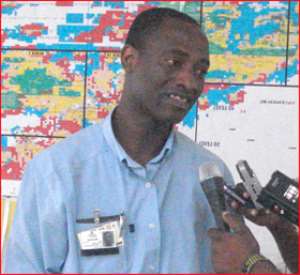
, the General Manager of AngloGold Ashanti, Obuasi Mine told CITY & BUSINESS GUIDE that “a holistic approach involving all stakeholders was needed to help address the “galamsey” operations which have taken a different dimension because foreigners are said to be sponsoring it.
“Galamsey is posing a huge challenge to our operations.
“People are digging on our shafts so I think if our workers go underground it will collapse on them,” he added.
Commenting on the issue, Jurgen Eijgendaal, President of the Ghana Chamber of Mines and the Ghana Manganese Company, Tarkwa-Nsuta, expressed worry about the menace, calling for its immediate check to avert potential problems.
According to him, the mining companies have invested millions of dollars and needed to protect their concessions.
The General Manager of Goldfields, Tarkwa mine, Pee Van Skulkwic, on his part, advised civil society groups to refrain from portraying mining as destructive to the environment but rather to see it as contributing significantly to the nation's development.
Mining companies, he observed, have good environmental programmes that makes the environment conducive after mining.
A recent study, which was carried out by the Ghana Chamber of Mines and the Business Advocacy Challenge (BUSAC), revealed that foreigners were the brains behind illegal mining in the country.
The foreigners, who comprised of Chinese, Togolese, Malians and Burkinabes, are believed to be financing indigenous people to carry out the illegal mining operations.
Nevertheless, about 95 percent of the illegal operators who were not licensed to operate were willing to do so if grounds were available, the report stated.
It suggested a holistic, mutli-stakeholder approach that would involve the government, private sector, Artisanal Small-scale Miners (ASM), community, non-governmental organizations, donors, development agencies and civil society groups.
The action would include the formalization of ASM operations, engagement and dialogue between communities and ASM operators.
Dr. Joyce Aryee, Chief Executive Officer of Ghana Chamber of Mines, stated that her outfit had supported the formalization of small-sale mining since “it contributes significantly to the mining sector, local communities and the state.”
According to her, not only would it lead to employment generation but provide revenue for government to ensure compliance with environmental regulations, among others.
By Charles Nixon Yeboah
 Accra floods: 70 seized excavators to be deployed to NADMO for desilting — Munta...
 Kasseh Market executives stop sale of food near toilet facility
 Three arrested over theft of critical equipment at Komenda Sugar Factory
 Nearly half of Ghanaians say military rule can be justified if governments fail ...
 GWL resumes production at Barekese Water Treatment Plant after completion of rep...
 Economic performance most powerful source of Mahama’s goodwill — IEA
 Nyinahini SHS assault: Court strikes out case, urges reconciliation
 Even traffic lights in front of police headquarters are being stolen — Roads Min...
 One major cause of Ablekuma North rerun violence was lack of security coordinati...
 BTU Council divided as Chairman rejects parliamentary mediation in VC dispute



Comments
"According to him, the mining companies have invested millions of dollars and needed to protect their concessions. " Jurgen Eijgendaal, President of the Ghana Chamber of Mines and the Ghana Manganese Company, Tarkwa-Nsuta is supposed to have made this statement. Foreign Companies have invested on sophisticated machines and tools to turn my country into a pit, and THEIR INTEREST should therefore be protected? Sure, they will leave 3% of the profit in Ghana, but why can't somebody up there ...