




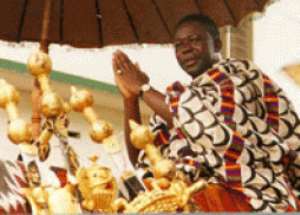
Time, which eventually catches up with every activity and brings it to the ultimate conclusion, is at play. The pomp and pageantry, the euphoria and the excitement which characterised the 10th anniversary celebration of ’s ascendancy to the Golden Stool have come and gone.
It is time for a sober reflection and evaluation on the activities of the immediate past, appreciating the present and to planning for a more beautiful development-oriented foreseeable future.
It will be unnecessary to belabour the point by recounting the numerous achievements and successes the great king has chalked up in the first decade of his rule in respect of poverty reduction, health, education, etc.
Writers, social commentators as well as individual objective thinkers within and without the country have done justice to them over the days, especially in the three months preceding the eventful celebrations and the evidence is solid and palpable for anyone who cares to see.
Therefore, it can be said without doubt that has set a precedent and a standard never realised in the annals of chieftaincy as an institution in our contemporary times, in respect of traditionalism and socio-economic development.
When the event for the celebration of the anniversary was launched in the early days of the year and the subsequent programme of activities released, there was a feeling of fear and apprehension in respect of the realisation of some of the items on the programme. In fact, some of them seemed quite “ambitious” and needed a collaborative effort of the central government and the Manhyia Palace to effect their consummation.
Coming on the heels of a closely contested and tension-packed general election, which resulted in favour of a party perceived to be not too “comfortable” with the people of Ashanti, there was a premonition that the needed camaraderie will be hard to come by as the tendency to look at things from the ethno-political lenses seemed imminent.
However, the whole celebration took a national character and the climactic spirituality, cohesion and oneness needed for the success of such a great event was felt and eventually realised.
With guests seated to await the ultimate chief celebrant, , sirens and motorcades announced the arrival of the Chief Executive Officer of the nation and his entourage.
This was made up of the ‘who is who’ in Ghana, a lot of foreign dignitaries, including former Heads of State of some African countries, Diasporans, Europeans and the crПme de la crПme of the global community.
Otumfuo’s entry to the durbar grounds was uncharacteristically low key. But for the palanquin in which he rode and the hordes of people around him, especially the “Ekyemfour” and the “Ntahara” heralding his majesty’s arrival and the ceremonial umbrellas (with their golden insignia perched on top) forming a large canopy about him, it could have been without much fanfare.
As soon as he arrived, the function took effect. A short but impressive ceremony, comprising speeches by the king and the President, as well as awards to deserving personalities, both local and foreign, who have made their marks in Asanteman and by extension, the nation, Ghana. So the short impressive ceremony came to an end and the President of Ghana and his entourage left the grounds.
Otumfuo then rose to greet and acknowledge his subjects who had filled the spacious Baba Yara Stadium to capacity. There and then did the spirituality, the charisma and the ultimacy of the king manifest itself.
With the Fontomfrom drummers beating to a frenzy and Otumfuo in his palanquin dancing majestically with a golden whisk in hand, the atmosphere became so charged that a spark of light could have set the whole place ablaze.
Subsequently, the chiefs started filing out in their order, all in the agitation and the infectious power emanating from the Otumfuo’s aura.
Once again, Otumfuo has used his charm, charisma, diplomacy and power to bring the whole nation together.
Barriers, both political and tribal, have been broken, and all Ghanaians brought together under one umbrella for a great event.
The first decade, with all its ramification and achievements culminating in the various workshops, fora, round-table discussions, hosted and addressed by world acclaimed leaders and strategic thinkers and the grand durbar, have all achieved their desired results to the glory of God and the advantage of mankind.
The organisers have done a wonderful job. A trail has been set by the one who has been the trailblazer in Ghana’s traditionalism and development over the past decade, setting a course and an agenda to be followed by key players and stakeholders in the institution.
What then is the way forward to such a high standard already set? Are there possibilities to excel more than already achieved?
Before one can go further to explore and attempt to conjecture the future, it might be prudent to go back to the remote past to understand what actually underpins the stupendous spirituality, which underscores the Asante kingdom, kingship and its socio-cultural practices and has sustained it till today.
This 16th century kingdom was founded effectively by the great king Opemsuo Osei Tutu I. He, by dint of hard work, wars of conquest and diplomacy, with the collaboration of his spiritual mentor and friend, Okomfo Anokye established the kingdom.
Legend has it that the golden stool was commanded from the heavens by Okomfo Anokye and it embodies the hopes, aspirations, unity and cohesiveness of the kingdom.
The stool has survived various regimes and vicissitudes and it is still potent. The unity, cohesion and the spirituality underlining the body politic of the kingdom for over 400 years of its existence can be attributed to the Golden Stool.
So as long as the custodians of the stool maintain its sacredness and originality, the Asante Kingdom, though modern and sophisticated in conformity with the ever-changing world dynamics, still retains its socio-cultural balance.
Another interesting thing about this write-up is the attempt to draw a parallel between the present King Osei Tutu II and his great predecessor King Osei Tutu I.
There are a lot of similarities between them and it is not coincidental that he bears his name. Asantes have a great belief in life after death and reincarnation.
One, therefore, cannot be entirely wrong from perspective to suggest that King Osei Tutu II is King Osei Tutu I’s incarnation!
King Osei Tutu I was called by God like the biblical Moses in the ancient time to take Asante out of political servitude.
Historically, Asantes, at a point in time, were ruled by the Denkyiras. Through a lot of machinations, both spiritual and physical, which time and space will not permit to explain and appreciate much in context, King Osei Tutu I, with the spiritual help of Okomfuo Anokye, defeated the Denkyiras in the war of Feyiase, released Asantes of the “Denkyira yoke” and went on to establish this great kingdom we are relishing today.
It cannot be wrong, therefore, in a similar vein to regard King Osei Tutu II as having been equally called by God to help relieve his people of Asante and by extension Ghana of the socio-economic yoke around our necks in these contemporary times.
This “God-man-dated” responsibility he has tackled with much commitment and gusto. Like his predecessor who enjoyed much support from his brave subjects to embark on wars of conquest to actualise his vision to establish the kingdom, so will our modern King Osei Tutu II require the active involvement and support of all and sundry to realise his dream of eradicating poverty, ignorance and disease, since the criteria or the yardstick for measuring contemporary success is no longer wars of conquest, but the socio-economic development of the people of Asante and the nation as a whole.
The Otumfuo Educational Fund, which forms the bedrock of the academic and professional development of the people, should be highly embraced and contributed to by all.
People must not take advantage of the king’s altruism and expect him to do everything single-handedly. The idea must be replicated in various traditional areas to lessen the pressure on Otumfuo’s resources in order to shift focus and concentrate on other equally important and critical areas such as poverty reduction to create more social and economic opportunities that will radically change lives for the better.
Institutions, as well as business establishments, should come out and donate more generously in the form of corporate and individual social responsibilities to augment the king’s purse to undertake many projects within the next 10 years and beyond.
Whereas at the peak of Asante power, Otumfuo’s empire was even bigger than the present day Ghana, some may argue that the current political system has lessened the influence and power of the King considerably and his area of jurisdiction limited.
That notwithstanding, the nation must take advantage of his ‘Solomonic’ wisdom, look onto him for inspiration and direction to accelerate national development. Otumfuo’s leadership qualities should encourage the country’s political leaders to collaborate closely without traditional authorities to achieve the needed socio-economic development for our people.
Fifteen years may seem some distance from now. However, we pray our king would be alive and kicking and like the biblical Moses, “his eyes may not be dim or his natural force abated” when we celebrate him for greater and more successful achievements in 2024.
God bless Otumfuo.
 BoG's $260 million building: It was Ato Forson who first proposed 'sell-and-leas...
 'We have to do soul-searching' — Mahama orders nationwide flood assessment
 Court orders woman beater to pay GHS5,000 compensation to midwife at Tema Commun...
 Over 12,000 women living with obstetric fistula in Ghana — Asokwa MP
 Mahama secures 1,840 farm equipment deal from Belarus
 Titus Glover slams Mahama’s flood report directive, calls it “waste of energy an...
 We have increased posting of doctors from 12 to 100 to underserved regions in 20...
 'You had the effrontery to call me struggling lawyer, you won't come back to pow...
 Belarus manufacturers to storm Ghana next week after President's visit
 Government to offer tax incentives for factories located outside Accra


