




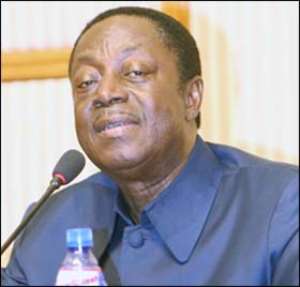
Dr Kwabena Duffuor-Finance Minister The Ministry of Finance and Economic Planning has confirmed that Ghana's growth rate for this year fell significantly from 7.3 percent to 4.7 percent.
BUSINESS GUIDE, a sister paper of DAILY GUIDE, two weeks ago reported that the country's Gross Domestic Product (GDP) had dropped drastically. This means that Government would miss its projected target of 5.9 percent, which was enshrined in this year's budget.
A reliable source told the paper that the projected growth rate target of 5.9 percent GDP would not be achieved this year, noting that the provisional estimate was between 4.2 and 4.7 percent.
Officials of the Ministry of Finance yesterday confirmed to Joy Business that the provisional growth rate for this year was 4.7 percent.
However, they were of the view that the figure could get closer to the original target when the GDP growth rate was finalized.
“Business activities usually pick up in the last quarter of the year. We expect that growth for the last quarter will be significant,” the officials stated.
The growth rate was low for this year because government expenditure was small or insignificant, a move taken to help stabilize the economy.
According to the earlier report by BUSINESS GUIDE, the construction sector, which has contributed significantly to the GDP over the years, grew at a negative rate because ongoing projects were not financed by government; with a typical example being the Achimota-Ofankor road, which is progressing slowly because of lack of funds.
The agriculture sector, which represents about 35 percent of the GDP, grew above its target due to good rainfall and the revamp of the Aveyime rice project. But the rest of the sectors recorded a drop in their projected targets.
The manufacturing sector achieved a positive growth rate, but could have performed very well if the Tema Oil Refinery (TOR) whose output constitutes about one-sixth of the total output was operational.
In addition, the wholesale and retail trade performed below the projected target in the previous year.
This was because traders' sales had dipped significantly because of the drop in the patronage of goods.
Similarly, the percentage increase in school fees had affected the expenditure of Ghanaians.
Government services also dropped because of the freeze on public employment.
The salary adjustment of 17 percent across board was lower than the average inflation rate for 2009.
Meanwhile, the country's Gross International Reserve (GIR) has improved significantly from 1.8 months of import cover to 2.4 months as at the end of September. A high GIR cushions the country against imports and stabilizes the local currency.
From Business Desk
 BoG's $260 million building: It was Ato Forson who first proposed 'sell-and-leas...
 'We have to do soul-searching' — Mahama orders nationwide flood assessment
 Court orders woman beater to pay GHS5,000 compensation to midwife at Tema Commun...
 Over 12,000 women living with obstetric fistula in Ghana — Asokwa MP
 Mahama secures 1,840 farm equipment deal from Belarus
 Titus Glover slams Mahama’s flood report directive, calls it “waste of energy an...
 We have increased posting of doctors from 12 to 100 to underserved regions in 20...
 'You had the effrontery to call me struggling lawyer, you won't come back to pow...
 Belarus manufacturers to storm Ghana next week after President's visit
 Government to offer tax incentives for factories located outside Accra


