




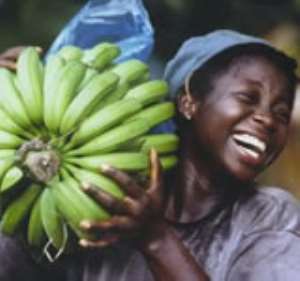
Entering the Global Mamas store in the bustling Osu district of Accra, Ghana, shopkeeper Rosemary Doom offers a friendly greeting and her assistance. Weaving through the shop she points out products on display arrayed in a rainbow of colors from batik printed blouses to small purses made from recycled bags to an assortment of beaded necklaces and bracelets. Looking around, you will find the store is home to thousands of hand-made goods blending together traditional African design with modern day style. Women striving towards economic independence and sustainability for themselves and their families produce the items seen hanging from the hooks and paraded on the shelves. Women in Progress, the fabric behind the Global Mamas fair trade brand name is altering women's lives one hand-made apparel item at a time.
In Ghana, roughly 50.2 percent of the population are women, which make up about half of the entire labor force and are a significant contributor to national output growth, according to a 2007 report on women entrepreneurs in Ghana published by the International Finance Corporation (IFC), a member of the World Bank Group. Most economically active women in Ghana operate in the informal economy, where they outnumber men, and are particularly involved in various micro-enterprises and retail trade, the report finds. Women in Progress/Global Mamas has directly enhanced the wages, standard of living, and confidence of over 400 low-income women in Ghana by helping woman-owned businesses expand their operations.
Launched in 2003, Women in Progress/Global Mamas is a non-profit organization, founded by two former Peace Corps volunteers, whose mission is “to achieve economic independence of women and alleviate poverty at a grassroots level in developing nations through the sustainable growth of small women-owned businesses and at the same time establish mutual understanding among people of diverse cultures” according to the organization's website. Global Mamas exists so women can earn an income and in doing so gain respect. With this, women are able to make choices within their families as well as in their communities, explained Renae Adam, one of the co-founders, who resides in Ghana.
How are they achieving this? According to their 2008 annual report, Women in Progress/Global Mamas provides artisans with financial and management support through a series of initiatives: creating direct market linkages through the coordination of sales of over 175 different types of products in hundreds of designs to over 250 commercial customers overseas and here in Ghana, financing cash flow by providing up-front payments for the production of high-quality goods, reducing the cost of raw materials by sourcing in bulk via a Raw Materials Revolving Inventory Fund, and hands-on training in new product development, strategic planning, bookkeeping, marketing, and quality control. Through these operations located in Cape Coast, partnered with local businesses and administered through the extensive worldwide volunteer network the organization has created, Women in Progress / Global Mamas is able to strengthen the capacity of women entrepreneurs in Ghana.
By nurturing economic opportunity among women, Women in Progress/Global Mamas is part of an ever-increasing global consensus that suggests empowering women is the key to eradicating poverty. The African Development Bank Group (AfDB) held a conference in Cameroon recently which focused on women entrepreneurship development. According to a concept paper produced by AfDB, it is estimated that in Africa, over one-third of the businesses belong to women. The paper states that in the developing world, women workers make up around 60 percent of non-agricultural employment in the informal economy – including up to 90 percent of street vendors and up to 80 percent of home-based workers. As a result, many of these women often remain outside the scope of laws and regulatory mechanisms aimed at providing basic health and safety standards and workers' rights, the paper concludes.
Women in Progress/Global Mamas recognizes the uphill battle women entrepreneurs face and strives to reduce the disparity by employing fair trade practices (living wage, safe and healthy working conditions, advancement opportunities, public accountability) for all women in the cooperative. In addition, the organization links them to international markets many small businesses in Ghana don't currently have the opportunity to access. The IFC/World Bank Group reports a significant proportion of women entrepreneurs do not participate in international trade. However, Women in Progress/Global Mamas is changing that by linking the overseas demand for hand-made African goods with the supply here in Ghana. As at 2008, there were over 80 individually owned businesses in the Global Mamas network that created more than US$500,000 in global sales of their fair trade products to retail markets in Ghana, North America, Europe and Australia, according to their annual report.
Women in Progress/Global Mamas' approach is long-term and what the organization calls 'assisted-implementation' focused, setting them apart from many of the other NGO's working in Ghana. Their emphasis is not only on the components of training but more sustainably on the day-to-day operations and barriers women may face running their business in the future. By providing a hands-on approach, not just a hand out, women experience sustainability and thus are able to employ more women. Global Mamas recognizes that not every woman is the same and not every woman wants to run a business. As a result, they encourage women to step outside of their comfort zones but ultimately the women choose what they feel is best suited for them; whether it be focused on sewing or managing a product line.
Women in Progress/Global Mamas is connecting women in Ghana to the global economy and thus to cultures all over the world through the beautifully handcrafted goods the network produces and sells. Furthermore, they are empowering women today who are inspiring tomorrow's female entrepreneurs. On the horizon they look to continue their mission by expanding efforts into bulk shea butter by partnering with roughly 700 women in the north of Ghana. Global Mamas/Women in Progress is in the driver's seat of a positive and exciting global change, impacting the life of one global mama at a time.

 Gov’t renames 24-hour economy markets as District Economy Markets, targets 100% ...
 BoG, Police arrest 7 in Accra over alleged use of cedi notes for money bouquets,...
 SkyTrain trial: High Court adjourns case management conference to October 19
 Edudzi Tameklo recalls how Duffuor was slapped with GH¢100 million bail in 2020,...
 About 800 Director I and II applicants unreachable due to invalid contact number...
 'Boakye Agyarko was seen as anti-Bawumia' – Lecturer on John Boadu’s victory
 'NPP delegates made wrong choice electing John Boadu as chairman' — Political Sc...
 MTN Ghana secures new 5G spectrum in 700 MHz and 3 GHz bands
 Bawumia explains NPP hunt for winnable parliamentary candidates, not deep-pocket...
 Ghana to tap Egypt’s expertise for new capital city, housing projects – Mahama


