




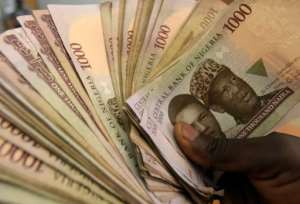
Abuja (AFP) - Nigeria's central bank on Tuesday agreed to introduce greater flexibility in the foreign exchange market after shortages that have hurt investment and sparked a petrol shortage.
The announcement came as Africa's leading economy faces a string of challenges, from a weakened currency and spiralling inflation, to negative GDP growth and rising unemployment.
President Muhammadu Buhari has refused to devalue the naira, despite a growing gulf between the official exchange rate of 197/199 to the dollar and black market rates nudging 350.
The difference has led to a shortage in foreign exchange, hitting businesses and leaving fuel importers unable to buy supplies, causing pumps to run dry.
Central Bank of Nigeria governor Godwin Emefiele was last Friday urged by financial experts to make a U-turn in policy to avoid a "full-blown fiscal, financial and economic meltdown".
But he said the CBN's Monetary Policy Committee (MPC), which met Monday and Tuesday, decided on the "the least risky option" and agreed to adopt "a flexible foreign exchange rate policy".
No further details on abandoning the currency peg were immediately available, with the bank promising more information in "coming days".
Economist Alan Cameron, from Exotix Partners in London, said he expected "a two- or three-tiered" foreign exchange system, keeping the official rate for "critical transactions".
"I think Nigeria has clearly taken quite a hit after a year of Buhari's policies where he hasn't been willing to have any flexibility at all," he added.
"I think the market will view this positively, I think investors could take a new look at Nigeria but we need specific details about how the new system is going to work."
Nigeria's woes can be traced back to the slump in global oil prices since mid-2014, which has cut revenue from oil sales worth 70 percent of its government income.
Renewed militancy in the oil-producing south has also hit production, cutting output to 1.4 million barrels per day from a budgeted 2.2 million bpd.
Last week, the National Bureau of Statistics announced that the Nigerian economy shrank by 0.36 percent in the first quarter of this year. In the same period, unemployment increased to 12.1 percent.
Inflation rose to 13.7 percent in April.
Emefiele said recession was "imminent", blaming the slump on global oil prices as well as delays in passing this year's federal budget.
But in a surprise move, he kept interest rates on hold at 12.0 percent.
 BoG's $260 million building: It was Ato Forson who first proposed 'sell-and-leas...
 'We have to do soul-searching' — Mahama orders nationwide flood assessment
 Court orders woman beater to pay GHS5,000 compensation to midwife at Tema Commun...
 Over 12,000 women living with obstetric fistula in Ghana — Asokwa MP
 Mahama secures 1,840 farm equipment deal from Belarus
 Titus Glover slams Mahama’s flood report directive, calls it “waste of energy an...
 We have increased posting of doctors from 12 to 100 to underserved regions in 20...
 'You had the effrontery to call me struggling lawyer, you won't come back to pow...
 Belarus manufacturers to storm Ghana next week after President's visit
 Government to offer tax incentives for factories located outside Accra


