




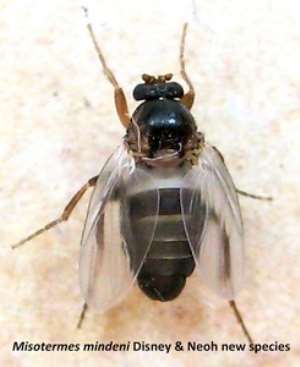
Researchers in Malaysia have found a new scuttle fly species which was parasitizing a mound-building termite in Penang, Malaysia. Although the research is still in its early stages, this new species may have the potential to be a biological agent in controlling termite infestation.
The species has been named Misotermes mindeni, after the university campus where it was discovered and their findings has been published in the latest issue of Sociobiology.
Mr Kok-Boon Neoh, a Ph.D. student under the supervision of Prof Chow-Yang Lee of the Urban Entomology Laboratory, Vector Control Research Unit, School of Biological Sciences, Universiti Sains Malaysia made this discovery while he was studying termite (Macrotermes gilvus) population mounds in the Minden campus of Universiti Sains Malaysia.
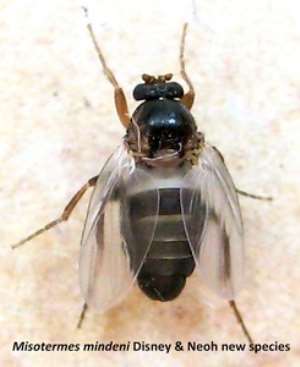 Misotermes mindeni (Disney and Neoh new species)
Copyright : Universiti Sains Malaysia
He first noticed some termite soldiers which looked different from the others. These soldiers had large heads, but very small mandibles. Back in the laboratory, Mr Neoh observed movements in the abdominal section of these 'different looking' termite soldiers. After a couple of days, the soldiers died and subsequently small flies emerged out from the termite bodies. For additional confirmation, the flies were sent to Dr R. Henry Disney, a world-authority of phorid flies at Cambridge University, UK who confirmed the fly to be a new species to science.
Based on observations of fly larva, the researchers speculate that the fly infects immature (young) termites. The larva will grow in the termite head until it is ready to pupate. The larva will then move to the termite abdomen, contract intensively and apply sideway pressure using its spiracles to break the termite's abdominal wall. The body fluid will ooze out of the wall perforation and the termite will die. Thus, a dry micro-environment is created to enable the fly larva to pupate inside its host's body.
The mechanism of parasitism is yet to be determined but further studies made on the effect of parasitism by M. mindeni on the termites revealed that the parasitized termite soldiers have larger head and smaller mandibles when compared to the normal termite soldiers. In addition, the parasitized soldiers also demonstrated less aggressive behaviour when disturbed, when compared to the normal ones.
Termite management is the most important business in the pest management industry in Malaysia. It costs approximately RM 50 million a year, while the repair cost to termite damage is 3-4 times higher. At the moment chemical treatment is the only and most effective way to manage termite infestation.
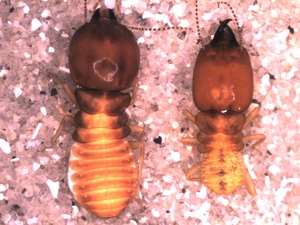 Parasitized Macrotermes gilvus soldier (left) by fly Misotermes mindeni, versus the normal soldier (right). Notice the larger head and the smaller mandibles in the parasitized soldier Copyright : Universiti Sains Malaysia
For more information, please contact:
Kok-Boon Neoh and Chow-Yang Lee
Urban Entomology Laboratory
Vector Control Research Unit, School of Biological Sciences
Universiti Sains Malaysia, 11800 Penang, Malaysia.
Email: [email protected]; [email protected]
Originating at www.researchsea.com
 BoG's $260 million building: It was Ato Forson who first proposed 'sell-and-leas...
 'We have to do soul-searching' — Mahama orders nationwide flood assessment
 Court orders woman beater to pay GHS5,000 compensation to midwife at Tema Commun...
 Over 12,000 women living with obstetric fistula in Ghana — Asokwa MP
 Mahama secures 1,840 farm equipment deal from Belarus
 Titus Glover slams Mahama’s flood report directive, calls it “waste of energy an...
 We have increased posting of doctors from 12 to 100 to underserved regions in 20...
 'You had the effrontery to call me struggling lawyer, you won't come back to pow...
 Belarus manufacturers to storm Ghana next week after President's visit
 Government to offer tax incentives for factories located outside Accra


