




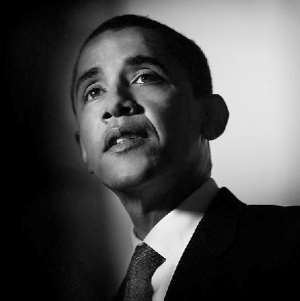
OBAMA ANAAAA! By CAMERON DUODU
When Ghanaians say “anaaa!” after your name, then, to them, you have taken off into outer space.
The word is normally a rhetorical question, meaning “Not so?” But when they are conversing about an exciting football match and one of them says of a goal-scorer, “Muntari anaaaa!” he is not asking any question. He is acknowledging artistry so powerful that it leaves a sign of question in one's mind: but is what Muntari did with that ball really possible? Just imagine what Ebonics speakers say when Kobe Bryant goes coast to coast to slam-dunk the basketball, or Michael Jordan “defies gravity”.
In the same way, “Obama anaaa” recognises what the President meant when he stated, during the 2008 election campaign, that he was an “unlikely” candidate.
I suggest to President Obama, after watching his TV interview with AllAfrica.com, that as far as Africa is concerned, the legacy he ought to leave behind, to emphasise that he intends to make a difference to us, is as follows.
He should forget conventional economic aid. Aid is only a 'band-aid' plastered on an ulcer that demands a far more skilful healing operation. The President's father was born in Kenya, and naïve Kenyans, for instance, might entertain the belief that he can give them more aid than previous US Presidents could. You see, many Africans do not fully grasp the limitations of presidential power in the US, given the oversight responsibilities of the US Congress and the partisan politics that dogs that role. However, even if the President could get Congress to increase aid for Africa substantially, it would not solve the problems of poverty on the continent.
The only really important thing the President can do, not only for Africa but also for the entire developing world, is to use his enormous powers of communication to lead and continually engage opinion in the G8 to change the whole system of exchanging products in the world. No less.
At the moment, Africa, for instance, is locked into a system, at least a hundred years old, which makes it a price-taker. This means that however hard Africans work, their ability to survive economically depends not on their own efforts, but on what happens in the countries where the commodities they produce are consumed.
Kenya is one of 40 countries in the world that produce coffee, a $40 billion industry; the biggest industry in the world after petroleum. But while the petroleum producing countries are rich because of the way they have managed to transform themselves into price-givers, coffee producers are poor.
Of any £2 charged for a cappuccino in a British coffee shop, an average Kenyan coffee farmer gets less than 2p. Similarly, a $3 cup of latte drunk in the US, yields only 3 cents to the coffee farmer in Africa.
I suggest that if you do the math, you are bound to ask yourself: Is this not as bad as slavery? Yet this is a system that has been going on silently, day after day after day, for over 100 years. A group of film-makers have found the situation so revolting that they have produced a film about it called “Gold”. It paints a devastating picture. One told the London Observer:
'Coffee is one of the least transparent industries in the world…We're supposed to be marking 200 years since the abolition of slavery. The coffee industry is not slavery, but when people are being paid half a dollar a day, it is not far off.
“The companies argue that it's better than nothing, and that's a problem. By which standard is an equitable wage being judged?… The whole debate about sustainability has been hijacked by Starbucks. …You go to a [Starbucks] shop and see pictures of happy, smiley coffee farmers, but we need to go back to the value chain and ask how much of the $3 cappuccino or latte goes to the farmer?'
http://www.guardian.co.uk/film/2007/may/27/foodanddrink.food
If the President wants, in future, to have a dialogue with Africans who matter, it isn't African Presidents alone that he should invite to the White House, but people like a Mr Andrew Rugasira of Uganda. In an article in the London Guardian, Mr Rugasira wrote:
“As an African entrepreneur, I am not looking for handouts that I have not earned. I only want the same opportunities that British entrepreneurs coming to Africa have access to. We went to the same schools and universities, and in the global community we are all looking for the same things: markets and equal opportunities to exploit them.“Many Africans are condemned from birth to a future of poverty, disease and premature death. … The prevailing perception of Africans and their capabilities never transcends the confines of their so-called limitations. You are poor because you are poor. …[But] it is wealth creation that links the African struggle of yesterday, today and tomorrow. To understand this we must remove the blinkers and see an Africa beyond kleptocracy and Kalashnikovs. …
“In the face of the controlled markets [in the G8], African countries face three problems. First, African manufacturing and processing seldom adds much value to the raw product. Think about this: coffee is the second most traded commodity in the world after petroleum. Of the £35bn the global coffee market represents, [only] £3.8bn accounts for the value of the raw coffee beans traded annually.
“Second, the industrialised countries' tariff and non-tariff barriers escalate with each additional stage of processing for most primary commodities. The vertical integration of transnational corporations means producers are usually totally unaware of their product's true value…. One of the biggest obstacles to Africa's long-term development in exports is the transnational control over processing. If exports are to lead to greater wealth creation for Africans through economic growth, then these exports must have as much value added as possible, and market access must be improved…
“Let me give you a simple illustration of why we need to use trade and not aid as our principal weapon. One needs approximately five grams of roasted and ground beans to make a cup of coffee that sells for £2, so one kilogram can make 200 cups worth £400. Green coffee beans are bought for an average price of 70p per kilogram. In other words less than 0.2% of the value of processed coffee is retained by the growers.”
“If profit sharing leads to the empowerment of African growers, employees and shareholders, then this is what needs to be done. Make aid history and trade justice the future.”
http://www.guardian.co.uk/world/2005/jun/08/hearafrica05.debtrelief/print
The President will be visiting Cape Coast on his visit to Ghana. It will be an extremely educative experience for him, but I wish he could also travel an extra 50 miles or so to go and see the Takoradi harbour -- maybe he can do that another time or ask to see footage of what happens there. He would see all sorts of bulk exports from Ghana in the water and in warehouses, awaiting shipment: enormous amounts of cocoa beans in sacks (depending on the season); perhaps some huge logs; unprocessed manganese, bauxite etc.
The sight of these products that are going to take up huge amounts of space in the ships of the West -- at a cost to Ghana -- but which could be processed here and turned into manufactured goods, should turn the stomach of the President.
Mr President, it is criminal! It is a direct continuation of the system that took human beings out of our land, put them in the stinking dungeons in Cape Coast Castle, and shipped them off to go and slave to make America rich. It is part of the system that denied even the “40 acres and a mule” that had been promised to the freed descendants of the enslaved captives.
It is when the President is able to have coffee in the White House with the CEO of Starbucks and look him in the eye and ask, “But why at all do you have to continue grinding and packaging your coffee in the US, and not where it is grown?;
It is when the President is able to call the CEO of Hershey and tell him, “I am asking the children of America not to eat your chocolates and confectionary until you manufacture them in Ghana and the Ivory Coast, where the best cocoa is produced”;
It is when the President tells Boeing and other aircraft manufacturers, “Do you know that you could be producing aluminium in Ghana and exporting aeroplanes more cheaply from there?” that the Obama legacy will amount to what it could really be worth.
Otherwise, he could be so easily going down in history as one of the caricatures created by the pen of Frantz Fanon: black skin, white mask.

 One dead, fire officer hospitalised after bee attack at Quarry Site in Sokode Gb...
 Israel and Iran step back from further strikes after renewed clashes
 Patients stranded as doctors, nurses refuse to see new patients over KATH CEO su...
 Avenor Rural Bank CEO’s house destroyed by fire
 Three arrested in Winneba for illegal mining near GWL water lines
 Two pupils of Alice Elite Academy laid to rest after fatal school bus crash
 Here are areas to be affected by ECG's planned maintenance on Tuesday
 Family of civil engineer killed in alleged military shooting demands justice
 SHS teacher allegedly beats female student over unpaid hostel fees
 Blow to EU defence cooperation as France, Germany abandon joint fighter jet prog...


