




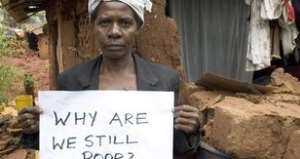
According to the World Bank, it is, “a vital source of financial and technical assistance to developing countries around the world. We are not a bank in the common sense. We are made up of two unique development institutions owned by 184 member countries—the International Bank for Reconstruction and Development (IBRD) and the International Development Association (IDA). Each institution plays a different but supportive role in our mission of global poverty reduction and the improvement of living standards. The IBRD focuses on middle income and creditworthy poor countries, while IDA focuses on the poorest countries in the world. Together we provide low-interest loans, interest-free credit and grants to developing countries for education, health, infrastructure, communications and many other purposes."
The above statement of claim taken from the World Bank website contains half truth. Yes it is true that in theory the World Bank would like to reduce global poverty but in practice it is the opposite. The fact still remains that both the Bank and the IMF have done very little to help the world´s poor rather their condition has been worsened by the past and present behaviour of the Banks. There is little evidence to back the claim of both institutions that they are a vital source of financial and technical assistance to developing countries. The World Bank may be a vital source of financial assistance to the corrupt regimes in these poor countries and not to the poor. There is no evidence to suggest that the poor people from third world countries have benefited from loans given to their governments. At best what the Bank and IMF have helped the poor countries to do is to build up massive debts that they may never be able to pay.
Third World countries including the whole of Africa have incurred trillions of dollars in debts through loans contracted from the Bank, IMF and Western governments which the people who now wallow in utter poverty, never benefited. Most of these conditional loans were either stolen or used to service debts already owned by these poor countries. Part of the loans were also used to pay foreign expatriates supplied to the poor countries by IMF, World Bank as ´technical experts´ but whose contribution is the result of poverty seen in the third world. Again the loans were used to prop up corrupt regimes who diverted the funds to their private bank accounts in Switzerland, France, Britain, Liechtenstein and Luxembourg and Austria among others.
In 2006 for example, developing countries owed $3.7-trillion in odious debt, servicing more than $570-billion per annum. An analysis by economist James Henry revealed that more than $1-trillion worth of loans "disappeared into corruption-ridden projects or was simply stolen outright". Out of this debt Africa owes $200 billion and uses $14 billion annually to service it, money that could be used to provide education, healthcare other basic needs for the people. The over $200 billion that African countries owe to foreign creditors represents a crippling load that undermines economic and social progress. The all Africa Churches Conference says this debt and its servicing represent "a new form of slavery, as vicious as the slave trade".
The servicing of such massive debts has brought untold and worsening economic hardships to the poor as third world governments have been forced to freeze investments in education, health, transport, agriculture, housing, sanitation and other vital infrastructures. Evidence of this hardship are chronic poverty, malnutrition, diseases, starvation, hunger, decaying and inadequate infrastructures and economic failures seen everywhere in the developing world. The sad aspect of these debts servicing is that the current generation who are paying for it never requested it nor benefited from it in anyway. The debts were incurred at a time when these countries did not even need loans yet World Bank, IMF and Western governments encouraged them to go for it.
Africa Action a Not for Profit Organisation says, "The albatross of illegitimate debt diverts money directly from spending on health care, education and other important needs. While most people in Africa live on less than $2 per day, African countries are forced to spend almost $14 billion each year servicing old, illegitimate debts to rich country governments and their institutions, the World Bank and the International Monetary Fund (IMF). Over the past two decades, African countries have paid out more in debt service to foreign creditors than they have received in development assistance or in new loans. Much of Africa's foreign debt is illegitimate in nature, having been incurred by unrepresentative and despotic regimes, mainly during the era of Cold War patronage. Loans were made to corrupt leaders who used the money for their own personal gain, often with the full knowledge and support of lenders. These loans did not benefit Africa's people.
More generally, many Africans question the notion of an African "debt" to the U.S. and European countries after centuries of exploitation. They ask, "Who really owes whom?"Yet, despite the social and economic costs of this massive outflow of resources from the world's poorest region, the wealthy creditors of Africa's debts continue to insist these debts be repaid." Source http://www.africaaction.org /campaign_new /debt.php
Joseph Hanlon of Jubilee Research UK gives details to what happened to monies loaned to Mobutu of former Zaire now DR.Congo. He says: "Much of poor country debt is related to the Cold War, when both sides pushed money at their supporters. Zaire's ruler, Mobutu Sese Seko, was one of the world's most corrupt leaders and it was for his government that the word kleptocracy was first coined. Mobutu became one of the world's richest men, with a personal fortune estimated at more than $10 billion owning palaces in Europe and Zaire. But the West saw Mobutu as a loyal ally in the Cold War (in part for his support of the US, in its backing for UNITA in Angola). In 1978 the IMF appointed their own man, Edwin Blumenthal, to a key post in Zaire´s central bank. He resigned two years later, complaining of "sordid and pernicious corruption" that was so serious that "there is no chance, I repeat no chance, that Zaire's numerous creditors will ever recover their loans."
And look what happened after this report.
Shortly after Blumenthal's report to the IMF, it gave Zaire the largest ever loan given to an African country. When Blumenthal wrote his report, Zaire's debt was $5 billion; by the time Mobutu was overthrown and died in 1998, the debt was over $13 billion. In the six years after Blumenthal's report, the IMF lent Zaire $600 million and the World Bank $650 million. In those six years Western governments lent Mobutu nearly $3 billion.
About 50% of the $13-billion was stolen and deposited in Western Banks notably Switzerland and France while the rest was wasted on white elephant projects that never solved the poverty problem in the country. Today majority of Congolese live on less than a dollar a day while hundreds of millions of dollars are paid to the IMF and World Bank every year as fees for loans taken and stolen by Mobutu.
In another classic example, the World Bank lent Indonesia a total of US$30 billion in the course of General Suharto's three decades of rule. In 1998, World Bank resident staff in Indonesia estimated that: "at least 20-30 per cent of GOI [Government of Indonesia] development budget funds are diverted through informal payments to GOI staff and politicians, and there is no basis to claim a smaller 'leakage' for Bank projects as our controls have little practical effect on the methods generally used". That means by the Bank's own account that up to US$9 billion of World Bank loans to Indonesia were wasted through corruption and that World Bank staff knew it. And they did absolutely nothing to stop the corruption. Today the poor people of Indonesia are still paying for the billions of dollars wasted before the eyes of IMF.
In Philippines during the regime of the dictator Ferdinand Marcos, the Bank and IMF were absolutely aware of the fact that most loans to Philippines were transferred into the bank accounts of Ferdinand Marcos and his generals; nevertheless they considered it as a necessary bribe for paying the political staff in power in order to ensure the acceleration of the neoliberal counter reform. As a result World Bank lent Marcos $400m in 1980; $251m in 1982 and $600m in 1983 and Marcos deposited the money in his accounts in Switzerland. So far the Philipinos are still paying for the policies of the Bank and IMF.
Dr. Susan Hawley author of Exporting Corruption has written extensively about how loans taken and diverted into private banks by Ferdinand Marcos have gruesomely affected Philippines´ development and her quest to reduce poverty. She says: "The US company, Westinghouse won a contract in the early 1970s to build the Bataan nuclear plant in the Philippines. It was alleged that Westinghouse gave President Ferdinand Marcos US$80 million in kickbacks. The plant cost $2.3 billion three times the price of a comparable plant built by the same company in Korea. Filipino taxpayers have spent $1.2 billion servicing the plant's debts even though the plant has never produced a single watt of electricity because it was built at the foot of a volcano near several earthquake faultlines. The Philippine government is still paying $170,000 a day in interest on the loans taken out to finance the nuclear plant and will continue to do so up to the year 2018. A Philippino Treasurer Leonor Briones recently commented on the loans: "It is a terrible burden which never fails to elicit feelings of rage, anger and frustration in me. We're talking of money that should have gone to basic services like schools and hospitals". Source: Dr. Susan Hawley.
Patricia Adams, executive director of Probe International, in her book Odious Debts estimates the Philippino dictator, Ferdinand Marcos, and his wife Imelda, pocketed literally one-third of the Philippines' entire borrowing – much of it in the form of kickbacks and commissions on aid and loan-funded projects. His personal wealth when he was overthrown was $10 billion. Source: Jubileeresearch.org.
The behaviour of the two Banks and other lending institutions to prop up corrupt regimes explains why after 50 years of loans there has not been any appreciable reduction in poverty levels world wide and especially in Africa. As I said the best the two Bretton Woods institutions have done is to help the poor countries to build massive debts and increase poverty. Today majority of the 945 million Africans (70%) live on less than two dollars a day meanwhile hundreds of billions of dollars have been loaned to their corrupt leaders and there is nothing to show for it.
James Wolfensohn, Ex-World Bank President seems to disagree and says: "As a public institution we are accountable for helping our borrowers to see that the money allocated under Bank-financed operations is being spent on what it should be spent on and that our borrowers are getting good value for what is being spent". But how does Wolfensohn reconcile his statement with reports regarding loans to dictators in Africa, Asia and South America that produced nothing but poverty? The question is has the billions of loans and aid to third world countries change anything for the poor people in those countries? Can Wolfensohn say with empirical evidence that countries that have borrowed money from the Bank got value for the money? I do not think so. There is no evidence to suggest that IMF and World Bank even made the effort to ensure the people benefited from the loans and there is no evidence to prove that both institutions made effort to recover the money from Mobutu, Suharto, Marcos, or the Banks in Switzerland after it became obvious the dictators had stashed the money in foreign Banks. The two mega banks did not make any effort because they knew future generations cannot afford to refuse to pay as that will be a stain on their credit worthiness. But how fair is it to ask people to pay for things they or their country never benefited?
Instead of being agents of growth, development and helping to fight poverty, what the two institutions and their western political masters have done so far is to entrench poverty, diseases, hunger, starvation and malnutrition in these poor voiceless countries. The pressure on the poor countries to meet their debt obligations has forced many of them to use scarce resources to service these debts to the detriment of their economies and their peoples. If indeed the Bank and the IMF are committed to reducing poverty why would they loan money to corrupt regimes or refuse to take responsibility for the failures of their own policies and actions? Why would they help poor countries to build massive debts only to wash their hands off the debt? And why should poor Africans, Asians and Latinos be made to pay the odious and illegitimate loans that they never benefited? Why should poor African and third world countries be made to take responsibility for the failures of IMF and the Bank´s ill conceived policies that have brought misery and untold hardships to the poor? Who should take responsibility for these odious and illegitimate debts is it the Bank who loaned out of negligence and without due diligence or the people who never benefited?
To ask these poor countries to continue to pay these debts is not only unfair but morally not justified. Poor countries should stop paying these odious and illegitimate debs unless the IMF and the World Bank can prove that the people benefited from it. World Bank and IMF were wilful accomplices to the loot, corruption and mismanagement that took place during Mobutu, Suharto, Marcos, Lansana Conte regimes and which are being repeated by the corrupt regimes of Obiang Nguema, Denis Sassou Nguesso, Gaddafi, Hosni Mubarak, Omar Bongo, Obiang Nguema and Blaise Campore. If lending institutions fail to demand proper accountability from these corrupt rulers then it would be unlawful and improper to ask future generations to pay for the sins of their rulers.
When consultants Morgan Grenfell urged against the sale of the Uganda Commercial Bank, the World Bank and IMF insisted the sale go ahead. Sold to a Malaysian engineering consortium linked to the brother of the Ugandan president, the bank had to be re-nationalised in 1998 "after running into trouble giving out millions of dollars worth of dubious loans". According to the head of Uganda's privatisation unit, "When [the sale of Uganda Commercial Bank] went bad", the World Bank "disappeared off the radar screen" and refused to take any responsibility for it. Source: greenleft.org.au
Apart from their support for corrupt regimes, the Bank and IMF prescriptive policies have also played a huge role in entrenching poverty in the third world. Worth mentioning are the structural adjustment programme and trade liberalisation which were sold to the poor countries by these financial institutions and supported by the western economic saboteurs. The fact is that the SAP and trade liberalisation among others were ill formulated, implemented and monitored with the results that countries that embraced them have all lived to regret.
The SAP forced onto poor third world countries by the Bank and the IMF forced their governments to abandon their support for the public sector with serious devastating consequences to the health, education and agric sectors. The withdrawal of farm subsidies in particular made it difficult for farmers to produce to support local consumption or compete with their rich Western counterparts who receive billions of dollars of government subsidies every year. The unrests and disturbances over food shortages and high food prices that occurred in Egypt, Haiti, Ivory Coast, Liberia, Mauritania, Indonesia, Afghanistan, Eritrea, Somalia and Sierra Leone in 2008 were the direct result of the Bank and IMF bitter pills prescribed to these poor countries.
Trade liberalisation required the poor countries to privatise or close down certain companies, opening up the economy to foreign goods, reforming economic policy, liberalising labour market, eliminating subsidies, and environmental regulations, eliminating set prices for producers and consumers, increasing exports, cutting government expenditures and giving foreign multinationals free hands to do as they wish often to the detriment of the countries concerned. The cost of trade liberalisation to third world countries is estimated to be $300-billion.
The sad aspect of this exercise is that almost all the companies that were sold went to foreigners and cronies of corrupt government officials and the proceeds stolen or used to service debts already owned by these poor nations. This policy also led to closure of a number of factories, and decline in agriculture output that were sources of livelihoods to hundreds of millions of families. The mention of this retrenchment exercise always brings painful memories to millions who lost their jobs and had to live a life of squalor without any help or whatsoever from their governments.
Also the Bank and the IMF tax and trade policies towards these poor countries always put them at a disadvantage positions when dealing with multinational corporations. Many poor countries are forced to grant tax concessions to multinational corporations as a favour for investing in the third world economies. These concessions include instituting secrete memorandums of agreement, subsidies to foreign corporations and massive tax concessions (such as income tax, usage fees, property tax) which are the primary source of revenue for export-oriented developing countries.
How do you fight poverty when rich companies are made to pay close to nothing for raping countries of their natural resources? Why wouldn´t poverty increase and people die of starvation, hunger and diseases when money meant for development are used to service debts for which the people never benefited?
In an article by Khadija Sharife entitled Capital Flight: Gingerbread Havens, Cannibalised Economies she wrote: "The IMF and World Bank tax policies towards the developing world is very lethal especially where the poor are now caught in tax brackets, courtesy of the IMF and World Bank´s structural adjustment programmes (SAP), instituting policies ranging from tax holidays to the privatisation of state services, carving out huge slices of natural capital at corporate auctions. Africa has collectively lost more than $600-billion in capital flight, excluding other mechanisms of flight such as ecological debt (globally estimated at a potential $1.8-trillion per annum). Thus with the support and collusion of IMF and the Bank, poor countries are loosing billions of dollars in revenue to rich multinational corporations.
The unflinching support that the Bank and the IMF give to multinational corporations against the wishes of third world governments is another reason why poverty is still rampant in Africa and elsewhere. For example, in 1998 the Pakistani anti-corruption agency investigated over 20 Western companies for paying kickbacks to Benazir Bhutto's government for public contracts to provide electricity. Six of the companies later confessed to offering bribes. Instead of receiving support from Britain, France, the US, IMF, World Bank and other Western governments they were told to quash the investigation on the grounds that investors would shy away from Pakistan. The IMF even made a package of loans conditional on the government dropping the charges against the companies involved. Source:http://www.thecornerhouse.org.uk/item.shtml?x=51975. In the end Pakistan had no choice but to stop the investigations.
It is on record that about 45% of all World Bank project contracts go to multinationals in the US, Germany and Britain why? Why not companies in these poor countries where the projects take place and who finally end up paying for the projects?
But it is not surprising that these multinational financial institutions behave the way they did. Both institutions only acknowledged in 1996 the role corruption plays in entrenching poverty after more than 50 years in existence. Why did they continue to loan to the dictators after mounting evidence that they were looting the loans? Why did it take World Bank 50 years to recognise the devastating impact corruption was having on the world´s poor? Could it be that both institutions are corrupt themselves?
Dr. Jeffrey Winters of Northwestern University says, "The World Bank has participated mostly passively in the corruption of roughly $100 billion of its loan funds intended for development." Other experts estimate that between 5 percent and 25 percent of the $525 billion that the World Bank has lent since 1946 has been misused. This is equivalent to between $26 billion and $130 billion. Even if corruption is at the low end of estimates, millions of people living in poverty have lost opportunities to improve their health, education, and economic condition".
And Sen. Richard G. Lugar speaking about corruption in the World Bank and its impact in fighting poverty said, "Corruption thwarts development efforts in many ways. Bribes can influence important World Bank decisions on projects and on contractors. Misuse of funds can inflate project costs; deny needed assistance to the poor, and cause projects to fail. Stolen money may prop up dictatorships and finance human rights abuses. Moreover, when developing countries lose development bank funds through corruption, the taxpayers in those poor countries are still obligated to repay the development banks. So, not only are the impoverished cheated out of development benefits, they are left to repay the resulting debts to the banks."
In fact, allegations of corruption at the Bretton Woods institutions are as old as the institutions themselves. In 1994, marking the 50th anniversary of its creation at Bretton Woods, South End Press released "50 Years is Enough: The Case Against the World Bank and the International Monetary Fund," edited by Kevin Danaher. The book details official Bank and IMF reports that reveal the same kind of corruption and embezzlement back then. In addition, it revealed different types of corruption, for instance, "Beyond the wasted money and the environmental devastation, there was an even more sinister side to the Bank during the McNamara years: the World Bank's predilection for increasing support to military regimes that tortured and murdered their subjects, sometimes immediately after the violent overthrow of more democratic governments.
In 1979, Senator James Abourezk (D-South Dakota) denounced the bank on the Senate floor, noting that the Bank was increasing 'loans to four newly repressive governments [Chile, Uruguay, Argentina and the Philippines] twice as fast as all others.' He noted that 15 of the world's most repressive governments would receive a third of all World Bank loan commitments in 1979, and that Congress and the Carter administration had cut off bilateral aid to four of the 15 --Argentina, Chile, Uruguay and Ethiopia -- for flagrant human rights violations. He blasted the Bank's 'excessive secretiveness' and reminded his colleagues that 'we vote the money, yet we do not know where it goes." There is no doubt the money was stolen by the corrupt government officials and dictators who received the money. But the sad thing is that the Bank and IMF have failed to take responsibility for their actions pushing the blame on the poor countries and their poor people who never benefited from it.
Fifty years of loans to the world´s poor and fifty years of extreme poverty and odious debt among the world´s poor. It is as if the World Bank has guided these countries into poverty rather than fight poverty. Can we say these mega financial institutions are truly there to help the world´s poor fight poverty or they serve a higher authority whose aim is to keep the world´s poor in debt and in poverty as Jenkins pointed out is his book 'The Confessions of Economic Hit Man'? That is in reality do the Bank and IMF promote poverty or development?
By Lord Aikins Adusei
The Author is a political activist and anti-corruption campaigner.

 BoG's $260 million building: It was Ato Forson who first proposed 'sell-and-leas...
 'We have to do soul-searching' — Mahama orders nationwide flood assessment
 Court orders woman beater to pay GHS5,000 compensation to midwife at Tema Commun...
 Over 12,000 women living with obstetric fistula in Ghana — Asokwa MP
 Mahama secures 1,840 farm equipment deal from Belarus
 Titus Glover slams Mahama’s flood report directive, calls it “waste of energy an...
 We have increased posting of doctors from 12 to 100 to underserved regions in 20...
 'You had the effrontery to call me struggling lawyer, you won't come back to pow...
 Belarus manufacturers to storm Ghana next week after President's visit
 Government to offer tax incentives for factories located outside Accra



Comments
Despite promises from former World Bank President James Wolfensohn back in 1996 to take vigorous action to combat bribery, a new book by bank insider Steve Berkman suggests that nothing has changed, writes Peter Bossard. Citing case studies from Nigeria and Gambia, Bossard says Berkman's The World Bank and the Gods of Lending 'combines number crunching with vivid detail and moral outrage'. Berkman concludes that not one of the more than 100 projects he worked on 'did not reek of corruption', say...