




By Uzor Maxim Uzoatu
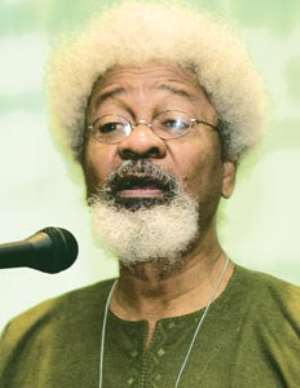
The presentation of the book, Journeys around and with Kongi: Half a Century on the Road with Wole Soyinka written by the ebullient German journalist, translator and cultural activist Gerd Meuer provoked my own memories of my encounter with the Nobel Laureate as humanist and writer. I had personally chosen Soyinka as my own teacher; that was why I ended up at the Dramatic Arts Department of University of Ife (as it then was) where Soyinka was the Head of Department, leading the cast of lecturers such as Kole Omotoso, Yemi Ogunbiyi, Femi Euba, Olu Akomolafe, Segun Akinbola, Bankole Bello and others. The ambience provided by the presence of Soyinka made for a joyous engagement with his works.
The greatest discovery I made back then was Soyinka's refrigerator, which was always well-stocked with cold beer and wine! One evening when Soyinka was teaching my classmates in his house, he found me otherwise engaged in a corner. Aghast, the great man asked why I was drinking beer while my classmates were busy getting educated. 'Well, sir, beer is how I get my own inspiration!' I told Soyinka. He only laughed, before continuing to teach the other more serious students. Any other don would have rusticated me for such behaviour but Soyinka was much larger than them all. My best friend in the school was of course Soyinka's Ghanaian houseboy, Francis, who left the fridge and its multiform artworks at my mercy even as the legendary playwright taught my classmates at the department or travelled all over the world directing his plays.
Another boon companion of those days was the great Ugandan poet Okot p'Bitek, author of Song of Lawino and a formidable tippler as well! My time with Okot is material for another day, however. My subject today is my mentor Soyinka, whose life and times one is hard-pressed to come to terms with in this offering. Oluwole Akinwande Soyinka, universally known as Wole Soyinka, was born on July 13, 1934. His father Ayodele whom he fondly calls 'Essay' in his acclaimed book Ake - The Years of Childhood hailed from Ijebu-Isara town while his mother Eniola or 'Wild Christian' came from Abeokuta of the selfsame Ogun State. With a father from the Ijebu section and a mother from the Egba zone Soyinka refers to himself as an 'Ijegba' man. His father was a primary school headmaster who rose to become a school supervisor. His mother was a trader who ran her shop with an iron grip that spared no debtor.
A precocious child, Soyinka began his elementary education at the age of four, attending St. Peter's School, Ake, Abeokuta, one of the elite primary schools in colonial Nigeria under the headship of his father. He was a brilliant, if rascally, pupil who played a lot of practical jokes. He had little interest in sports. In Standard III he performed the role of The Magician on prize-giving day. Thus was the early beginning of Soyinka as a dramatist. He was always the prankster amongst his mates, witty, inventive and unstoppable.
Aged 10 in 1944, he was admitted into his secondary school, Abeokuta Grammar School, popularly known as AGS, where the maverick musician Fela's father, Rev. A. O. Ransome-Kuti, was the principal. Fela was of course Soyinka's cousin. Soyinka was the youngest student in the school; most of his classmates could even pass for his teachers in age! Soyinka's early grooming by the principal Ransome-Kuti whom Soyinka fondly addresses as Daodu was matched by the mother-care offered the young lad by his famous wife Olufunmilayo whom Soyinka fondly refers to as Beere.
Even in his early years Soyinka had started building his stature as an activist by serving as a go-between between his own mother Wild Christian and Fela's mother Beere in the Women's Movement that demanded the abolition of the tax on women from the District Officer, the Alake of Egbaland and his Council of Chiefs.
Soyinka's father wanted his son to have the best of education available; in the young boy's second year at AGS he sat for examination to win a scholarship into the prestigious Government College, Ibadan (GCI). He passed the exam and was summoned for an interview in Ibadan. For the first time in his life he had to make a long journey without his parents or any elders. He was on his own, as it were. He eventually got admission into GCI but did not win a scholarship.
The students of GCI were drawn from all parts of Nigeria. Most of Soyinka's classmates were 'men' just as in AGS though a good number of the lads were nearer his age bracket. Some 24 students were admitted and they were divided into two groups to occupy either Grier House or Swanston House. Soyinka was allocated to Swanston House. One of his mates was Olumuyiwa Awe who recalls that even in Class Four Soyinka was so small in size that he was appointed the Captain of 'Mosquito Football Eleven', a team made up of Class One or Two students! He was a scorer for the cricket team, touring with the squad to such far-flung schools as Government College Umuahia, Kings College Lagos, Edo College Benin and Government College Ughelli.
Soyinka excelled in drama at GCI, being a prominent member of the dramatic arts society. He excelled in English and Literature while Mathematics was never his strong suite even though he surprised all by taking a credit in the subject. He left GCI in December 1950, and was in January of 1951 appointed a stores assistant in the medical stores of the Government Medical Department in Lagos.
Soyinka wanted to start a career in journalism. He applied to the Daily Times and took a written test with the other wannabes. The applicants were asked to imagine a market fight and report the incident for the newspaper. The other applicants wrote up their reports and left while Soyinka stayed on, writing furiously, filling up eight lined foolscap pages as though intent on writing up the entire newspaper. He was indeed expansive, giving the detailed histories of the market fighters and their extended families, their ill-assorted businesses etc. The exasperated white invigilator could not but snatch the foolscap sheets from the irrepressible young writer! This may well have been a blessing in disguise. Given the addictiveness of journalism, one wonders what would have become of Soyinka if he had not failed the Daily Times test. He quit the job at the medical department in September 1952 following his admission into University College, Ibadan (UCI).
Soyinka talks of his great excitement sometime in 1951 at having one of his short stories broadcast on the Nigerian Broadcasting Service. He mastered typing and bought his first typewriter. A major highlight of his UCI days was the founding of the Pyrates Confraternity aimed at abolishing convention, reviving the age of chivalry, ending elitism and tribalism. After reading Robert Louis Stevenson's Treasure Island Soyinka and his mates were struck by the lives of the pirates as narrated by young Jim Hawkins. The original seven founders of Pyrates Confraternity are Wole Soyinka, Muyiwa Awe, Ralph Opara, Pius Oleghe, Ikpehare Aig-Imoukhuede, Ifoghale Amata and Nat Oyelola.
The critic Bernth Lindfors has traced Soyinka's first poem published in UCI to The University Voice, the official organ of the Students' Union, in January 1953. The poem of 98 lines is entitled Thunder To Storm and, to say the truth, was a very bad effort indeed. He was politically active on campus, belonging to the radical Progressive Party that opposed the policies of the Dynamic Party. He edited the cyclostyled newsletter The Eagle. His acting prowess was immediately recognized on campus, and he played the part of Tobias in the play Tobias and the Angel by James Bridie while his friend Ifoghale Amata played Raphael, to wit, the angel. He starred in other plays such as The Devil's Disciple by George Bernard Shaw. He was the source of admiration of the few young ladies around then.
He was of course very brilliant in his academics as a student of English, History and Greek. He led the class in English, competed with Gamaliel Onosode in Greek and slugged it out in History with Ifoghale Amata. It was back then that Soyinka read Bacchae by Euripedes in the original Greek, a play he would later write his own version of as The Bacchae of Euripides. He left Ibadan for Leeds University, England, in October 1954 but continued to send articles to the campus publications The Eagle and The Criterion edited by his friends Pius Oleghe and Ralph Opara respectively as 'Epistles of Cap'n Blood to the Abadinians'. In one of the articles he wrote of a white girl who kept staring at him until he felt he had won the girl's heart only for the girl to retort that she was only wondering how many average noses could be made out of Soyinka's big nose! In yet another article he wrote of the strong winds blowing in England which pushed his hand so sharply that he ended up shaking the person behind him when he had actually wanted to shake the hands of the man in front of him!
His short story 'Keffi's Birthday Treat', broadcast on the children's programme of the Nigerian Broadcasting Service was published in the Nigerian Radio Times magazine of July 1954. Soyinka was awarded second prize in the Margaret Wong Memorial Fund writing competition of 1956 for the short story 'Oji River'. He wrote poems such as 'The Other Immigrant' and two of his short stories were published in the University Of Leeds magazine The Gryphon. The first story, 'Madame Etienne's Establishment', appeared in the March 1957 edition of the magazine. The next story was, like Charles Dickens novel, entitled 'A Tale of Two Cities.'
He graduated from Leeds with an Upper Second Degree, and there is no truth whatsoever to the fable spread in certain quarters that Soyinka managed only a Third Class degree at Ibadan! Soyinka initially enrolled for graduate studies but soon turned his back on further university degrees. He fell in love with the young English girl Barbara who gave birth to his first son, Olaokun, born in November 1957. Soyinka eventually formalized his union with Barbara into his first marriage.
The Royal Court Theatre, London, was all the rage for all theatre wannabes in the Britain of those days. It was the golden age of British theatrical revival that was built on the success of John Osborne's play Look Back in Anger. The great director and theatre manager George Devine held court at the Royal Court Theatre and young playwrights like Harold Pinter, John Osborne, John Arden, Edward Bond, Arnold Wesker, Ian Johnstone, Anne Jellicose earned their breakthrough under Devine's direction. There was the Sunday night innovation in which new plays were tried out and fledging playwrights earned ten shillings a script as play-readers. Soyinka was attached to the Royal Court Theatre as Play Reader between 1957 and 1959. He acted in the Royal Court production of Eleven Men Dead at Hola, dealing with colonial repression in the British detention camps, a production he made significant contribution to. His unpublished play The Invention was performed in the theatre on a November 1959 event 'An Evening without Decor' alongside excerpts from A Dance of the Forests and the much-anthologized poem 'Telephone Conversation'.
His play The Swamp Dwellers was produced in 1959 for the Sunday Times Students Drama Festival. In the same year, the earliest version of his comedy The Lion and the Jewel was produced in Ibadan alongside The Swamp Dwellers. Soyinka was building quite a reputation for himself even as he had not broken into print with a major publisher. Literally all his plays had not been published then. It was not until 1963 that plays like The Lion and the Jewel were published for the critical industry to dissect the written texts. Soyinka was a total man of the theatre who wrote, acted and directed plays. He could build the set, and knew so much about costuming. Many theatre enthusiasts at the time learnt at his feet.
Soyinka returned to Nigeria in January 1960. He had been awarded a Rockefeller Foundation fellowship to travel all over Nigeria to study and record traditional festivals, rituals and masquerades rich in dramatic content. He bought a Land Rover with which he made his many journeys.
Soyinka's writing began to get some international attention with the 1960 publication of the great African-American poet Langston Hughes' African Treasury that contained some of the fledgling writer's poems. He formed The 1960 Masks, a drama company, to kick-start theatre activities in the country. His entry for the independence playwriting contest, A Dance of the Forests, won the first prize. After winning The Encounter Award, Soyinka discovered that after a thorough reading of the play some of the officials were not comfortable with the subversive nature of the play, and it was officially turned down as a part of the independence programme. The 1960 Masks produced the play at Ibadan to sold-out audiences. The speech of Forest Head, acted by Soyinka, himself underscores the relentless pessimism of the play.
It was in the selfsame 1960 that Soyinka earned the distinction of writing the first play produced on Nigerian television. The Western Nigeria Television (WNTV) reached the milestone at 8.45 pm on Saturday August 6, 1960 with the screening of the first full-length play produced in the Ibadan studios entitled 'My Father's Burden' by Wole Soyinka and directed by Segun Olusola.
The year of independence was indeed remarkable for the artistic exploits of the young Soyinka. He served as a Master of Ceremonies at the independence ball where he literally chased off the stage the boring opera singer flown into the country at the special request of Governor-General Dr Nnamdi Azikiwe, 'Zik of Africa'. He made contributions to The Horn, a magazine founded at the University of Ibadan by J. P. Clark and Martin Banham. His critical essay, 'The Future of West African Writing' published in the magazine in 1960 made the case for novelist Chinua Achebe as pointing the right direction of future African writing. Of course Soyinka would later charge Achebe of 'unrelieved competence' in his writings.
When eventually Soyinka made the famous statement on negritude that 'a tiger does not have to proclaim its tigritude; it pounces', it has to be understood that it harked all the way back from the 'duikeritude' article he had published in The Horn in 1960. At the turn of the year in March 1961, Soyinka had done enough on the national stage to earn a major illustrated feature article in Drum, easily the most popular magazine in the country then, entitled 'Young Dramatist is earning the Title of Nigeria's Bernard Shaw.'
His early comedy, The Trials of Brother Jero, was produced at Ibadan in March, 1960. The respected theatre director and teacher Dapo Adelugba informs that the play was written at his request in three days! He would later in October of that year act the part of Yang Sun in Bertolt Brecht's The Good Woman of Setzuan at Ibadan. The next year, he again directed a production of his The Trials of Brother Jero, alongside R. Sarif Easmon's Dear Parent and Ogre, in which he played the part of Dauda Touray. Soyinka was fast winning a reputation for himself as a leading member of the emerging writers in the new nation. It was little wonder that he was well represented in the anthology of the new Nigerian writing, Reflections, edited by Frances Ademola. His works published in the anthology include the small play The House of Banigeji, poems like 'Telephone Conversation' and the essay on Yoruba culinary overdrive entitled 'Salutations to the Gut'.
With the troubles in the Western region rearing up, the activist in Soyinka began to manifest in earnest. He wrote 'Emergency Sketches' in 1962 - press lampoons on Dr Majekodunmi who had been appointed administrator of the troubled region.
After serving as a Rockefeller Research Fellow mainly attached to the University of Ibadan up to 1962 Soyinka took appointment as a lecturer in English at the University of Ife. He waged consistent wars with the goons of the Premier of the Western Region, Ladoke Akintola, who had fallen out with the party leader Chief Obafemi Awolowo. He raised a dust of controversy over the world middleweight boxing title fight staged at Ibadan between Nigeria's Dick Tiger and America's Gene Fullmer, dismissing it as amounting to a misguided sense of national priorities. He put up the satirical revue, The Republican, in 1963, and it was followed up in the year with a performance ofThe New Republican.
The year 1963 marked Soyinka's major breakthrough into mainstream publishing. A Dance of the Forests and The Lion and the Jewel were published by Oxford University Press. Soyinka's poems were well represented in the Anthology of Modern Poetry from Africa edited by Gerald Moore and Ulli Beier and published by Penguin.
Soyinka felt that his theatre group The 1960 Masks was not professional enough to drive his drama revolution. He therefore formed the Orisun Theatre drama group in 1964. His highly-charged one-act play The Strong Breed was adapted and filmed in Nigeria for American television by Esso World Theatre. To round off the year, The Strong Breed and The Trials of Brother Jero were produced at Greenwich Mews Theatre, New York. A collection of his plays, Five Plays, was published by Oxford University Press.
By 1965 the crisis in the Western region was getting to boiling point, and Soyinka stood up to be counted. His satirical revue depicting the mood of the times, Before the Blackout, was produced in Lagos and Ibadan in September, 1965. His play The Road was directed by David Thompson at Theatre Royal, Stratford, East London.
Soyinka, as a crucial part of his activist intervention in the politics of the day, moved into the Ibadan radio studio to switch the tape of Premier Akintola's broadcast. The aghast public, instead of hearing the Premier's voice, heard another voice hectoring the Premier to 'Get out!' Soyinka was immediately fingered as the 'mystery gunman' who had done the damage. He was declared wanted. He went into hiding, traveling to the Eastern region to be with Sam Aluko, who had taken up an appointment at the University of Nigeria, Nsukka, after he had been hounded out of the University of Ife by Akintola's administration. Soyinka met with the Premier of the Eastern region, Dr Michael Okpara, who promised to back the activist-playwright .
It was eventually decided that Soyinka should submit himself to the police, that is, after making a round of the newspaper houses. He went around in the company of Dapo Fatogun, the leftist ideologue. He submitted to arrest in October 1965. He was acquitted in December by Justice Kayode Esho on a technical error of the prosecuting team. Soyinka's bosom friend Femi Johnson, who had provided his driver and car for the forceful evacuation of the activist-playwright from the court in the event of a conviction, had to settle for a victory party.
Even so, Soyinka knew that the government, which had lost face, would resort to extra-judicial choices to deal with him and his compatriots. Instead of enfeebling his resolve to fight the regime, this paradoxically emboldened him as several activists rallied behind him in the arduous task of saving Nigeria from the iron grip of the thieving political class.
From 1963, the publishing of Soyinka's plays became an almost yearly affair. Early plays such as A Dance of the Forests and The Lion and the Jewel were published by Oxford University Press (OUP) to wide critical acclaim. Soyinka raised the standard of Nigerian drama from the standard fare of This is Our Chance by James Ene Henshaw. The Road as a play text was published by Oxford University Press in 1965.
Soyinka directed his new play Kongi's Harvest in Lagos. His radio play Camwood on the Leaveswas broadcast by the BBC, London in 1965, depicting tragedy of an authoritarian father and his stubborn son who put a neighbour's daughter in the family way.
He gained appointment as a Senior Lecturer in English at the University of Lagos in 1965 and was soon made the Acting Head of Department. A major highlight of the Dakar, Senegal, Festival of Negro Arts in 1966 was the performance of Soyinka's Kongi's Harvest. Back at the University of Lagos, Soyinka celebrated what he tagged Rites of the Harmattan Solstice. In June of that year, The Trials of Brother Jero was produced at Hampstead Theatre in London. In December, The Lion and the Jewel was produced at Royal Court Theatre, London. The opening lines of The Trials of Brother Jero are some of the most quotable lines in the annals of Nigerian theatre.
Kongi's Harvest was eventually published in 1967. For reasons no one can really explain, the alias 'Kongi' has stuck with Soyinka amongst his students and colleagues even though the character in question in the eponymous play is highly detestable.
Soyinka's reputation is largely based on the poetic nature of his drama. To that extent, he is seen in most critical circles as the world's most poetic dramatist. Even though he had been well represented in many anthologies of poetry it was only in 1967 that he published his first collection of poetry,Idanre and Other Poems. It is remarkable that Soyinka did not include his most popular poem'Telephone Conversation' in the collection. Instead what would later become the title of his 2006 memoirs, You Must Set Forth at Dawn, was limned in one of the early poems 'Death in the Dawn'.
As a part of the global recognition of his writing prowess, he was awarded the John Whiting Drama prize in 1967. It was in the same year that he was appointed Head of the Department of Theatre Arts at the University of Ibadan, succeeding Geoffrey Axworthy.
The country was teetering on the edge of Civil War following the controversial January 1966 coup carried out by the young majors led by Emmanuel Ifeajuna and Chukwuma Kaduna Nzeogwu. The revenge coup of July, 29 1966 undertaken by Northern soldiers in which the Head of State General JTU Aguiyi-Ironsi was murdered alongside his host Adekunle Fajuyi in Ibadan somewhat worsened matters. The genocide meted out to the Igbo in the North led to a mass movement of the people back to the Eastern region. Col. Emeka Odumegwu-Ojukwu decided to pull the Eastern region from Nigeria, declaring the sovereign state of Biafra. Amid the confusion, Soyinka took it upon himself to visit the Eastern region to see what he could do in stopping the descent to war. He led a group he called the 'Third Force'. He outrageously countered the mantra formed with Gowon's name, to wit, 'Go on with one Nigeria,' with his own dictum: To have one Nigeria justice must be done!
He met with major figures in the war effort such as Ojukwu, Victor Banjo and Olusegun Obasanjo. He was promptly locked up by Gowon for his efforts, an imprisonment that Soyinka writes about in his prison notes, The Man Died. He spent most of the prison term in solitary confinement, stubbornly resisting his captors' efforts at breaking his mind. While in prison confinement he was awarded the Jock Campbell New Statesman Literary Award. Soyinka's translation of D.O. Fagunwa's novelOgboju Ode Ninu Igbo Irumale was published as The Forest of a Thousand Daemons in 1968.
The prison walls certainly did not still his voice. His Three Short Plays was published in a volume in 1969. Poems from Prison was equally released and he was eventually set free from detention in October 1969. He thereafter assumed his position as Head of the Department of Theatre Arts at the University of Ibadan. Soyinka was immediately thrust into the mainstream of the theatre circuit as he staged his play Madmen and Specialists at the Eugene O'Neil Theatre Centre, Waterford, USA in 1970. He would produce the same play in 1971 at Ibadan and Ife. He also published his revues,Before the Blackout. He traveled out of Ibadan to Britain in July 1971, ostensibly for the long vacation, but it turned out to be a four-year self-imposed exile. He sent in his letter of resignation to the university authorities in 1972.
He published his prison notes, The Man Died, in 1972, decrying the massacres that led to the war, the alliance of the corrupt military and civilian mafia, the repression of trade unionists and organized labour, and championing the cause of the triumph of the human spirit. His collection of poems, A Shuttle in the Crypt, which includes Poems from Prison was also published in 1972, giving voice to Soyinka's 25 months of solitary confinement.
The British publishing house Methuen would in 1973 publish his The Jero Plays in one volume made up of The Trials of Brother Jero and Jero's Metamorphosis. The charlatanism overwhelming Christianity in The Trials of Brother Jero is given a greater bite in the sequel Jero's Metamorphosiswhich begins with Jero dictating,
in time of trouble it behoves us to come together, to forget old enmities and bury the hatchet in the head of a common enemy
It ends with Jero promoting his followers in the manner of the military, only to appoint himself a General because 'After all, it is the fashion these days to be a Desk General.'
Camwood on the Leaves was also published by Methuen. Oxford University Press publishedCollected Plays 1. His second novel, Season of Anomie, was published by the London-based publishing house Rex Collings in 1973. This very difficult novel follows Ofeyi into the commune of Aiyero in the search for egalitarian community. Soyinka undertook an adaptation of the ancient Greek play The Bacchae by Euripides which he entitled The Bacchae of Euripides and it was performed at the National Theatre, London.
When he was appointed a Visiting Fellow at Churchill College, Cambridge University in 1973-74, he wondered why he should be assigned to do his lectures in the Department of Social Anthropology, rather than Literature. 'African literature' was not then recognized; but Soyinka and his colleagues in the intervening years have done enough work for the world to take requisite notice. It was at Cambridge that Soyinka helped to supervise the work of a certain young man named Henry Louis Gates who had since become a lifetime friend of the master dramatist.
His beloved father, Essay, died while he was in exile and he was warned by his mother, Wild Christian, not to come home for the burial as the military regime was still out to deal with him because of his damning prison memoirs The Man Died. His mother warned him to be prepared to bury mother and father, should he risk coming home at such an inauspicious time! In 1974, Soyinka edited the epochal Poems of Black Africa published by Secker Warburg, which gave the needed break to younger African poets such as Odia Ofeimun and Richard Ntiru.
He would later in 1974 return to Africa, to Ghana, to edit the influential magazine Transition (later renamed Ch'Indaba) and served as a Visiting Professor at the University of Ghana, Legon. He used the magazine to launch a no-holds-barred attack on the evil regime of Idi Amin of Uganda. He was in 1975 elected the Secretary-General of the newly formed Union of Writers of the African Peoples (UWAP).
Soyinka's arguably greatest play, Death and the King's Horseman, was published by Methuen in 1975. In the play, the King's Horseman has to follow tradition by dying with his King, but he hesitates and there is the intervention by the colonial officer, only for the Horseman Elesin's Europe-trained son, Olunde, to kill himself instead. His father eventually kills himself so that there are two deaths instead of one.
His Collected Plays II was published by Oxford University Press in 1975 and the radio play The Detainee was broadcast by the BBC, London. His play Jero's Metamorphosis was performed in Lagos, that year.
The regime of Yakubu Gowon fell in a July 29, 1975 coup. Gen. Murtala Mohammed became the new military Head of State with Soyinka's townsman Gen. Olusegun Obasanjo as the second-in-command. Soyinka felt safe enough to return to Nigeria to take up appointment as Professor of Comparative Literature at the University of Ife. He produced Death and the King's Horseman at the University in 1976. Soyinka's longest poem Ogun Abibiman that lauds Samora Machell's bold decision to lead his Mozambique in the damning of apartheid South Africa was published in 1976.
Cambridge University Press published Soyinka's collection of essays, Myth and the African World, in 1976, containing the lectures he gave as a Churchill Fellow at Cambridge and an early essay, 'The Fourth Stage' that juxtaposed Yoruba gods with Greek deities in the study of tragedy. Soyinka's adaptation of Bertolt Brecht's The Threepenny Opera was performed in 1977 at Ife as Opera Wonyosi with the author as the director. The play, set in a Nigerian expatriate colony in Jean-Bedel Bokassa's Central African Empire, is a classic parade of mass-murderers, fools, clowns, prostitutes and villains.
From the date of the performance of the play in December 1977 to its publication by Rex Collings in 1981, deadly African dictators such as Idi Amin of Uganda and Emperor Bokassa of Central African Empire were chased away from power while Macias Nguema of Equatorial Guinea not only lost power but ended up being hanged.
On the home front, Soyinka in 1977 resigned from the International Secretariat of FESTAC, the second Black and Arts Festival staged in Lagos, Nigeria. He became the Head of Department of the newly established Department of Dramatic Arts at the University of Ife in 1978. He formed the UNIFE Guerrilla Theatre, the troupe with which he performed satirical revues against the regime of the day.
Even while at Ife his commitments abroad remained high, and he directed Death and the King's Horseman at the Goodman Theatre, Chicago and the J.F. Kennedy Centre, Washington. Between 1979 and 1980 he served as a Visiting Professor at Yale University, USA.
The ruling National Party of Nigeria (NPN) regime of President Shehu Shagari got several knocks from the pen of Soyinka. The party's politics of rice was satirized by Soyinka in his 1980 satirical revues, Rice Unlimited, performed at Ife, Ibadan and Lagos. Soyinka helped the Oyo State government run by his bosom friend Governor Bola Ige to organize the road safety corps of the state. He worked with the likes of his childhood friend Prof. Olumuyiwa Awe.
His childhood memoirs, Ake, The Years of Childhood, which more than any other book extended the frontiers of Soyinka's reception all over the world, was published in 1981. The New York Timesnamed it one of the year's best books. Soyinka gave his inaugural lecture at the University of Ife entitled The Critic and Society: Barthes, Leftocracy and Other Mythologies, which was later published by the University of Ife Press in 1981. The radio play Die Still, Dr Godspeak was broadcast by BBC, London in 1982. The play was later put on stage as Requiem for a Futurologist at Ife in 1983 and it undertook a countrywide tour. His satirical revues, Priority Projects, also undertook a tour of the country that year.
The general elections of 1983 in Nigeria was massively rigged, which eventually led to the return of the military through a coup in the last day of the year. Soyinka waxed an LP, Unlimited Liability Company, to lampoon the politicians, and the songs written by him were performed by Tunji Oyelana and the Benders alongside Jimi Solanke.
The injustice in the country is what maddens Soyinka no end. He had stressed in The Man Died that 'For me, justice is the first condition of humanity.' Soyinka even shot a film, Blues for a Prodigal, to depict the shenanigans of the politicians. He had earlier turned Kongi's Harvest into a movie in which he acted the part of Kongi under the direction of the Hollywood great, Ossie Davies, and the production of Francis Oladele's Calpenny Films.
The return of the military, especially the emergence of the iron rule of Gen. Muhammadu Buhari and his partner, Tunde Idiagbon, drew the ire of Wole Soyinka. The military regime's refusal to announce a date for a return to democratic rule met with the opposition of Soyinka and sundry activists. The draconian decrees on detention and gagging the press alongside the retroactive conviction and execution of three drug couriers further confirmed the unpopularity of the administration. Gen. Ibrahim Babangida took over through a palace coup, and Soyinka felt that the new man who addressed himself as a Military President was a 'listening' leader as opposed to the dour Buhari.
Soyinka eventually fell out with Babangida even as he had volunteered to set up the Federal Road Safety Corps (FRSC). Soyinka's 'international conspicuosity' , as the village teacher Lakunle would put it in The Lion and the Jewel, was growing in leaps and bounds, such that his name started being mentioned in enlightened circles as odds-on favourite to win the Nobel Prize for Literature. A celebration of his 50th birthday by his colleagues at the University of Ife in 1984 underscored the pull of the Soyinka mystique. He published A Play of Giants in 1984, sending-up dictators such as Idi Amin of Uganda on the hallowed floors of the United Nations. Requiem for a Futurologist was also published that year. Soyinka directed The Road at The Goodman Theatre, Chicago in April of that year.
He won the Enrico Mattei Award for the Humanities in 1984, run by the ENI (Agip) group. In 1985 there was so much speculation in Nigeria that Soyinka would be announced the winner of the coveted Nobel that year. When it was eventually given to the French writer Claude Simon there was acute depression in the land.
Then came 1986. Soyinka had just made the flight from Cornell University, New York where he was then teaching, to the International Theatre Institute (ITI) in Paris to attend the executive meeting of the world body, which he headed. His plan was to spend a quiet time at the apartment of his cousin Yemi Lijadu. He found his cousin giddy with joy: The news had just broken that Nigerian playwright Wole Soyinka had won the 1986 Nobel Prize for Literature, thus becoming the first African to win the coveted award.
Even in the anonymity of his cousin's apartment Soyinka could not hide away from the invasion of the world press. He therefore made quick plans to return immediately to Nigeria. He wanted his entry into Nigeria as quiet and uneventful as possible, but his friends were quick to sniff out that he was on his way back home. His bosom friend, the insurance magnate Femi Johnson sent a car and driver to ferry him from the airport. Dr. Yemi Ogunbiyi and other close friends ensured that the goldfish had no hiding place.
The government of Babangida provided a presidential jet for the ferrying of Nigerians to the Nobel award ceremonies in Stockholm, Sweden, even as the government continued to deny accusations of orchestrating the killing of Dele Giwa, ace journalist and friend of Soyinka, through a parcel bomb delivered to his home days earlier. Soyinka's Nobel lecture entitled 'This Past Must Address Its Present' was dedicated to Nelson Mandela, who was still imprisoned at the time. Soyinka was conferred with the high national honour of Commander of the Federal Republic.
Soyinka notes that George Bernard Shaw had said that he would readily forgive Alfred Nobel his invention of the evil dynamite but not the diabolical Nobel Prize for Literature. The aura of the prize overwhelmed Soyinka soon after the award such that he could do no other work. He hoped that the din of the Nobel would end after the crowning of the next winner only to be reminded in Cuba by novelist and 1982 Nobel Prize winner Gabriel Garcia Marquez, author of One Hundred Years of Solitude, that 'It never ends, my friend. It never ends.'
He published a collection of poems, Mandela's Earth, after winning the Nobel and celebrating the triumph of the human spirit as exemplified by Nelson Mandela of South Africa after his epic sojourn in the dreadful Robben Island Prison. A bemused Soyinka would later discover that the next three years would amount to 'three lost years.'
The vagaries of Nigerian military politics also took its toll on Soyinka. Babangida's interminable transition programme to civil rule had enough twists to overwhelm a faddish fiction writer. Politicians were banned and un-banned while dates were fixed and cancelled.
Even amid the merry-go-round in Nigeria, Soyinka was able to premier his play From Zia with Loveat the Dionysus Chianti World Festival in Contemporary Drama in Italy in 1992. The London publishing company Methuen published A Scourge of Hyacinths in 1992.
Nigeria's political troubles got out of hand with the annulment of the June 12, 1993 Presidential election, an election generally accepted as won by Chief MKO Abiola. The annulment of Nigeria's freest and fairest election by Babangida threw the country into turmoil. Abiola insisted on affirming his mandate while Babangida was forced to step aside in disgrace on August 26, 1993. The lame-duck Ernest Shonekan Interim National Government was put in place only to be displaced by General Sani Abacha who unleashed a brutal dictatorship on the country. Abiola, was arrested jailed.
With a price on his head, Soyinka escaped into exile on a life-and-death ride on a motorbike. Abroad, he mounted a sustained campaign against the regime of Abacha until the dictator suddenly dropped dead in June 1998. Abiola, curiously, died the very next month.
General Abdulsalami Abubakar who took over power discussed with Soyinka on the possibility of the Nobel Laureate inheriting the mantle of leadership of the country from him! Gen. Obasanjo was eventually talked into taking power through the elections held in 1999. He won re-election in 2003 and canvassed for a Third Term in power which was stoutly opposed by Soyinka, the National Assembly and the vast majority of the Nigerian people. President Umaru Musa Yar'Adua took over the mantle of leadership after the worst elections ever organized in the history of the country. Soyinka is currently calling for the convocation of a Sovereign National Conference (SNC) to find lasting solutions for the problems of the country.
The activism within the annals of Nigerian national politics has not dulled Soyinka's creative enterprise. His play, The Beatification of Area Boy: A Lagosian Kaleidoscope, was published in 1995 by the Ibadan-based Spectrum books. On August 6, 2001 Soyinka's King Baabu was premiered at the National Theatre, Lagos. A loose adaptation of Alfred Jarry's Ubu Roi, the play depicts the murderous exploits of Basha Bash who to all intents and purposes is modeled after Sani Abacha.
Soyinka's latest collection of poetry, Samarkand and Other Markets I have Known, was published by Crucible Publishers Limited, Lagos, in 2002, and was launched at the National Theatre under a tree that is now known as the Samarkand Tree. In the poems he celebrates departed friends such as Femi Johnson, Kudirat Abiola, former French President Francois Miterrand, Ken Saro-Wiwa, Nobel Laureate Naguib Mafouz, and 'the dead and maimed of Kenya, Tanzania.' He pillories Abacha in the poems 'Exit Left, Monster, Victim in Pursuit (Death of a Tyrant)' and 'Where the News Came to Me of the Death of a Tyrant.'
The long poem 'Elegy for a Nation' dedicated to Chinua Achebe at Seventy is quite striking. Soyinka had wanted to read the poem at 'An Evening With WS' sponsored by Globacom, but there was too much noise at the Golden Gate, Ikoyi venue such that it did not provide a conducive environment for the Nobel Laureate to pay homage to his great compatriot.. Soyinka was a notable presence at Bard College, New York, in 2000 where Achebe celebrated his 70th birthday. Both writers shared the stage at the celebration of the Christopher Okigbo Festival in September, 2007 at Harvard University, USA.
Critics of Soyinka's works charge him with willful obscurantism. Chinweizu, Onwuchekwa Jemie and Ihechukwu Madubuike, in their acerbic book Toward the Decolonization of African Literature, argue that Soyinka's art suffers from a total embrace of Euro-modernist obfuscation that does not lend itself to clear meaning. Soyinka always replies his critics in kind, publishing his hot exchanges with the critics in the 1988 book Art, Dialogue and Outrage, and likening Chinweizu to the mythical Ghanaian bird Chichidodo that hates shit yet only eats worms, as depicted in the novel The Beautyful Ones Are Not Yet Born by Ayi Kwei Armah. Critics of the socialist bent argue that Soyinka does not depict the class divide in his plays and would not let the oppressed triumph in their struggle.
At the last count, Soyinka is the author of some 17 plays, six collections of poetry, two novels, eight non-fiction books and the ongoing intervention series he publishes on burning national issues. Soyinka appears to be in no hurry to depart the scene of Nigeria's national events. Although he had previously been Special Guest at the Inaugural Edition of the Nigeria Literature Prize, which was organized annually by the Nigeria Liquefied Natural Gas Ltd (NLNG), Soyinka called for a total boycott of the 2007 awards ceremony by the Association of Nigerian Authors (ANA) because former Military President Ibrahim Babangida was appointed the Keynote Speaker. The call created a lot of controversy in the media, with some of Babangida's associates such as Godwin Daboh taking full-page advertorials in the newspapers to attack the Nobel Laureate.
Soyinka's argument against the choice of Babangida was anchored on the fact that the former Head of State did nothing for literature during his tenure even as he ended up executing soldier-poet, General Mamman Vatsa, despite the pleas of Soyinka, Chinua Achebe and J.P. Clark. Most of Nigeria's notable writers such as ANA President Wale Okediran, past presidents of the writers' body Olu Obafemi and Femi Osofisan boycotted the awards night in Lagos. Babangida was supported at the ceremony by former Head of State General Yakubu Gowon and Head of the Interim National Government (ING) Chief Ernest Shonekan.
As the never-flinching conscience of the nation, Soyinka takes on all-comers with uncommon gusto. His many demands across the globe have in no way dimmed his appetite for participation in Nigeria's national affairs almost on a daily basis. It is in character for the playwright to fly into the country at short notice from Emory University, Atlanta, where he has tenure, to address a press conference in Lagos.
These days, a major concern of his is the drafting of a people's constitution for the country. The call for the convocation of a Sovereign National Conference (SNC) has his unalloyed support. He is a major promoter of the People's Representative National Conference (PRONACO). Even amid all his engagements, Soyinka remains a family man, married to Adefolake Wole-Soyinka, who at times calls the peripatetic master 'visiting husband'. He is blessed with children.
But beyond his biological children, Soyinka is a father-figure and mentor to multitudes. Nobody comes into the Soyinka presence without being moved. During the PEN conference in Toronto, Canada in 1989, I told a venerable Roman Catholic reverend sister and writer to look forward to Soyinka's reading. She was in a tizzy after witnessing the performance. While attending the 2008 Caine Prize for African Writing in England I laughed when one of my fellow nominated authors was being touted as a student of South African Nobel Laureate JM Coetzee. The house came down when eventually it was revealed that I was a student of Soyinka as opposed to some 'eaglet' Nobel prize-winner!
Originating at www.burningpot.com
 'If we were wrong, we must first apologise to NPP' – Mustapha Gbande on National...
 Han SHS to get boarding status as Mahama inspects GETFund projects in Upper West
 Late herbal doctor’s wife granted GH¢100,000 bail amid poisoning, arson claims
 NDC has failed to deliver on Agenda 1-3-3 for 24-hour economy – Sam Pyne
 Wa-Bolgatanga trunk road to be asphalted – Mahama
 Gbewaa College of Education lecturer dies after alleged military assault in Pusi...
 Ghana won’t back down on mining value addition – Ambassador Kojo Bonsu
 How Dr Jesse Amuah, wife was murdered over GH¢1,500 payment dispute
 Mahama announces 20% salary incentive for health workers in deprived areas
 Ghana must move from plastic policies to implementation – EPA CEO


