




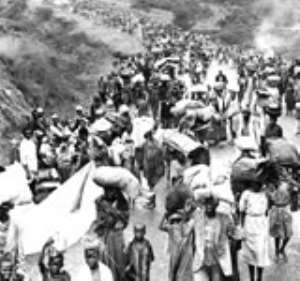
Half the world's population could face climate-induced food crisis by 2100, a new report by US scientists warns.
Rapid warming is likely to reduce crop yields in the tropics and subtropics, according to Prof David Battisti of the University of Washington.
The most extreme summers of the last century will become the norm, he calculates, using 23 climate models.
We must urgently create crops tolerant to heat and drought if we are to adapt in time, he writes in Science journal.
"The stresses on global food production from temperature alone are going to be huge," said Mr Battisti, a professor of atmospheric sciences.
"And that doesn't take into account water supplies stressed by the higher temperatures."
He collaborated with Professor Rosamond Naylor, director of Stanford University's Program on Food Security and the Environment, to examine the impact of climate change on the world's food security.
Beyond extreme
The duo combined direct observations with projections from 23 global climate models that contributed to the Intergovernmental Panel on Climate Change's (IPCC) 2007 global assessment.
They calculate there is greater than 90% probability that by 2100, the average growing-season temperatures in the tropics and subtropics will be higher than any temperatures recorded there to date.
"We are taking the worst of what we've seen historically and saying that in the future it is going to be a lot worse unless there is some kind of adaptation," said Professor Naylor.
"This is a compelling reason for us to invest in adaptation, because it is clear that this is the direction we are going in terms of temperature and it will take decades to develop new food crop varieties that can better withstand a warmer climate."
In the tropics, the higher temperatures can be expected to cut yields of the primary food crops, maize and rice, by 20-40%, the researchers said.
Rising temperatures also are likely to reduce soil moisture, cutting yields even further.
Currently three billion people live in the tropics and subtropics, and their number is expected nearly to double by the end of the century.
"You are talking about hundreds of millions of additional people looking for food because they won't be able to find it where they find it now," said Professor Battisti.
Crop failures will not be limited to the tropics, the scientists conclude.
As an example, they cite record temperatures that struck Western Europe in June, July and August of 2003, killing an estimated 52,000 people.
In France and Italy, the heatwave cut wheat yields and fodder production by one-third.
Scientists say such temperatures could be normal for France by 2100.
"I think what startled me the most is that when we looked at our historic examples there were ways to address the problem within a given year. People could always turn somewhere else to find food," Professor Naylor said.
"But in the future there's not going to be any place to turn unless we rethink our food supplies."
"You can let it happen and painfully adapt, or you can plan for it," said Professor Battisti.
"You could also mitigate it and not let it happen in the first place, but we're not doing a very good job of that."
Uncertain future
"This is a very important report," said Dr Geoff Hawtin, director general of the International Centre for Tropical Agriculture (CIAT) and a former executive secretary of the Global Crop Diversity Trust.
"What worries me is the uncertainty about the speed at which the growing season temperatures will rise.
"We do have long enough to adjust to these kinds of temperature increases - they are well within our capabilities. But it requires a huge effort - much bigger than we are making currently - and it requires us to start now," he told BBC News.
"We don't know where the tipping points are - they could come quite quickly."
Along with some other experts, Dr Hawtin believes that maintaining the maximum level of genetic diversity in crops and seedbanks is a good insurance policy, providing options for developing future strains.
"We are not doing enough," he said.
"We've done a fairly good job on cereal crops, but we have a long way to go on minor crops that could turn out to be of major importance in the future.
"We need to understand more about the physiology of drought and heat resistance in plants - maize, beans, legumes, sorghum, millet - anything which grows in an environment subject to drought.
"We need to take genes for heat tolerance, for example, and put them together in crops.
"And we have to start now."
Harsh reality
As the summers get hotter, said Dr Hawtin: "We can't just move all our crops north (or south) because a lot of crops are photosensitive. Flowering is triggered by day length - so you would run into all sorts of problems if you tried that.
"And even if Russia and Canada turn out to be the world's bread baskets, the cost of transporting the food to Africa will be too much. People in these areas can't afford food now."
Researchers at CIAT are part of the global Consultative Group on International Agricultural Research (CGIAR) network, aiming to create new, improved crop varieties able to survive the extreme growing seasons predicted throughout the coming century.
Approaches range from conventional crop breeding to genetic modification.
A number of other public research institutions and commercial companies are also working on drought- and heat-tolerant varieties. Agrichemical giant Monsanto said this week it had made a "significant step" in creating a drought-tolerant maize which could be available as early as 2010.
The genetically modified (GM) corn, which Monsanto claims will "reset the bar" in farming productivity, has moved to the final stage of development and could reach commercial usage within two years, the company said.
However, the claims were dismissed as "hype and misinformation," by Bill Freese, a science analyst at the Centre for Food Safety in Washington DC.
 AstraZeneca covid-19 vaccine is not administered in Ghana anymore - GHS
 ‘You’re respectful, intelligent and decent’ – Dormaahene eulogises Bawumia
 Limited voter registration crisis: EC directs district officers to switch to off...
 Presidency declines MFWA’s request for full KPMG report on SML/GRA deal
 KPMG report on SML/GRA deal exempt from public disclosure — Presidency refuses M...
 ‘We’re digitizing our system; payment to temporary staff will no longer be delay...
 Covid-19: AstraZeneca vaccine being withdrawn because of other superior vaccines...
 Wa: 55-year-old man sentenced for peddling restricted drugs
 We’ve not announced Societe Generale’s exit from Ghana – MD debunk reports


