




In his review of Cuno's Who owns Antiquities?, (www.savingantiquities.org) Lord Renfrew sees as a weakness in Cuno's argument a confusion between antiquities looted in recent times and plunder by imperial powers and declares:
“But the issues in the two cases – modern, clandestine looting, versus colonial or imperial appropriation, mainly during the nineteenth century and by the leading world powers of the day – are not the same”.
Lord Renfrew also agrees with the underlying assumption of Cuno's book despite his criticism of specific points: “Most of us would share the aspiration underlying Cuno's question 'Who owns art?' that the past is the inheritance of us all”.
When I read these statements, I had a feeling and suspicion that the noble archaeologist, for whom I have the greatest respect like many of those concerned with restitution and the fight against illicit traffic in cultural objects, was going to defend colonial plunder and loot. Fortunately, he stopped short of explicit endorsement and did not elaborate further on the distinction between colonial plunder and modern loot. I pondered over these statements and concluded that suspicion is not evidence and we should leave the matter as it stood. However, I read a few days ago in the Financial Times (www.ft.com) and at Looting Matters further statements from Lord Renfrew which caused me some worries and revived my early suspicions:
“I'm much in favour of collecting, so long as it doesn't involve objects recently taken from the ground. In my opinion all too many collections are scandalous for this very reason. I don't mind so much people buying antiquities looted a century ago, but not if the items in question entered the market post-1970 when the convention on the illegal trade in antiquities was signed.”
What this statement means is that plunder and loot of some hundred years ago is fine with the noble lord. He reinforces this position with reference to 1970, the date of the UNESCO Convention on the Means of Prohibiting and Preventing the Illicit Import, Export and Transfer of Ownership of Cultural Property.
To hear from a leading archaeologist that a period of hundred years is sufficient for us to forget looting and plunder of cultural objects came to me as a shock. I have always argued and still argue that hundred years may be a long time in the life of a person but for a people or a community, hundred years are like yesterday. Injustices of the past hundred years are felt by the victims and their successors as if they were committed only yesterday. I need not furnish here the examples of felt injustices of the past which are still causing eruptions of violence and disorder in the world. Lord Renfrew surely knows that such injustices are still intensely felt today and will continue to be so until attempts are made to resolve the issues or assuage the pains and anger of the victims and their successors. Do archaeologists who deal with issues and objects of thousands of years ago view hundred years as a longer period than we the ordinary average persons?
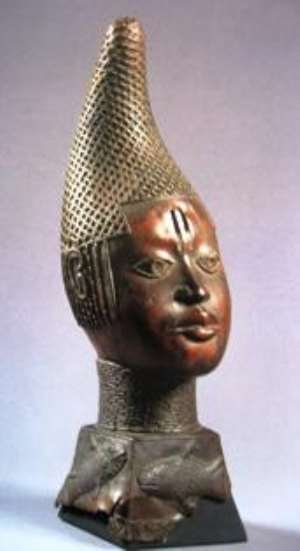
If we were to accept the time limit of a century stated by Lord Renfrew, we would not need to worry about Nefertiti, the Rosetta Stone, the Parthenon/Elgin Marbles, the Benin Bronzes and a whole lot of cultural artefacts which were looted/stolen in the colonial and imperialist period.
Lord Renfrew calls in support of his closure of century old plunder and loot, the
1970 UNESCO Convention and implicitly leaves the impression that the Convention forecloses looting and stealing before 1970. This is a usage of the Convention which is wide-spread in western art circles; the impression that unlawful and illegitimate acquisition of cultural objects before 1970 need not or cannot be raised or discussed. This position is not supported by the Convention.
Article 15 of the 1970 UNESCO Convention, which has been conveniently forgotten or overlooked by many commentators, provides as follows:
”Nothing in this Convention shall prevent States Parties thereto from concluding special agreements among themselves or from continuing to implement agreements already concluded regarding the restitution of cultural property removed, whatever the reason, from its territory of origin, before the entry into force of this Convention for the States concerned.”
In his Commentary on the 1970 UNESCO Convention (Second Ed. 2007, p.89). Patrick J.O'Keefe states: “During the drafting process one delegation pointed out that Article 15 does not restrict the rights of States to conclude bilateral agreements for the restitution of cultural property removed from the territory of another State before or after the entry into force of the Convention.”
The non-retroactivity of the 1970 Convention does not imply approval or disapproval of transactions made before the entry into force of the Convention. Nor does this Convention solve the moral and other questions regarding the legitimacy of colonialist and imperialist plunders. Those issues are still pending.
Can scholars and other intellectuals honestly hide behind the 1970 Convention and refuse to enter discussions on the moral issues involved in colonial plunder and loot? Can any honest person seek to justify the retention of looted cultural objects by simply refusing to discuss the issue?
It is also remarkable that many western commentators write as if the 1995 UNIDROIT Convention on Stolen and Illegally Exported Cultural Objects did not exist. Article 10 (3) of this Convention provides that:
“This Convention does not in any way legitimise any illegal transaction of whatever nature which has taken place before the entry into force of this Convention or which is excluded under paragraphs (1) or (2) of this article, nor limit any right of a State or other person to make claim under remedies available outside the framework of this Convention for the restitution or return of a cultural object stolen or illegally exported before the entry into force of this Convention.”
Thus a State can claim the return of stolen or looted cultural objects, in private law, by bilateral negotiations and agreement or through the UNESCO Intergovernmental Committee for Promoting the Return of Cultural Property to its Countries of Origin or its Restitution in case of Illicit Appropriation.
It should also be noticed that the 1995 UNIDROIT Convention provides in its Article 9(1) that: “Nothing in this Convention shall prevent a Contracting State from applying any rules more favourable to restitution or the return of stolen or illegally exported cultural objects than provided by this Convention.”
Lord Renfrew is surely aware that the new rules of the American Association of Museums (AAM) issued on 11 August, 2008, , Standards Regarding Archaeological Material and Ancient Art go beyond the 1970 cut-off date and provide that “Beyond the requirements of U.S. law, museums should not acquire any object that, to the knowledge of the museum, has been illegally exported from its country of modern discovery or the country where it was last legally owned”. No limitation by date is included in this rule so that acquisitions before 1970 are also covered and not explicitly excluded. The AAM rules are aimed at breaking the automatic reflex of many westerners to become legalistic and hang on to some rule that helps to avoid examining the complex moral and ethical considerations that are involved in questions of the provenance of cultural artefacts prior to acquisition. Is Professor Renfrew going to step back from the new rules and encourage an adherence to 1970 that would exclude examination of old acquisitions which continue to raise doubts in the museum world?
The time limit of 100 years and the cut-off date of 1970 are very problematic with respect to Nazi loot and plunder. The evil spoliations of the Nazi era are not yet hundred years old but will anyone dare to suggest that when these nefarious events are 100 years old we should no longer examine and condemn the abhorrent practices of the Nazi regime?
Surely the 1970 cut-off date cannot prevent us from investigating Nazi looted artefacts that came on to the antique markets before 1970.
We observe that UNESCO and United Nations resolutions calling for the return of cultural artefacts to their countries of origin are routinely ignored by many western writers even though these international bodies represent the majority of the peoples of the world. Evidently, the message of those bodies is against the deep-seated belief of many westerners that they have a God-given right and duty to steal and hold on to the cultural artefacts of others. Similarly, ICOM's Code of Conduct and recommendations do not seem to exist for many. The provisions on return of cultural property (Art. 6.2) and on restitution of cultural property (Art. 6.3) do not seem to interest many western museums.
It is always interesting to hear from persons whose profession or work is to study and keep record of evidence of the past achievements of human society, advising us not to concern ourselves with the past but to look to the present and future events. What they are telling us is not do study the archaeology of the acquisition of cultural objects. Can this be right?
We hope that Lord Renfrew, whose contribution to the fight against illicit traffic in antiquities is recognized and appreciated by all, will take the earliest opportunity to clarify these recent statements which send wrong signals.
It surely cannot be up to Europeans and Americans who have been mainly responsible for much of the looting and plundering in our world to set time limits for the recovery of stolen/plundered cultural artefacts from Africa, Asia and Latin America.
The history of relationship between Europe, Africa, Asia and America in the last two hundred years in which many cultural objects were looted would indicate that a time limit of hundred years would amount to allowing those responsible for the looting to keep whatever they managed to plunder. This surely cannot be considered as fairness or justice in any moral sense.
Concern for the human rights and cultural self-determination of others militates against such a limitation.
When Europeans and Americans proclaim that the world's antiquities belong to all of us they seem to be excluding Africans, Asians and Latin Americans. They have never argued that some of the European antiquities should be divided and spread around the world so that all of us have a share of what is available. The philosophy behind this position is like saying that my breakfast is mine but your breakfast belongs to all of us. African cultural objects are said to belong to all of us but European artefacts belong only to Europeans. There is not a single European cultural icon that is being kept in an African museum against the will of Europeans.
Even Europeans and Americans must see that there is something fundamentally wrong with the present distribution of cultural artefacts in the world. Much of what is worthwhile is in Europe as a result of plunder. Europe has more of Africa's best artworks than Africa itself and the place to see African art is not Lagos, Accra or Bamako but London, Paris and Berlin. Germany has more of the Benin Bronzes than Nigeria, the country of origin of those pieces.
We must fight for a fairer distribution of artworks. Arbitrary cut-off dates set by Europeans and Americans cannot lead to a better distribution but will only give to the present holders of looted/stolen artefacts calm consciences.
They stole over a hundred years ago
Members of the British Punitive Expedition which invaded Benin in 1897 posing proudly with the Benin artefacts they looted.
Kwame Opoku, December 2, 2008.
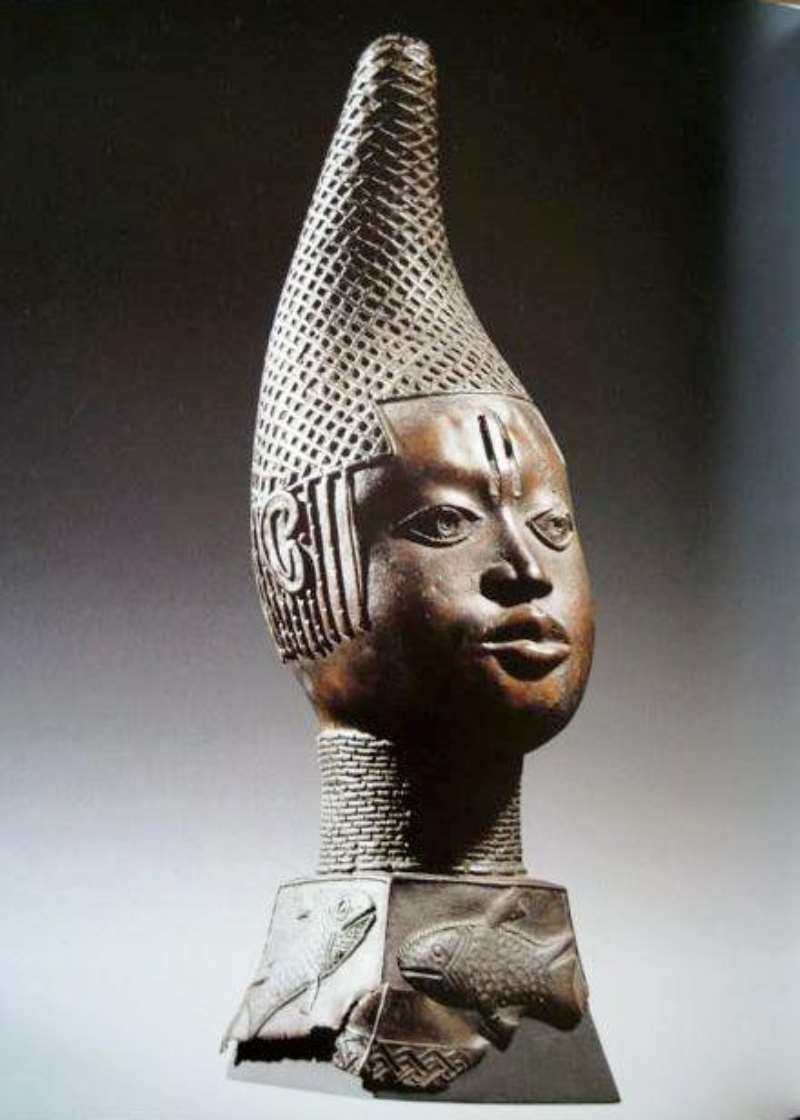 Queen Mother Idia, Benin/Nigeria
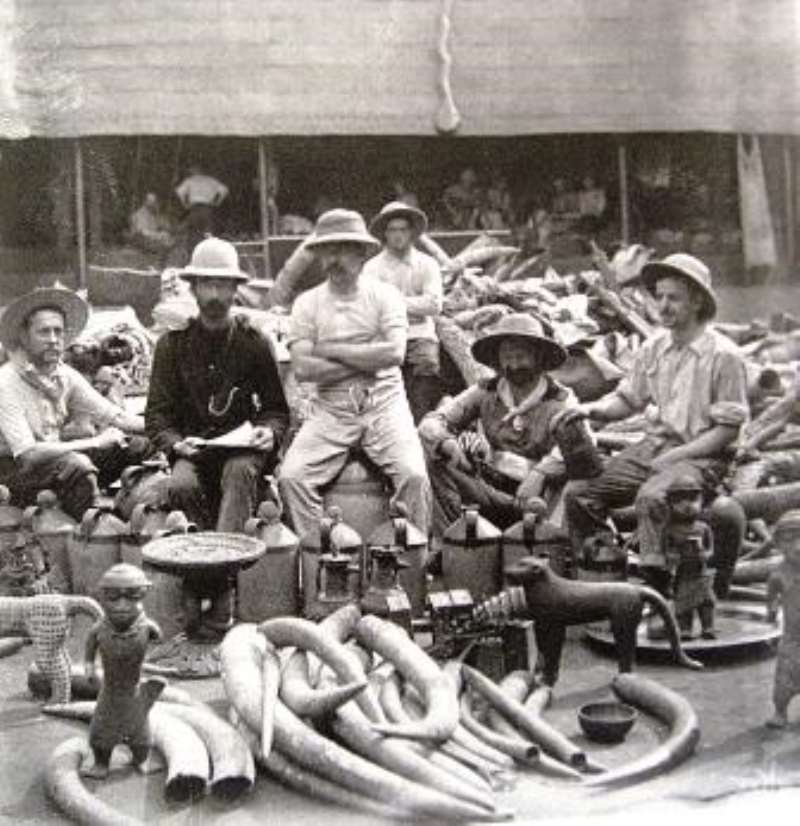
Members of the British Punitive Expedition which invaded Benin in 1897 posing proudly with the Benin artefacts they looted.

 One dead, fire officer hospitalised after bee attack at Quarry Site in Sokode Gb...
 Israel and Iran step back from further strikes after renewed clashes
 Patients stranded as doctors, nurses refuse to see new patients over KATH CEO su...
 Avenor Rural Bank CEO’s house destroyed by fire
 Three arrested in Winneba for illegal mining near GWL water lines
 Two pupils of Alice Elite Academy laid to rest after fatal school bus crash
 Here are areas to be affected by ECG's planned maintenance on Tuesday
 Family of civil engineer killed in alleged military shooting demands justice
 SHS teacher allegedly beats female student over unpaid hostel fees
 Blow to EU defence cooperation as France, Germany abandon joint fighter jet prog...


