




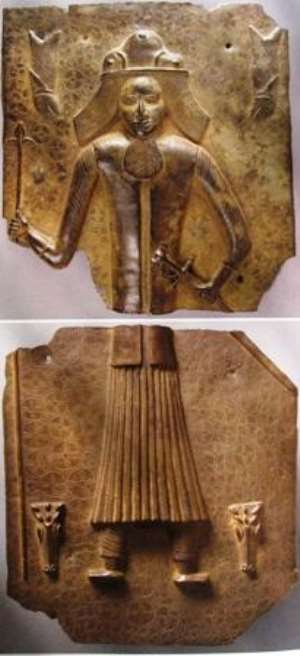
Plaque showing the body of a Portuguese soldier, Benin. The upper part of the soldier is in London, British Museum, and the lower part is in Vienna, Museum für Völkerkunde. That the two museums are not embarrassed to have the head of this soldier on one side of the British Channel whilst his feet are on the other side shows how much they care for the dissemination of knowledge. (1).
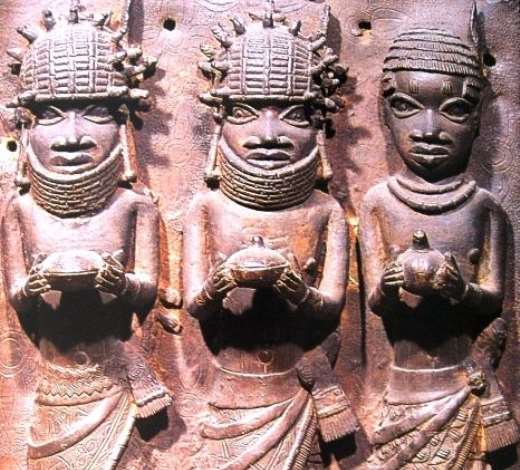
When I read reports on the opening of the exhibition Benin Kings and Rituals: Court Arts from Nigeria on 8 February 2008, at the Ethnology Museum, Berlin, I was surprised by the general impression given that the Nigerians were in no hurry to recover the stolen Benin bronzes; they were said to be more interested in co-operation with the Ethnology Museum and above all, in establishing an inventory of the Benin artefacts. (2)
As readers know by now, it has become a hallmark of this travelling exhibition that speeches made at the opening are not fully reported. The museum hosting the exhibition does not issue any full report on the opening. The reason seems to be the desire to avoid raising issues fundamental to the relations between the hosts and Nigeria, such as the issue of restitution of the Benin bronzes. Experience however, has shown that wherever this travelling exhibition went there were controversies regarding restitution. Questions were raised in different manners and with different intensities.
Dead silence on the issue of restitution, such as the organizers may have wanted, has not been the general rule. There were serious debates in Vienna, within the framework of an International Symposium organized by the Ethnology Museum on 9 and 10 May 2007, as part of the opening of the exhibition. The report on the symposium has not yet been published. Paris was rather muted. Berlin was somewhat mild but part of the press reported the desire of the Nigerians to have their stolen objects back even though the overall impression given was the desire of the Nigerians for co-operation with the Ethnology Museum. Given the reputation of the Director of the Art Institute of Chicago (AIC), James Cuno and his well-known attacks against those seeking to recover stolen art objects, the issue was surely raised at Chicago. Cuno was obliged to concede at the opening on July 2008 that if a request were made for the return of the Benin bronzes, it would be given serious consideration. In the meanwhile the Art Institute of Chicago which has 20 Benin bronzes, has distanced itself from the views of Cuno (3) Equally, Field Museum, Chicago, which holds 400 Benin bronzes, has also declared its readiness to consider seriously any request made for the return of the Benin artefacts.
According to information on the statement made at the opening of the Berlin exhibition by the Nigerian Minister of Tourism, Culture and National Orientation, Prince Adetokumbo Kayode, the Minister made a clear demand for the restitution of the Benin objects:
“I wish to appeal to the conscience of all as the BERLIN PLEA OF RETURN OF NIGERIA'S CULTURAL OBJECTS that while Nigeria prepares itself and perhaps Africa prepares an official request for the return of its stolen artifacts, those hearts that are touched by that reckless act of colonization should on their own return all or part of the objects in their collection to Nigeria and Africa. It should not be seen as another declaration of war but a passionate plea”.
The Minister explained further the significance of Berlin in this matter.
“There is this coincidence of history in this great city by the presence of this exhibition. Berlin was the meeting place for the partitioning of Africa in 1884 (the scramble for Africa). It was here that the instrument of colonization was first hatched. African nations were then vulnerable and very week. They were recovering from the ravages of the Slave Trade. Africa had no voice in the partitioning of its land by the powerful countries of the time. It was an unbalanced equation in the theatre of war. The Berlin Conference led to and gave muscle to the plunder of African colonies and hence Benin Kingdom”.
The Minister underlined the significant role of the Benin bronzes and the need for a healing process between the countries responsible for the loot or retention of the Benin bronzes and other African cultural objects, and the victims of these aggressions:
“This exhibition presents the soul of our Nation, the pages of history that were torn away violently, the emblems and insignia of power and authority and the source of inspiration to our country. I hope that this appeal shall be taken in good faith, in brotherhood, love for one another and in bridging gaps between the rich and powerful countries of the world and the weak. It is a way of reaching out to the once oppressed and wounded with the view that there can be a new healing process in the world were we live to share and play responsible roles. This process of voluntary return will go a long way to correct the ills of the past and heal the wounds of colonization”.
We have often referred to the need for a healing process. It seems that while most Africans understand this need, many Europeans do not appear to be sensitive to this. They do not appear to recognize and appreciate the spiritual wounds and damages resulting from colonialism. In short, they do not understand the nature and effects of colonialism, its destruction of the socio-political structures of African societies and the subjugation of the spirit as well as the deep humiliation of the colonized African peoples.
How often must the Nigerians ask for the return of their cultural objects that have been stolen or looted?
We know that there is no obligation in International Law or for that matter in Municipal Law that the owner of stolen goods must make a formal request before the object can be returned.
We also know how most African cultural objects came to Europe and America - through stealing, looting or some other dubious means. (4)
The Austrians and Germans pretend there has been no demand by the Nigerians for the return of their artifacts. The Ethnology Museum, Vienna and the Ethnology Museum, Berlin, were both co-organizers with the Nigerians in the Benin exhibition. The catalogue of the exhibition contains a foreword by the Oba of Benin in which he makes a clear demand for the return of some of the Benin objects. (5) What about the requests made by the Benin Royal Family at the Symposium organized by the Ethnology Museum, Vienna, on 9 and 10 May 2007?
The Ethnology Museum pretends there has been no request from the Nigerians. What about the request of the Nigerian Minister, Prince Kayode, at the opening of the exhibition in Berlin on 8 February? What about the Berlin Plea for the Return of Nigeria's Cultural Objects? Did it all fall on deaf ears?
The Field Museum, Chicago, which has 400 Benin pieces and admits they are all from the 1897 loot, declared itself ready to consider requests for restitution. Can the Museum itself not act without a request from the Nigerians who do not have the full information about the 400 objects? Or is the Museum preparing a document with full information for the Nigerians? In this connection, we must note that it is not easy to obtain precise information about the location and numbers of the Benin bronzes as well as the African art objects in European and American museums. (6)
The British who started the stealing of African art objects and organized the loot of the Benin bronzes have remained generally quiet recently on the issue. Neil MacGregor, Director of the British Museum, even pretends that Africans have not asked for the return of their cultural objects in the British Museum. The various demands by the Nigerians are forgotten; the request by the Benin Royal Family to the House of Commons in 2000 is conveniently overlooked. (7) As we have said repeatedly, if one has in his possession stolen property, the right thing to do is to return it to the lawful owner and not keep on proclaiming that no one has asked for its return.
The Art Institute of Chicago has declared that if there were a request for restitution, it would consider the request. But has there not been any request? James Cuno, Director of the AIC signed a Foreword in the catalogue of the Benin exhibition. In the same catalogue is a plea by the Oba of Benin for the return of the Benin bronzes. Is this not enough? When these objects were being removed, there was no formality or demand for permission to remove. So why all this talk about a demand for return when the owner has been crying out loud since 1897 for their return? If the holders of these objects were acting in good faith and with goodwill, they would have long declared their willingness to return the objects and not simply a willingness to consider requests for restitution. Are they wainting for formal requests drafted by lawyers? It would be interesting to read about the reaction of the Field Museum when they eventually receive a written request from the Nigerians. Shall we hear soon that the demand was not precise enough because they do not give sufficient description of the objects demanded or that there is no clarity about the numbers to be returned?
We have on the question of restitution an incredible play being acted over and over again. When the Nigerians and other Africans ask for the return of their cultural objects, there is silence or denial. After a while, the retentionists declare that nobody has asked them to return the items. The Africans ask again and there is silence. So how long will this play go on? The hypocrisy, lies and disrespect in this matter is beyond belief. The United Nations and UNESCO resolutions do not seem to matter to those who created these institutions. Western governments and their museums do not pay any attention to the demands of these international organizations. They should not be surprised if others follow their practice in other areas.
It is amazing that Nigeria has so far not received a single object returned. We recall the statement by Ekpo Eyo, leading expert on Nigerian art and former Director of The National Museum:
“By the end of the 1960s, the price of Benin works had soared so high that the
Federal Government of Nigeria was in no mood to contemplate buying them.
When, therefore a National Museum was planned for Benin City in 1968, we
were faced with the problem of finding exhibits that would be shown to reflect
the position that Benin holds in the world of art history. A few unimportant
objects which were kept in the old local authority museum in Benin were
transferred to the new museum and a few more objects were brought in from
Lagos. Still the museum was “empty”. We tried using casts and photographs to
fill gaps but the desired effect was unachievable. We therefore thought of
making an appeal to the world for loans or return of some works so that Benin
might also be to show its own works at least to its own people. We tabled a draft
resolution at the General Assembly of the International Council of Museums
(ICOM) which met in France in 1968, appealing for donations of one or two
pieces from those museums which have large stocks of Benin works. The
resolution was modified to make it read like a general appeal for restitution or
return and then adopted.
When we returned to Nigeria, we circulated the adopted resolution to the
embassies and high commissions of countries we know to have large Benin
holdings but up till now we have received no reaction from any quarters and the
Benin Museum stays “empty”. (8)
In 2002, the Nigerian Parliament called on president Obasanjo to request the repatriation of artifacts taken away during the colonial period and the Nigerian National Commission for Museums and Monuments was requested to provide a list of all Nigerian artifacts in the British Museum and list their value. (9)
Since 1897, the British Museum has been selling some of the Benin bronzes for profit and even to the Nigerian Government at a high price. (10) The first auction of the Benin bronzes was held already in 1897, a few months after the invasion and the loot.
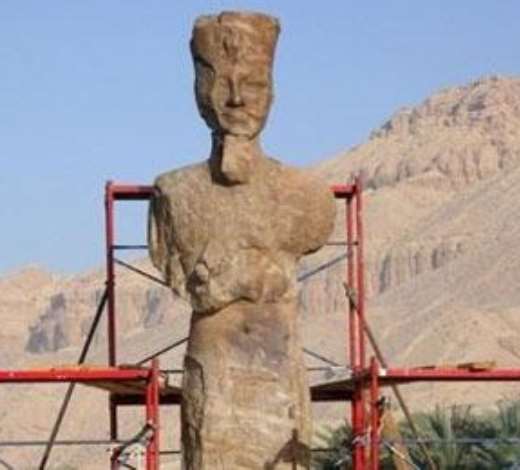
In the last few months, Greece, Egypt, Turkey and Italy have received some of their stolen objects. There has been so many returns that some are talking about “contest” for return of antiquities. (11) Indeed, as I write this article, there is news everywhere that Switzerland is returning to Egypt a stolen Pharaoh's “eye”. which was stolen some 36 years ago from the statute of Pharaoh Amenhotep III discovered in 1970 in his Luxor temple. The eye is about 50 cm. (19 inches) and was stolen in 1972 when fire broke around the temple.
This is another indication of the continuing success of Egypt, under the dynamic leadership of Zahi Hawass, in recovering its stolen cultural artefacts. Could other African countries learn something from the successes of the Egyptians? So what is the difference between Nigeria and these other countries that are successful in reclaiming their lost or stolen cultural objects?
Kwame Opoku, 15 September, 2008.
 |  |
 |  |
| View All | |
NOTES
1) Similarly, there is an image of a dignitary where the upper body is on a plaque in Berlin and the lower body is on another plaque in Hamburg. The split plaque confirms the view that the European and American museums are, in our age, primarily concerned with their own possessions and glory rather than any desire to spread knowledge. Most museums have not even been able or willing to take advantage of the existence of modern electronic media to make available full information about their possessions to readers elsewhere on the globe; there are no adequate listings or catalogues of their possessions or images of their objects. The museums show a few images of their objects and yet assert that in the age of digitalization there is no need for physical repatriation of objects. They prohibit photographs in the museums on the pretext that this will damage the objects in view. How can bronze objects in glass show-cases be damaged by a few digital shots? Art objects that have stood outside in Africa and have withstood tropical rains and other climatic conditions in Africa, suddenly become fragile in Europe so that even in glass show-cases they are threatened by digital cameras? Or are there other reasons, perhaps, copyright gains, behind the general ban on photographing in museums? Are all museums objects as sensitive to flashlight as paper?
2) K. Opoku, “Is the Absence of a Formal Demand for Restitution a Ground for Non-Restitution?”
www.afrikanet.info
3) K. Opoku, “The Art Institute of Chicago Distances itself from the Controversial Book of its Director”,www. museum-security.org
4) K. Opoku, “Nefertiti, Idia and other African Icons in European Museums: The Thin Edge of European Morality”, www.modernghana.com
5) Barbara Plankensteiner (Ed.), Benin: Kings and Rituals - Court Arts from Nigeria, 2007
6).K Opoku, “Once in the British Museum, always in the British Museum: Is the Deaccession Policy of the British Museum a Farce?” www.eliginism.com; see also Select Committee on Culture, Media and Sport Appendices to the Minutes of Evidence.
7) Location and Numbers of the Benin Bronzes
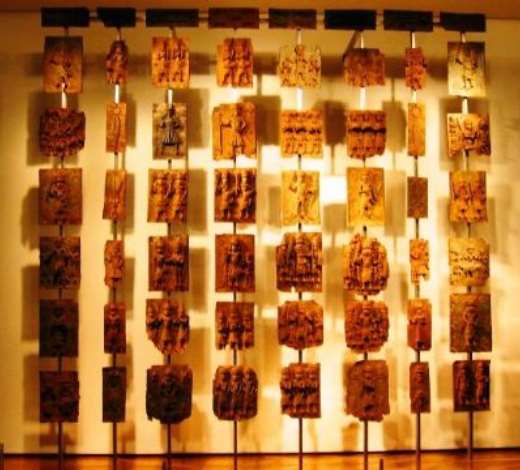
We list here some of the places where Benin bronzes may be found and their numbers. This is not an attempt to be complete but to give the general reader an idea about how widely spread these stolen art objects are. For a complete list, consult Philip J.C. Dark, An Introduction to Benin Art and Technology, 1973, Oxford University Press, London, pp. 78-81.
Berlin - Ethnologisches Museum 580,
Chicago - Art Institute of Chicago 20, Field Museum 400,
Cologne - Rautenstrauch-Joest-Museum73,
Hamburg - Museum für Völkerkunde, Museum fur Kunst und Gewerbe 196,
Dresden - Staatliches Museum für Völkerkunde 182,
Leipzig - Museum für Völkerkunde 87,
Leiden - Rijksmuseum voor Volkenkunde 98,
London - British Museum 700,
New York - Metropolitan Museum of Fine Art, 163,
Oxford - Pitt-Rivers Museum/ Pitt-Rivers country residence, Rushmore in Farnham/Dorset 327,
St. Petersburg - 40,
Stuttgart - 80,
Vienna - Museum für Völkerkunde 167.
8) Ekpo Eyo, Museum, Vol. XXL, no 1, 1979, Return and Restitution of cultural property, pp. 18-21, at p.21, Nigeria.
9) BBC NEWS, “Nigeria demands treasures back”, http;//news.bbc.co.uk
10) “British Museum Sold Benin Bronzes, Martin Bailey for The Art Newspaper http://www.forbes.com; http://www.randafricanart.com
11) “From Budapest to Athens: More Antiquities Returns to Greece”, looting matters.blogspot.com


 ‘Too arrogant, too sure of itself’ France confronts its legacy in Africa
 Nigeria's unwritten power-sharing rule looms over presidential race
 Several killed, dozens wounded in Jordan church shooting
 ‘I killed lots of terrorists, but it didn’t make me feel better’: The trauma hau...
 Casualties feared as multi-storey building collapses in Nairobi
 Cabinet approves bill to regulate public relations practice – Shamima Muslim
 Bawumia was right; NDC's economy is only on paper, not in people's pockets – Kwa...
 NDC should credit Bawumia for introducing gold-for-reserves policy – Kwadwo Poku
 Obuasi SHTS sex scandal: Gender Ministry deploys team to support affected studen...
 Adwoa Safo's Dome-Kwabenya comeback bid must push Elikplim Akurugu to deliver mo...


