




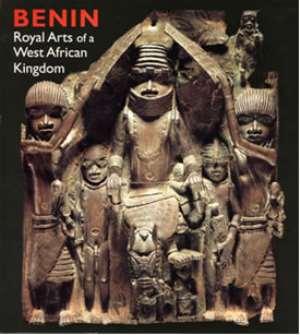
This book corresponds to what I think the average visitor to an exhibition needs: a short introduction to the subject-matter, with illustrations and sufficient information for the reader to understand the significance of the theme without being burdened by too many pages.
Benin Royal Arts of a West African Kingdom by Kathleen Bickford Berzock (1) was produced to accompany at the Art Institute of Chicago the exhibition, Benin - Kings and Rituals: Court Arts from Nigeria, July 10 - September 21, 2008. As readers may recall, this exhibition started in Vienna, went to Paris and Berlin and will end in Chicago. At Vienna, we had no such handy book but only the excellent catalogue edited by Barbara Plankensteiner, Benin - Kings and Rituals: Court Arts from Nigeria (2), a heavy tome of some 535 pages which only the strong and committed readers may venture to bring along to the exhibition. The edition was obviously intended for scholars and is bound to be the standard work for future reference. In Paris we had a very beautiful and useful pamphlet whilst in Berlin, we received photocopied pages of very useful information but of poor presentation. (3)
Berzock has provided us within 36 pages useful information that we need to know in order to understand the artistic production of Benin and why Benin art is important in the history of African art. The book has also some very beautiful illustrations of Benin art and a short select bibliography for those who want to deepen their knowledge of Benin art.
I would have appreciated having some more information on the premeditated character of the British attack and the calculation that the cultural objects to be found in Benin would pay for the expenses of the Punitive Expedition of 1897. Berzock repeats the story that “the British delegation was ambushed en route to Benin City” and comments as follows on the insistence of Captain Phillips to go to Benin City even though the Oba and others had advised him not to come to Benin City at the proposed date because foreigners were not to visit during that period of traditional rituals: “Willfully, and perhaps naively since Phillips had only recently arrived in the region, the Acting-Consul General ignored clear warnings from the oba and others that he was unavailable to receive visitors.”(4)
It is surely misleading to describe as a “British delegation” the army of some 250 African soldiers plus 5 British officers, an interpreter and a trader who set out, under the command of Lieutenant James Robert Phillips, Acting-Consul-General in December 1896 for Benin City. It is equally strange to ascribe to his naivety or lack of familiarity with the region, .the unwillingness or inability of Phillips to halt his march to Benin City. Since when do we visit a person, especially a king or any high dignitary, when he has expressly indicated that he is unable or unwilling to receive us? Phillips could not change his mind because the plans to invade Benin were too far advanced. The mission of Phillips was clearly to depose Oba Ovonramwen, replace him with a Native Council and pay for the costs of the expedition with sale of the ivory and the artefacts he expected to find in the palace.(5)
Berzock does not mention the brutal nature of the British invasion of Benin nor does she mention the execution of Benin nobles, and the acts of terrorism by the British troops in their search of Ovonramwen and the burning of the city. These acts of violence give the loot of the Benin bronzes a specific character and a special position in the history of African art. They also throw light on the colonial mentality and system, and the structural violence it implied. Violence has never been far away in the relations between Europe and Africa. (6)
Berzock does not discuss nor mention the issue of restitution of the Benin bronzes which has become prominent in the discussions on restitution of cultural objects. I believe that the restitution discussion is now part and parcel of the history of African art generally and specifically of Benin art history. A book published in 2008 should have a few remarks on the topic, especially since the exhibition in Chicago was obviously going to give impulse to the subject.
The hip pendant of Queen Mother Idia on page 28 will surprise many readers who know the versions in the British Museum and in the Metropolitan Museum of Arts. The author was of course, only concerned with those objects that were actually on show in Chicago. It would nevertheless be interesting to know whether the other two museums had refused to lend their Iyoba Idia hip masks. These masks have become symbols of pan-Africanism and one could have mentioned this fact, as was done in the Berlin photocopied pages.

Oba Ovonramwen on the British yatch Ivy, 1897 on his way to exile. Ethnology Museum Vienna, collection Maschmann, photo no.6186.
We know from the catalogue that none of the Benin bronzes held by the Art Institute of Chicago is in the exhibition. But we not know for sure how many pieces are held by the Institute. James Cuno, Director of the Institute, stated at the opening of the exhibition that his institute had half a dozen pieces but the spokesperson of the same institute is quoted as saying that the institute has 20 pieces. So does the institute have 6 or 20 pieces? In this connection, it should be mentioned that most museums are very reluctant to reveal the exact number of Benin bronzes they have. Few are as open as the Field Museum, Chicago which states at its internet site that it has 400 pieces and that they came from the 1897 loot. From writings of the staff of the Ethnology Museum, Berlin, we know there are some 580 pieces at that museum. Further information can be found in the catalogue edited by Plankensteiner. (7) The British Museum is absolutely silent about the number of Benin bronzes it has but we have seen figures raging from 280 to 700.
If these museums are concerned with the education of the public, why are they silent about such matters? Public education is not furthered by public institutions withholding information about the cultural objects in their possession nor do they create confidence and trust with the public. On the contrary, they create the suspicion that they have something to hide.
Kathleen Bickford Berzock and the Art Institute of Chicago are to be congratulated for this beautiful booklet. The institute has, through the exhibition and this publication, earned the reputation for good work on African art. However, this good work must be balanced against the attitude and views of the Director of the institute concerning the retention of stolen/looted African cultural objects in European and American museums. We have learnt that the institute is busy re-examining this matter. (8)
Kwame Opoku. 14 August 2008.

Plaque of Oba Ozolua with warrior attendants, Benin, Nigeria,
Ethnology Museum, Vienna.
NOTES
1) K. B. Berzock, Benin: Royal Arts of a West African Kingdom, Art Institute of Chicago/Yale University Press, New Haven and London, 2008
2) Barbara Plankenstener. Benin-Kings and Rituals: Court Arts from Nigeria,
Snoeck Publishers, Ghent, 2007
3) K. Opoku, “Benin in Berlin: A Successful Reconciliation of the Aesthetic and the Ethnological” http://www.museum-security.org
4) Berzock, op. cit, p.12.
5) Ekpo Eyo, “Benin: The sack that was,” http://www.dawodu.net/eyo.htm ,”The
Dialectics of Definitions: “Massacre” and “Sack” in the History of the Punitive
Expedition”, African Arts, 1997, Vol. XXX, No.3, pp.34-35.
Wikipedia, “Benin Expedition of 1897” http://www.dawodu.net/eyo.htm
K. Opoku, “Benin to Berlin Ethnologisches Museum: Are Benin Bronzes Made in Berlin?” http://www.museum-security.org
Frank Willet, “BENIN” in Afrika: Kunst und Kultur (ed.) Hans-Joachim Koloss, Prestel Verlag, Munich, 1999 p. 43 states that Phillips and his troops had peaceful intentions, and that the guns they had with them had been packed away and not ready for usage.
6) The story of Benin has been told several times but I found the short account by Sylvester Okwunodu Ogbechie very useful:
“In February 1897, an elite British force of about 1200 men (supported by several hundred African auxiliary troops and thousands of African porters) besieged Benin City, capital of the Edo Kingdom of Benin, whose ruler, the Oba Ovonramwen sat on a throne that was a thousand years old. The British Punitive Expedition used Maxim machine guns to mow down most of the Oba's 130,000 soldiers and secure control of the capital city. They set fire to the city and looted the palace of 500 years worth of bronze objects that constituted the royal archive of Benin's history, an irreplaceable national treasure. The king and his principal chiefs fled into the countryside, pursued by British forces who lay waste to the countryside as a strategy to force the people of Benin to give up their fugitive king. According to Richard Gott, for a further six months, a small British force harried the countryside in search of the Oba and his chiefs who had fled. Cattle was seized and villages destroyed. Not until August was the Oba cornered and brought back to his ruined city. An immense throng was assembled to witness the ritual humiliation that the British imposed on their subject peoples. The Oba was required to kneel down in front of the British military "resident" the town and to literally bite the dust. Supported by two chiefs, the king made obeisance three times, rubbing his forehead on the ground three times. He was told that he had been deposed. Oba Ovonramwen finally surrendered to stem the slaughter of his people. Many of his soldiers considered his surrender an unbearable catastrophe and committed suicide rather than see the king humiliated. A significant number, led by some chiefs, maintained guerilla warfare against the British for almost two years until their leaders were captured and executed. The remaining arms of the resistance thereafter gave up their arms and merged back into the general population.”
http://aachronym.blogspot.com
7) Plankensteiner, op. cit. pp. 213-225. From the essay by Gisela Völger, Curator, Trader, Benin Scholar - Felix von Luschan –An Austrian in Royal-Prussian Museum Service, we read the following distribution figures for the 2400 objects said to have reached Europe after the 1897 invasion of Benin by the British:
In Germany: Berlin 580, Hamburg 196, Dresden 182, Leipzig 87, Stuttgart 80,
Cologne 73, Munich, Braunschweig, Mannheim, Freiburg and other
towns in Germany not more than 95 items.
Outside Germany: British Museum 280, Pitt Rivers Museum (Oxford) and Pitt
Rivers country residence, Rushmore in Farnham/Dorset 327, various members
of the Punitive Expedition of 1897 300, Leiden 98, Chicago 33, St. Petersburg
40, Vienna 167.
8) K. Opoku, “The Art Institute of Chicago Distances Itself from the Controversial Book of its Director, James Cuno, Who Owns Antiquity?” http://www.afrikanet.info/

 One dead, fire officer hospitalised after bee attack at Quarry Site in Sokode Gb...
 Israel and Iran step back from further strikes after renewed clashes
 Patients stranded as doctors, nurses refuse to see new patients over KATH CEO su...
 Avenor Rural Bank CEO’s house destroyed by fire
 Three arrested in Winneba for illegal mining near GWL water lines
 Two pupils of Alice Elite Academy laid to rest after fatal school bus crash
 Here are areas to be affected by ECG's planned maintenance on Tuesday
 Family of civil engineer killed in alleged military shooting demands justice
 SHS teacher allegedly beats female student over unpaid hostel fees
 Blow to EU defence cooperation as France, Germany abandon joint fighter jet prog...


